
Why would you use a 4,000 Hz current when the therapeutic frequency you want is closer to 100 Hz? That question sits at the heart of interferential therapy, and once you understand the answer, the whole modality starts to make clinical sense. IFT is one of the most widely used electrotherapy modalities in physiotherapy practice, and this guide covers the physics, the physiology, the parameters, and what the evidence actually supports.
What is interferential therapy?
Interferential therapy (IFT) uses two medium-frequency alternating currents, set at slightly different frequencies, delivered simultaneously to the same tissue. Where the currents overlap inside the body, they interfere and produce a beat frequency between 1 Hz and 150 Hz. It is this lower beat frequency, not the 4,000 Hz carrier, that activates nerve fibres and drives the clinical effect.
In a standard quadripolar setup, IFT uses four electrodes arranged in two pairs so that the circuits from each pair cross at the treatment target. The two circuits interfere at their point of intersection, and the clinician selects the beat frequency that matches the physiological goal. This arrangement is called true interferential because the interference occurs within the tissue itself rather than inside the machine.
IFT can also be delivered in a bipolar (or premodulated) format, in which the two currents are mixed within the unit and delivered through just two electrodes. Electrode placement is simpler, but the interference occurs externally, before the current reaches the tissue. Some authors argue this reduces effective penetration depth compared with quadripolar delivery. Clinical evidence directly comparing the two formats is limited, and the distinction is worth noting as a student rather than treating it as fully resolved.
How does interferential therapy produce its effects?
The physiological effects of IFT depend primarily on the beat frequency selected, because different nerve fibre populations respond to electrical stimulation at different frequencies. Understanding which fibres are activated at each frequency range is what makes parameter selection logical rather than arbitrary.
At beat frequencies of 80 to 150 Hz, IFT selectively activates large-diameter, myelinated A-beta sensory fibres. According to the gate control theory of pain, first described by Melzack and Wall in their landmark 1965 paper in Science, activation of these large fibres closes a functional gate in the substantia gelatinosa of the dorsal horn of the spinal cord, inhibiting the onward transmission of pain signals carried by smaller A-delta and C fibres. This is the same mechanism proposed for conventional TENS, which explains the rapid onset of pain relief patients commonly report during treatment.
At lower beat frequencies, typically 1 to 5 Hz, the current is thought to stimulate the release of endogenous opioids (endorphins and enkephalins) through activation of A-delta fibres and descending inhibitory pain control pathways. A 2006 study by Jorge and colleagues published in Physical Therapy demonstrated antinociceptive effects of IFT across multiple animal models of inflammatory pain, offering experimental support for this mechanism. Translating animal model findings to human clinical populations requires care, but the study adds useful mechanistic plausibility to this frequency range.
IFT may also produce local circulatory effects through rhythmic muscle contractions generated at motor-threshold beat frequencies. These contractions increase venous and lymphatic return from the treated region, which forms the physiological basis for IFT in post-traumatic oedema management. This effect is supported more by mechanistic reasoning and clinical observation than by high-quality trial evidence.
In practice, what you notice most often is that patients report rapid subjective pain reduction during the first session. This is consistent with the fast onset of gate control analgesia. It is worth telling patients in advance that this intra-session effect is real but that it will diminish when the current stops. Explaining the mechanism prevents them from expecting permanent relief after a single treatment.
Interferential therapy produces pain relief through two proposed physiological mechanisms. At frequencies of 80 to 150 Hz, IFT activates large-diameter A-beta sensory fibres that inhibit pain transmission in the spinal cord dorsal horn, consistent with the gate control theory described by Melzack and Wall (1965). At lower frequencies of 1 to 5 Hz, research suggests stimulation of endogenous opioid release through A-delta fibre pathways. Both mechanisms are supported by experimental evidence, though the clinical magnitude of each effect continues to be investigated in human populations.
Why does IFT use a medium-frequency carrier current?
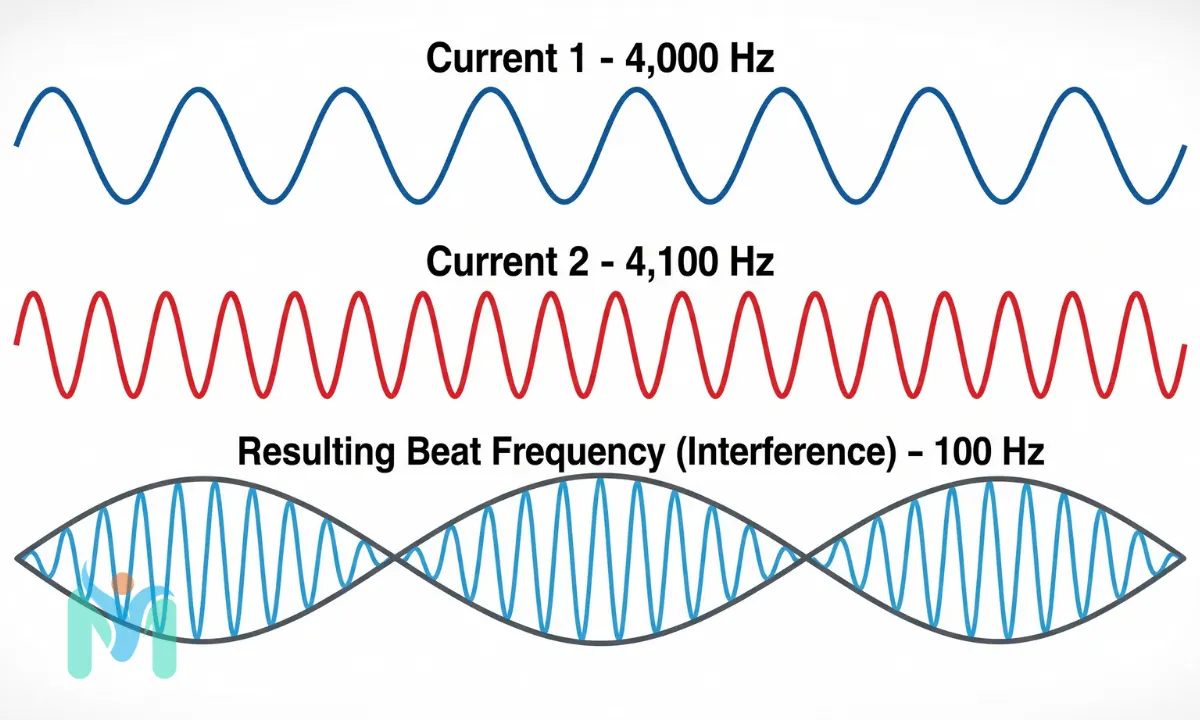
The 4,000 Hz carrier frequency is a deliberate solution to one of the central problems of low-frequency electrotherapy: skin impedance.
Human skin resists the flow of electrical current, and this resistance is disproportionately high at low frequencies. Below 100 Hz, a significant proportion of the current energy is dissipated at the skin surface before it can penetrate to deeper target structures. The patient begins to feel uncomfortable electrode-site stimulation before therapeutically meaningful current reaches the tissue. As Ward reviewed in Physical Therapy (2009), skin impedance is inversely related to frequency: it drops substantially as frequency rises into the kilohertz range. By using a 4,000 Hz carrier, IFT reduces skin impedance dramatically. The current passes into tissue more easily, reaches greater depths, and causes far less discomfort at the electrode site than an equivalent low-frequency current would.
The trade-off is that nerve fibres do not respond therapeutically to 4,000 Hz stimulation in the same way they respond to low-frequency input. The interference technique, generating the therapeutic beat frequency inside the tissue itself, is how IFT captures the deep penetration of a medium-frequency current while producing the physiological effects of a low-frequency one. That is the core physics of the modality, and it is the answer to the question this article opened with.
What parameters are used in interferential therapy?
Selecting the right parameters is one of the most consistent points of uncertainty for students approaching IFT for the first time. The beat frequency, also called the amplitude modulation frequency (AMF) or interferential frequency, is the most clinically important variable to understand. The table below summarises the main treatment goals and their corresponding parameter ranges.
| Beat Frequency (AMF) | Primary Clinical Goal | Proposed Mechanism | Typical Intensity Level |
|---|---|---|---|
| 1–10 Hz | Muscle contraction; chronic pain; endorphin release | Motor nerve activation; A-delta fibre stimulation | Motor threshold (visible contraction) |
| 10–50 Hz | Muscle re-education; post-traumatic oedema | Repeated motor stimulation; circulatory effects | Motor threshold to strong motor |
| 50–100 Hz | Mixed pain management; subacute conditions | Mixed sensory and motor activation | Sensory to motor threshold |
| 80–150 Hz | Acute pain relief (gate control) | A-beta fibre activation; dorsal horn inhibition | Strong sensory (no visible contraction) |
Interferential therapy parameter selection depends on the treatment goal. Beat frequencies of 80 to 150 Hz activate large-diameter A-beta sensory fibres for pain gate modulation and are delivered at sensory, non-contracting intensity for acute pain. Frequencies of 1 to 10 Hz produce motor-level muscle contractions for strengthening or chronic pain management. Sweep mode, which cycles the beat frequency through a defined range, prevents neural accommodation and broadens the therapeutic effect, as described in Robertson and colleagues’ Electrotherapy Explained (4th edition, 2006). Treatment sessions typically last 20 to 30 minutes, with intensity set to patient comfort and feedback throughout.
Sweep mode is a feature on most modern IFT units. Rather than delivering a fixed beat frequency throughout the session, sweep mode cycles the AMF through a specified range, such as 1 to 100 Hz, at a defined rate. The primary purpose is to prevent neural accommodation – the tendency of nerve fibres to habituate to a constant repeated stimulus and progressively reduce their response. The most common error students make when using IFT for the first time is choosing a fixed frequency without using sweep, and then wondering why the patient reports feeling the current fade during treatment even though the output hasn’t changed. Sweep is the default recommendation in most electrotherapy texts and is a sensible clinical starting point whenever you are uncertain which specific frequency will be most effective for a given patient.
Electrode placement for quadripolar IFT follows the cross-fire principle: the two electrode pairs are positioned so that their respective circuits intersect at the tissue target. The point of maximum interference sits at the centre of the X formed by the two circuits. Many modern units offer a vector rotation mode, which electronically shifts the plane of maximum interference through different tissue angles during the session, expanding the volume of tissue receiving maximal stimulation without requiring any electrode repositioning.
What conditions is interferential therapy used for?
IFT is applied across a range of musculoskeletal and neuromusculoskeletal presentations. Understanding the rationale behind each application is more useful at this stage of training than simply memorising a list.
- Musculoskeletal pain (back pain, neck pain, shoulder conditions, knee osteoarthritis): the most common application in clinical practice, targeting pain gate effects and short-term symptom reduction to support active rehabilitation. This is also where the majority of the research evidence is concentrated.
- Post-surgical pain management: used to reduce analgesic requirements and enable earlier active rehabilitation, particularly following orthopaedic procedures. A 2004 randomised clinical trial by Hurley and colleagues published in Spine demonstrated effectiveness of IFT combined with manipulative therapy in patients with acute low back pain.
- Sports injuries (muscle strains, ligament sprains, contusions): short-term pain management and oedema control in the acute and subacute phases, where reducing pain allows earlier functional movement and exercise compliance.
- Post-traumatic oedema: low-frequency motor stimulation produces rhythmic contractions that enhance venous and lymphatic drainage from swollen tissue.
- Stress urinary incontinence and pelvic floor dysfunction: IFT at low frequencies stimulates pelvic floor motor nerves and supports muscle re-education. This specific application has attracted dedicated RCT evidence and is a recognised clinical pathway in women’s health physiotherapy.
- Muscle weakness and atrophy prevention: motor-level stimulation can maintain or partially restore neuromuscular activity during periods of enforced immobilisation or disuse, particularly in post-operative patients who cannot exercise actively.
In practice, IFT is rarely used as a standalone treatment. It is most effective when embedded within a broader physiotherapy programme that includes exercise therapy, patient education, and where appropriate, manual therapy. Recognising electrotherapy as a facilitator of active rehabilitation (not a substitute for it) is a distinction worth developing early in clinical training.
What are the contraindications and precautions for interferential therapy?
Interferential therapy is contraindicated in the presence of cardiac pacemakers or active implanted electronic devices, over sites of active malignancy, during pregnancy (particularly over the abdomen and lumbar spine), over areas of active deep vein thrombosis, and in the presence of active infection or sepsis. Application near the head or neck in patients with epilepsy requires caution. As described in Robertson and colleagues’ Electrotherapy Explained (4th edition, 2006), these are absolute contraindications that must be screened for before every treatment session begins.
Absolute contraindications – do not proceed if any of the following are present:
- Cardiac pacemakers or implanted electronic devices: the electrical current can interfere with device function, creating a direct patient safety risk that cannot be mitigated by parameter adjustment.
- Active malignancy at or near the treatment site: electrical stimulation may theoretically promote cellular activity at the tumour; treat the whole region with caution and defer to the supervising clinician.
- Pregnancy: contraindicated over the abdomen and lumbar spine; most clinical guidelines extend this to a general precautionary contraindication throughout pregnancy due to the absence of safety evidence.
- Active deep vein thrombosis (DVT): circulatory stimulation risks dislodging a clot, creating a potentially fatal pulmonary embolism.
- Active infection, sepsis, or osteomyelitis: electrical stimulation at an infected site risks disseminating the infection to surrounding tissue.
- Epilepsy (near head or neck): current application in this region may lower the seizure threshold in susceptible individuals.
- Broken or ulcerated skin directly under the electrodes: current concentration at skin discontinuities increases the risk of burns and worsening of the wound.
Precautions require clinical judgement rather than automatic exclusion. Areas of impaired or absent sensation mean the patient cannot reliably report the intensity of stimulation, which removes your primary safety feedback mechanism and increases burn risk. Patients with cognitive impairment who cannot accurately communicate their experience during treatment need conservative dose titration and close monitoring throughout. Skin conditions such as eczema or psoriasis at the electrode site may worsen with electrode contact. Metal implants are a relative precaution: current can concentrate around metallic structures, so electrode positioning should avoid directing the current path directly across the implant, and senior guidance is appropriate before proceeding.
How does interferential therapy compare to TENS?
Students frequently encounter both IFT and transcutaneous electrical nerve stimulation (TENS) within the same electrotherapy curriculum and want to know which to choose. The clinical evidence does not strongly favour either modality for most musculoskeletal pain conditions.
IFT’s theoretical advantage is deeper tissue penetration due to lower skin impedance at medium frequency, and broader treatment area coverage through the quadripolar electrode arrangement. TENS delivers low-frequency current directly through two electrodes, is simpler to set up, and is small enough for home use, which gives it a meaningful practical advantage for managing chronic pain between clinic visits. A 2011 randomised clinical trial by Facci and colleagues in the Sao Paulo Medical Journal found no statistically significant difference in outcomes between IFT and conventional TENS for patients with chronic low back pain. This finding is consistent with the broader comparative literature.
The clinically important insight is that both IFT and TENS function as adjuncts to active rehabilitation: they reduce pain enough to allow the patient to engage with the movement and exercise that drives lasting recovery. Neither modality produces that recovery independently. Clinical choice between them is most often guided by equipment availability, whether the patient needs a home option, and the treatment setting rather than by evidence of one being superior to the other.
What does the evidence actually say about interferential therapy?
A 2010 systematic review and meta-analysis by Fuentes and colleagues published in Physical Therapy examined nine randomised controlled trials involving over 1,000 patients and found that interferential therapy produced greater short-term pain relief than placebo or sham treatment in musculoskeletal conditions. The effect sizes were moderate rather than large, and the authors noted considerable heterogeneity across the included studies in terms of patient populations, parameter settings, and comparison conditions. The Fuentes review is the strongest piece of evidence currently available for IFT in musculoskeletal pain and is worth reading in full as part of any evidence appraisal assignment.
This study reflects a pattern common in electrotherapy research: blinding is methodologically difficult because patients can usually feel the current, and parameter standardisation across trials is poor. Two studies nominally testing the same intervention may have used entirely different beat frequencies, electrode placements, and intensities – making meaningful pooling of results difficult. Recognising this limitation when interpreting the literature is a core critical appraisal skill.
The evidence is stronger for some applications than others. IFT for stress urinary incontinence has attracted more rigorously designed trials with more consistent methodology and shows generally favourable results in that specific context. For oedema management, general muscle strengthening, and wound healing, the research base is considerably thinner. Reporting this variation accurately, rather than applying the strongest evidence for one application uniformly across all IFT use cases, is the kind of clinical reasoning that separates a thoughtful practitioner from one who defaults to a modality without critical thought.
Frequently asked questions (FAQs)
The carrier frequency is the base frequency of each alternating current delivered by the machine, typically 4,000 Hz. The beat frequency (also called the amplitude modulation frequency or AMF) is the difference between the two slightly offset carrier currents, produced by their interference within the target tissue. If one current runs at 4,000 Hz and the other at 4,100 Hz, the beat frequency is 100 Hz. The carrier frequency determines depth of penetration and skin comfort; the beat frequency determines which nerve fibres are activated and what physiological effect is produced.
For acute pain using the pain gate mechanism, a beat frequency of 80 to 150 Hz is generally recommended. This range activates large-diameter A-beta sensory fibres, which inhibit pain signal transmission at the dorsal horn of the spinal cord. For chronic pain where endorphin release is the therapeutic goal, lower frequencies of 1 to 5 Hz at motor-level intensity are more appropriate. Sweep mode, which cycles the AMF through a defined range during the session, is the practical default when the optimal specific frequency for a patient is uncertain, as it prevents neural accommodation and provides a broader physiological effect.
Metal implants are a relative precaution rather than an absolute contraindication. Electrical current can concentrate around metallic structures, increasing the risk of localised heating. Most clinical guidelines recommend modifying treatment intensity, reducing the dose, and ensuring the current pathway does not cross directly over the implant site. The clinical decision must be based on careful individual reasoning, patient consent, and local departmental protocols. Seeking guidance from a senior physiotherapist before proceeding with any patient who has a metal implant is the appropriate course of action for a student or newly qualified clinician.
IFT is contraindicated during pregnancy over the abdomen and lumbar spine, and most clinical guidelines recommend avoiding it throughout pregnancy as a precautionary measure. The primary concern is that electrical stimulation in these regions may stimulate uterine contractions or have unpredictable effects on the developing foetus. There is no robust clinical safety evidence supporting the use of IFT in pregnancy. Pregnancy status must be confirmed through active patient screening before every new treatment course, and it must never be assumed from the patient’s appearance or history alone.
Clinical evidence does not reliably show that interferential therapy produces superior outcomes to TENS for most musculoskeletal pain conditions. A 2011 randomised clinical trial by Facci and colleagues found no significant difference in outcomes between IFT and TENS in patients with chronic low back pain. IFT offers theoretical advantages in tissue depth and treatment area coverage through its quadripolar setup, while TENS is simpler, more portable, and suited to home use. Clinical choice between the two modalities is most often determined by equipment availability, whether home use is needed, and patient suitability rather than by the evidence base alone.
Sweep mode continuously cycles the beat frequency through a pre-set range during the session rather than holding a fixed frequency throughout. Its primary function is to prevent neural accommodation, the natural tendency of nerve fibres to habituate to a constant repeated stimulus and reduce their response over time. Sweep mode is the recommended default for most clinical situations and is particularly appropriate when the optimal specific frequency for a patient is uncertain. Standard electrotherapy textbooks, including Watson’s Electrotherapy: Evidence-Based Practice, recommend sweep as routine practice for general IFT application.
Interferential therapy sessions in clinical practice typically run for 20 to 30 minutes, though this varies by condition, treatment goal, and departmental protocol. Shorter sessions of 10 to 15 minutes are sometimes used for a first treatment to monitor patient response before progressing to full duration. Treatment frequency also varies: daily sessions are used in some acute inpatient settings, while two to three sessions per week is more common in outpatient physiotherapy. The patient’s response across the first two to three sessions should guide decisions about frequency, duration, and continuation of the modality.
The role of IFT within evidence-based physiotherapy practice
Interferential therapy is a well-established electrotherapy modality with a coherent physiological rationale and moderate evidence of short-term analgesic benefit in musculoskeletal conditions. The physics of skin impedance explains why medium-frequency carrier currents are chosen. The beat frequency explains how the therapeutic effect is targeted at specific nerve fibre populations. And the evidence, best summarised by the Fuentes et al. 2010 systematic review, confirms that interferential therapy can produce clinically meaningful pain reduction, even if effect sizes remain modest and the research base contains significant methodological limitations that make confident, sweeping conclusions difficult to justify.
What the literature also reveals is that no electrotherapy modality should be treated as a therapeutic endpoint. The most important clinical role of interferential therapy is to reduce pain sufficiently to enable meaningful participation in the active rehabilitation that produces lasting functional change. Students who understand that distinction have already grasped something that takes some clinicians years of practice to fully articulate: the machine is the catalyst, and the patient’s movement is the cure.
Consult your doctor or a qualified physiotherapist before starting any new exercise programme, especially if you have an existing injury or medical condition.
References
- Melzack R, Wall PD. “Pain mechanisms: a new theory.” Science. 1965;150(3699):971–979. PMID: 5320816. URL: https://pubmed.ncbi.nlm.nih.gov/5320816/. Evidence Level: 6.
- Fuentes JP, Olivo SA, Magee DJ, Gross DP. “Effectiveness of interferential current therapy in the management of musculoskeletal pain: a systematic review and meta-analysis.” Physical Therapy. 2010;90(9):1219–1238. DOI: 10.2522/ptj.20090335. PMID: 20671112. URL: https://pubmed.ncbi.nlm.nih.gov/20671112/. Evidence Level: 2.
- Ward AR. “Electrical stimulation using kilohertz-frequency alternating current.” Physical Therapy. 2009;89(2):181–190. PMID: 19103669. URL: https://pubmed.ncbi.nlm.nih.gov/19103669/. Evidence Level: 6.
- Jorge S, Parada CA, Ferreira SH, Tambeli CH. “Interferential therapy produces antinociception during application in various models of inflammatory pain.” Physical Therapy. 2006;86(6):800–808. PMID: 16737408. URL: https://pubmed.ncbi.nlm.nih.gov/16737408/. Evidence Level: 5.
- Hurley DA, McDonough SM, Dempster M, Moore AP, Baxter GD. “A randomized clinical trial of manipulative therapy and interferential therapy for acute low back pain.” Spine. 2004;29(20):2207–2216. PMID: 15480130. URL: https://pubmed.ncbi.nlm.nih.gov/15480130/. Evidence Level: 4.
- Facci LM, Nowotny JP, Tormem F, Trevisani VF. “Effects of transcutaneous electrical nerve stimulation (TENS) and interferential current (IFC) in patients with nonspecific chronic low back pain: randomized clinical trial.” Sao Paulo Medical Journal. 2011;129(4):206–216. PMID: 21971895. URL: https://pubmed.ncbi.nlm.nih.gov/21971895/. Evidence Level: 4.
- Robertson VJ, Ward AR, Low J, Reed A. Electrotherapy Explained: Principles and Practice. 4th ed. Butterworth Heinemann; 2006. Evidence Level: 6.
- Watson T. Electrotherapy: Evidence-Based Practice. 12th ed. Churchill Livingstone; 2008. Evidence Level: 6.
- Goats GC. “Interferential current therapy.” British Journal of Sports Medicine. 1990;24(2):87–92. PMID: 2397209. URL: https://pubmed.ncbi.nlm.nih.gov/2397209/. Evidence Level: 6.