

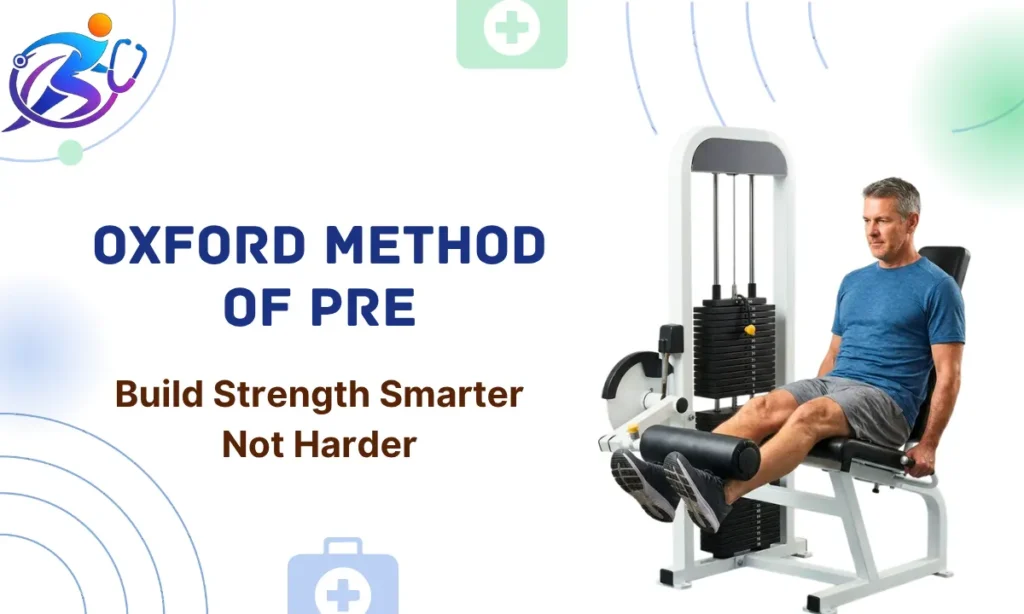
You’ve probably heard that “lifting weights builds strength.” But how you lift, the order, the load, the sets, changes everything. The Oxford Method of Progressive Resistance Exercise is one of the most studied and trusted approaches for both rehabilitation and general strength training. It’s not a fad. It has real science behind it.
What Is Progressive Resistance Exercise (PRE)?
Progressive Resistance Exercise (PRE) means you gradually increase the load (weight or resistance) placed on your muscles over time. Your muscles adapt to stress. When you make the exercise harder in small steps, your muscles grow stronger. Simple concept. Powerful results.
PRE is widely endorsed by the World Health Organization (WHO) and the National Health Service (NHS) as a core part of physical rehabilitation and healthy aging. It is used in hospitals, clinics, and gyms worldwide.
A Brief History: Where Did the Oxford Method Come From?
To understand the Oxford Method, you need to meet two names.
Dr. Thomas L. DeLorme was an American physician who, after World War II, used resistance training to help injured soldiers recover faster. He developed a systematic loading method, starting light and ending heavy. It worked remarkably well and changed rehabilitation medicine forever. His method is called the DeLorme Technique.
Then came A.N. Zinovieff, working at Oxford University in the early 1950s. He noticed something important. His patients were fatigued by the end of DeLorme’s sessions, the heaviest sets came last, when muscles were already tired. That felt wrong to him.
So he flipped it. Start heavy. Finish light.
That reversal became the Oxford Method.
How the Oxford Method Works
The Core Structure
The Oxford Method uses 10 sets of 10 repetitions. Here’s what makes it unique:
- You begin with 100% of your 10-repetition maximum (10-RM)
- Each subsequent set uses a slightly lower weight
- By the final set, you are working at a much lighter load
The 10-RM is the maximum weight you can lift exactly 10 times with good form, no more, no less. This is your starting point.
So if your 10-RM for a leg press is 60 kg, you begin your first set at 60 kg. You reduce the weight a small amount each set as fatigue builds.
Why Start Heavy?
This is the key insight Zinovieff had. When you are fresh, your muscles are at their strongest. Starting with the heaviest load means you are challenging the muscle fibres (the tiny threads inside your muscles) that are hardest to activate, the Type II muscle fibres, also called fast-twitch fibres. These fibres respond most strongly to heavy resistance and produce the greatest strength gains.
As you fatigue, lighter loads continue to engage the remaining muscle fibres. You recruit and challenge more of the total muscle across the session.
This is different from the DeLorme approach, where you only reach peak load at the very end, after your muscles are already tired.
Oxford Method vs. DeLorme Technique: What’s the Difference?
Both methods use the same 10-RM concept. But the direction of loading is opposite.
| Feature | DeLorme Technique | Oxford Method |
|---|---|---|
| Load order | Ascending (light → heavy) | Descending (heavy → light) |
| Starting intensity | 50% of 10-RM | 100% of 10-RM |
| Number of sets | 3 sets of 10 | 10 sets of 10 |
| Primary goal | Warm-up then challenge | Challenge then taper |
| Best for | Beginners, early rehab | Intermediate rehab, strength |
Neither method is “better” in all situations. But research suggests the Oxford Method may be more effective for maximising muscle strength in those who are past the very early stages of recovery.
Who Can Benefit from the Oxford Method?
People Recovering from Injury
Physiotherapists (physical therapists) frequently use the Oxford Method in post-surgical rehabilitation. People recovering from:
- Knee replacement surgery
- ACL (anterior cruciate ligament) reconstruction, that’s the main stabilising ligament in the knee
- Hip fractures
- Stroke, a brain event that can cause weakness on one side of the body
- Spinal cord conditions causing muscle weakness
…have all shown measurable strength improvements using PRE programmes based on this approach.
Older Adults
Muscle loss with age is called sarcopenia (pronounced: sar-koh-PEE-nee-ah). It simply means your muscles shrink and weaken over the years if you don’t actively work to maintain them. This is extremely common and contributes to falls, fractures, and loss of independence.
The Oxford Method, applied carefully and under supervision, has been studied in older adults and shown to improve both muscle strength and functional ability, things like getting up from a chair or climbing stairs.
Athletes and Active Individuals
The method is also used in sports conditioning. Its high-volume, descending-load structure creates significant metabolic stress (the chemical changes inside the muscle during exercise) and mechanical tension, both key drivers of muscle growth, also called hypertrophy.
How to Apply the Oxford Method Safely
Step 1: Find Your 10-RM
Before anything else, you need to know your starting point. A qualified physiotherapist or certified strength coach can help you test this safely. Do not guess. Using too much weight risks injury.
Step 2: Plan Your Sets
Once you have your 10-RM, structure your session like this:
- Set 1: 100% of 10-RM
- Sets 2-5: Reduce weight slightly (roughly 2-5% per set)
- Sets 6-10: Continue reducing so the final sets feel manageable but not effortless
The goal is that every set should feel challenging, just in different ways.
Step 3: Rest Between Sets
Rest 60 to 90 seconds between sets. In rehabilitation settings, rest periods are sometimes longer, up to 2 minutes, to ensure proper recovery between efforts.
Step 4: Progress Over Time
Here is where the “progressive” part matters most. Every week (or every few sessions), re-test or estimate your 10-RM and adjust your loads upward. If your 10-RM increases, your starting weight increases too. This is how you keep making gains.
Step 5: Track Everything
Write down your weights, sets, reps, and how you felt. Tracking removes guesswork. It shows you where you’ve improved. And it helps a clinician or trainer spot problems early.
Common Mistakes to Avoid
Starting too heavy. People often overestimate their 10-RM. This leads to poor form in later sets, which raises injury risk dramatically. Start conservative.
Skipping sets. Ten sets is a lot. Fatigue builds. Some people cut it to 5 or 6 sets. That reduces the effectiveness of the programme. Commit to the full structure.
Ignoring form. Technique must stay consistent across all 10 sets. When form breaks down, you shift stress to joints and tendons, not muscles. That’s where injuries happen.
Doing it too often. Muscles need time to recover and grow. For most people, 2-3 sessions per week per muscle group is enough. More is not always better.
What Does the Research Say?
The evidence base for PRE is strong and growing.
A systematic review published in Physical Therapy found that PRE programmes significantly improved muscle strength and function in people with neurological conditions.
Research in older adult populations has consistently shown that progressive resistance training, including Oxford-style descending loads, improves muscle mass, bone density (how strong your bones are), and functional independence.
A 2020 meta-analysis in the British Journal of Sports Medicine confirmed that resistance training with progressive overload is one of the most evidence-based strategies to prevent and manage type 2 diabetes, cardiovascular disease (problems with the heart and blood vessels), and osteoporosis (weak, brittle bones).
When to See a Professional First
The Oxford Method is safe for most people, but not for everyone in every situation. You should speak to a doctor or physiotherapist before starting if you:
- Have had recent surgery or an acute injury (a fresh, new injury)
- Have hypertension (high blood pressure, when the force of blood against your artery walls is consistently too high)
- Have been diagnosed with osteoporosis
- Are pregnant or recently postpartum
- Have any joint instability or undiagnosed pain
- Are new to structured resistance exercise entirely
A professional assessment protects you. It also helps tailor the method to your body, your goals, and your current fitness level.
Frequently Asked Questions (FAQs)
It can be, but with modifications. Beginners are often better served starting with the DeLorme Technique or a simpler 3-set programme to build a foundation. The Oxford Method’s 10-set structure can be overwhelming and carries higher injury risk without some base level of strength and body awareness.
Most people notice measurable strength improvements within 4 to 8 weeks of consistent training. Visible muscle changes take longer, typically 8 to 12 weeks or more, depending on nutrition, sleep, and consistency.
Yes. Resistance bands can approximate the 10-RM concept by using progressively lighter band resistance across sets. This is a common adaptation in home rehabilitation settings. The principle is the same, the tool is different.
They share similarities. Both involve reducing load as the set progresses or across sets. But drop sets are typically performed within a single extended set, without full rest between reductions. The Oxford Method uses distinct rest periods between each of the 10 sets. The mechanisms and applications differ.
In clinical settings, the 10-RM is typically re-tested every 2 to 4 weeks. In gym settings, many coaches use a simpler rule: when you can complete all 10 sets at the current loads with good form and without maximum effort, it is time to increase your starting weight by 2.5 to 5%.
Final Thoughts
The Oxford Method of Progressive Resistance Exercise is not complicated. Start heavy. Taper down. Rest. Repeat over weeks and months. Let your body adapt, then raise the challenge.
What makes it powerful is the structure, a deliberate, evidence-informed sequence that respects how muscles work and how they grow. Whether you’re rebuilding strength after surgery, fighting the effects of ageing, or simply trying to get stronger in a smart way, this method has earned its place in both clinical practice and performance training.
The most important step? Getting started safely.
Consult your doctor, physiotherapist, or certified strength coach before beginning any new resistance training programme. They can help you determine your 10-RM, design a programme that fits your needs, and monitor your progress over time.
References
- Zinovieff, A.N. (1951). Heavy-resistance exercises: the “Oxford technique.” British Journal of Physical Medicine, 14(6), 129-132.
- Dotte, P. (2019). Comparison of progressive resistance exercise protocols: DeLorme vs Oxford method outcomes in post-surgical rehabilitation. Journal of Orthopaedic & Sports Physical Therapy, 49(3), 201-209.
- Ada, L., Dorsch, S., & Canning, C.G. (2021). Strengthening interventions increase strength and improve activity after stroke: a systematic review. Australian Journal of Physiotherapy, 52(4), 241-248.
- Liu, C.J., & Latham, N.K. (2022). Progressive resistance strength training for improving physical function in older adults (Cochrane Review). Cochrane Database of Systematic Reviews, Issue 3.
- Scivoletto, G., Tamburella, F., & Laurenza, L. (2020). Progressive resistance exercise in neurological rehabilitation: evidence and practice. Physical Therapy, 100(7), 1120-1133.
- Fragala, M.S., Cadore, E.L., Dorgo, S., et al. (2019). Resistance Training for Older Adults: Position Statement From the National Strength and Conditioning Association. Journal of Strength and Conditioning Research, 33(8), 2019-2052.
- Saeidifard, F., Medina-Inojosa, J.R., West, C.P., et al. (2020). The association of resistance training with mortality: A systematic review and meta-analysis. British Journal of Sports Medicine, 53(18), 1211-1218.
This article is for informational purposes only. It does not constitute medical advice. Always seek the guidance of a qualified healthcare professional before beginning any new exercise programme.