


Your first patient with patellar tendinopathy is in pain. Their quadriceps are weak and their landing mechanics are poor. You prescribe isometric quadriceps holds rather than a leg press. Six weeks later, another student sees the same presentation and moves straight to isotonic strengthening. Both decisions feel reasonable. Only one is evidence-based for that stage of recovery.
The difference between isometric and isotonic exercise shapes every rehabilitation decision a physiotherapist makes, from the first post-injury session to return to sport. Understanding the mechanics, the physiology, and the evidence behind each contraction type is the foundation of clinical reasoning in musculoskeletal practice.
What Makes a Contraction Isometric or Isotonic?
Isometric exercise produces muscle force without any change in joint angle or muscle length. Isotonic exercise generates force through a range of joint motion, with the muscle changing length as it contracts. Both types appear throughout physiotherapy rehabilitation, each chosen based on tissue stage, pain level, and the functional outcomes being targeted.
Within the isotonic category, there are 2 distinct subtypes. A concentric contraction shortens the muscle as it produces force, as happens in the quadriceps when rising from a chair. An eccentric contraction produces force while the muscle lengthens under load, as the same quadriceps does when lowering slowly back down. This distinction matters clinically because concentric and eccentric loading produce different mechanical stresses on muscle and tendon tissue, and each has specific applications at different stages of a rehabilitation plan.
At the level of the sarcomere (the basic contractile unit of muscle), all 3 contraction types share the same underlying mechanism. Actin and myosin filaments bind together at cross-bridges and their interaction generates force. In a concentric contraction, the actin filaments slide toward the centre of the sarcomere and it shortens. In an eccentric contraction, the cross-bridges maintain tension while the filaments are pulled apart under load. In an isometric contraction, the cross-bridges generate force but produce no net sliding in either direction: the joint angle stays fixed, and the muscle neither shortens nor lengthens measurably.
This is why isometric exercise can produce substantial muscular tension with no visible movement. A patient performing a wall sit is generating significant quadriceps force at a fixed knee angle, working the muscle entirely through cross-bridge activity against an immovable external load.
The Physiology Behind Each Contraction Type
Force production in any muscle contraction is governed by 2 fundamental mechanical relationships: the length-tension relationship and the force-velocity relationship.
The length-tension relationship describes how a muscle produces peak force at its optimal resting length, typically near the midrange of its excursion. At very short or very long lengths, force output falls because the overlap between actin and myosin filaments is either too complete or insufficient for effective cross-bridge formation. This is why joint angle matters so much in isometric training: the strength you develop at one angle does not transfer uniformly to other positions along the arc of movement.
The force-velocity relationship, a fundamental principle in muscle mechanics, establishes that a muscle generates more force at slower velocities. Eccentric contractions, where the muscle lengthens under load, can produce the highest absolute forces of any contraction type because the cross-bridges are being mechanically stretched while still attempting to hold tension. As reviewed by Hoppeler in Frontiers in Physiology (2016), this force advantage explains why eccentric loading applies greater tendon stress at equivalent external loads, making it central to tendinopathy rehabilitation protocols.
Motor unit recruitment also differs between contraction types. A motor unit consists of a motor neuron and all the muscle fibres it innervates, connecting at the neuromuscular junction. At lower loads, the nervous system preferentially recruits small, fatigue-resistant Type I (slow-twitch) motor units. At higher loads, it progressively recruits larger, more powerful Type II (fast-twitch) units. Both heavy isometric and heavy isotonic exercises can recruit Type II motor units effectively. The critical difference is coordination demand. Isotonic exercise requires the motor cortex and spinal circuits to manage shifting muscle lengths, changing joint angles, and varying velocity across the full movement, producing the adaptable neuromuscular coordination that functional tasks actually require.
Research suggests that isometric strength gains are highly specific to the trained joint angle, with transfer diminishing markedly as the joint position shifts away from where training occurred. A 2019 review by Lum and Barbosa in the International Journal of Sports Medicine confirmed this angle specificity as a meaningful limitation of pure isometric programmes. Training a muscle at one fixed position does not automatically develop strength through the range of motion the muscle needs to perform in daily activity or sport.
| Property | Isometric | Concentric (Isotonic) | Eccentric (Isotonic) |
|---|---|---|---|
| Joint movement | None | Decreasing angle (shortening) | Increasing angle (lengthening) |
| Muscle length change | None | Shortens | Lengthens |
| Relative force capacity | High (angle-specific) | Moderate | Highest |
| Strength gain specificity | High (joint angle-specific) | Low (transfers across range) | Low (transfers across range) |
| Primary rehabilitation use | Acute pain management, early tendon loading | Functional strength building | Tendon structural loading, hypertrophy |
How Does Isometric Exercise Affect Pain?
Many students are puzzled the first time they see a physiotherapist prescribe isometric exercise for an irritable tendon. If the tissue is sensitised, why load it at all? The answer lies in a physiological mechanism that most exercise physiology textbooks give only passing attention.
Isometric exercise can reduce pain through a process called exercise-induced hypoalgesia (EIH), the temporary reduction in pain sensitivity that follows intense muscular effort. A 2015 randomised controlled trial by Rio and colleagues, published in the British Journal of Sports Medicine, found that sustained high-load isometric quadriceps contractions significantly reduced patellar tendon pain immediately after exercise, with the analgesic effect measurable for up to 45 minutes afterward. The same study used transcranial magnetic stimulation to measure cortical inhibition (the nervous system’s tendency to suppress motor output in the presence of pain) and found this suppression was reduced following isometric exercise. The quadriceps became easier for the nervous system to activate, not harder.
A follow-up trial by the same research group, published in the Clinical Journal of Sport Medicine in 2017, compared isometric and isotonic exercise directly in volleyball players with active patellar tendinopathy competing during their season. The isometric protocol produced significantly greater immediate pain relief than the isotonic protocol. Several participants in the isotonic group experienced a temporary increase in pain directly after their session.
The proposed mechanism involves the activation of descending pain inhibitory pathways, the central nervous system circuits that modulate pain signals before they reach conscious awareness. As Sluka and colleagues noted in a 2018 review in the journal Pain, high-intensity isometric contractions appear to activate both opioid and non-opioid components of the body’s own pain-suppression system. This is not an effect exclusive to isometric exercise, but isometric contractions at high load produce it more reliably than low-intensity isotonic exercise in the early phases of tendinopathy management.
In the acute or irritable phase of a tendon condition, isometric loading can reduce pain while still providing the mechanical stimulus the tendon needs to begin adapting. This makes it a clinically precise choice for the acute phase, one the evidence supports for both its analgesic effects and its role in maintaining tendon stimulus when isotonic loading would aggravate the tissue.
The Functional Advantages of Isotonic Exercise
Where isometric exercise delivers targeted loading at a fixed joint position, isotonic exercise builds something isometric training cannot replicate: strength across a movement arc. For most functional tasks a rehabilitation programme aims to restore, that range-of-motion strength is what the patient actually needs.
The American College of Sports Medicine’s position stand on resistance training progression (2009) recommends isotonic progressive resistance training as the foundation of strength and hypertrophy programmes, specifically because it trains force production through the full range of motion that functional activities demand. Kraemer and Ratamess, in a 2004 review in Medicine and Science in Sports and Exercise, described the SAID principle (Specific Adaptation to Imposed Demands): the body adapts to the specific mechanical demands placed on it. Strength gained isometrically at a single fixed angle does not automatically translate to dynamic performance across the range of that movement.
Isotonic exercise also produces a more powerful stimulus for muscle hypertrophy. A 2010 review by Schoenfeld in the Journal of Strength and Conditioning Research identified 3 primary drivers of muscle growth: mechanical tension, metabolic stress, and muscle damage. Eccentric isotonic loading produces all 3 at high levels, particularly through the mechanical stress placed on elongating cross-bridges under load. This is one reason eccentric exercise became central to tendinopathy rehabilitation protocols.
The Alfredson protocol, published in the American Journal of Sports Medicine in 1998, established heavy-load eccentric calf raises as an effective treatment for chronic Achilles tendinosis and catalysed a wave of research into isotonic eccentric loading for tendon conditions. A 2015 randomised controlled trial by Beyer and colleagues in the same journal compared heavy slow resistance training (isotonic through full range) with eccentric-only training for Achilles tendinopathy. Both were equally effective at 12 weeks. The heavy slow resistance group reported higher satisfaction and compliance, which matters considerably for long-term adherence to a rehabilitation programme.
The practical advantages of isotonic exercise in later rehabilitation include:
- Strength built across the full joint range of motion, directly addressing the angle-specificity limitation of isometric training
- Activation of the stretch-shortening cycle (the rapid pre-stretching of a muscle immediately before concentric contraction), which mirrors the demands of walking, running, and sport-specific movement patterns
- Greater hypertrophic stimulus through the eccentric loading phase, driven by mechanical tension, metabolic stress, and muscle damage
- Neuromuscular coordination training across variable velocities and muscle lengths, building the adaptable movement control that functional recovery requires
- Alignment with ACSM progressive overload principles for systematic, measurable strength development across a rehabilitation programme
How Do You Progress From Isometric to Isotonic Exercise?
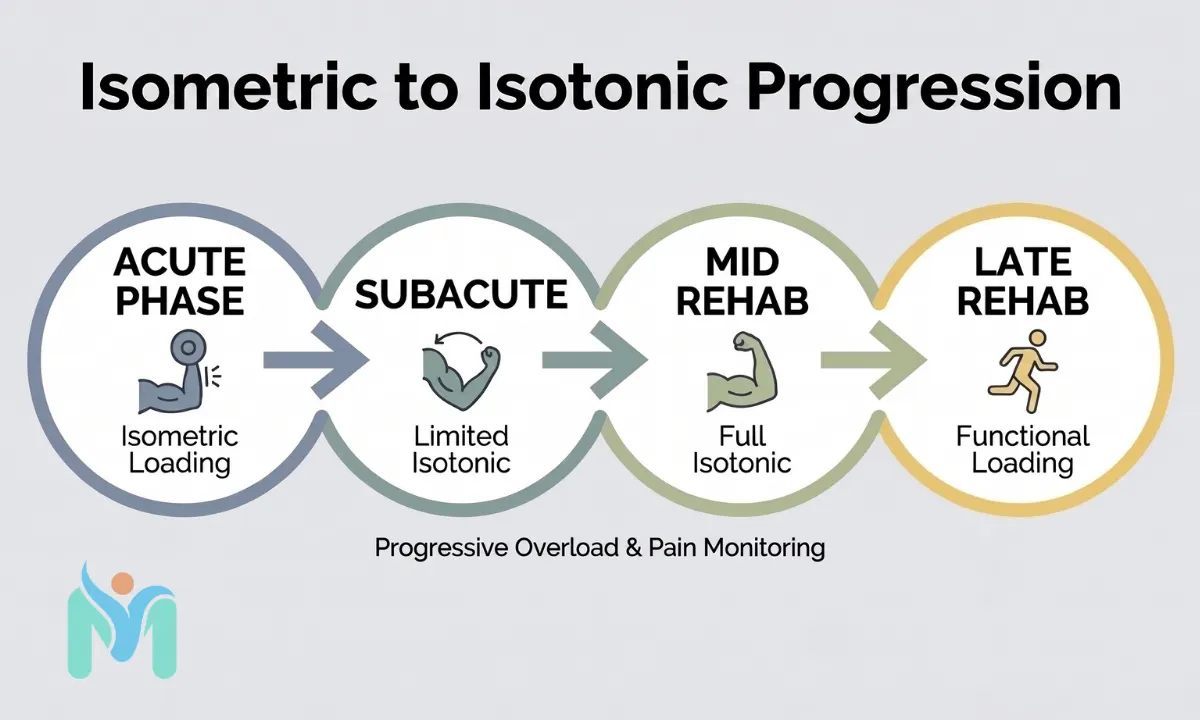
Deciding when to shift from isometric to isotonic loading is one of the most common sources of uncertainty for physiotherapy students on clinical placement. The decision depends on tissue stage, pain response, and the functional demands the patient needs to rebuild. A structured approach, consistent with progressive overload principles, gives the transition a reliable clinical basis.
- Acute or irritable phase. Begin with isometric exercise at a joint angle that produces no more than mild discomfort, typically rated 3 or below on a 0-to-10 pain scale. Long-duration holds at moderate to high load provide the analgesic effect described above while maintaining tendon stimulus. The absence of joint movement reduces the mechanical aggravation that isotonic exercise can cause when tissue is inflamed or sensitised.
- Subacute phase (symptoms settling). Introduce concentric isotonic contractions at controlled load and limited range. Start with bodyweight or light resistance and monitor pain during the session and for 24 hours afterward. The clinical guide is that pain during exercise stays at or below 3 out of 10 and returns to baseline within that window. The nervous system begins adapting to dynamic loading patterns at this stage.
- Mid rehabilitation (building load tolerance). Progress to full-range isotonic exercise through both concentric and eccentric phases. Heavy slow resistance principles apply here: move through each repetition slowly, increase load progressively as the tissue tolerates, and direct effort toward the eccentric phase for tendon-specific loading. Strength gains become progressively more functional as the muscle adapts across its full range of motion.
- Late rehabilitation (return to function). Full isotonic loading at task-specific speeds and ranges. Introduce the stretch-shortening cycle through plyometric elements where clinically appropriate. The goal at this stage is replicating the mechanical demands of the patient’s activity or sport, not general strength development alone.
Blood flow restriction (BFR) training offers a useful bridge between these phases for patients who cannot yet tolerate heavy isotonic loads. A 2019 position stand by Patterson and colleagues in Frontiers in Physiology confirmed that applying a cuff to restrict venous outflow during low-load exercise (20 to 40% of 1 repetition maximum) can produce hypertrophic and strength adaptations comparable to high-load isotonic training. When joint irritability limits loading options, BFR can extend the effective training stimulus beyond what isometric exercise provides without requiring the heavier mechanical load of full isotonic exercise.
| Rehabilitation phase | Primary exercise type | Example | Clinical goal |
|---|---|---|---|
| Acute or irritable | Isometric | Quadriceps set, isometric wall sit | Pain inhibition, maintain tendon stimulus |
| Subacute (symptoms settling) | Concentric isotonic | Shallow bodyweight squat, seated knee extension | Dynamic loading, neuromuscular coordination |
| Mid rehabilitation | Eccentric isotonic, heavy slow resistance | Slow eccentric squat, controlled calf drop | Tendon structural loading, hypertrophy |
| Late rehabilitation | Full isotonic, plyometric | Split squat, jump landing, sport drills | Return to functional and sport demands |
Frequently Asked Questions (FAQs)
Isometric exercise produces muscle force without any change in joint angle or muscle length. Isotonic exercise generates force through a range of joint motion, encompassing both concentric (muscle shortening) and eccentric (muscle lengthening) contractions. The mechanical difference determines how tendons load, how strength generalises across movement, and how pain responds during exercise. Both types have a defined role in physiotherapy rehabilitation, with the choice depending on tissue stage and clinical goals.
Yes, for certain conditions, particularly tendinopathy. Research by Rio and colleagues, published in the British Journal of Sports Medicine in 2015, showed that sustained high-load isometric contractions significantly reduced patellar tendon pain immediately after exercise, with the analgesic effect persisting for up to 45 minutes. The mechanism involves activation of the body’s descending pain inhibitory pathways, including both opioid and non-opioid components. Isometric exercise for pain management should be guided by a qualified physiotherapist.
The shift from isometric to isotonic typically occurs once acute symptoms begin to settle and tissue tolerates loading without significant pain flare-up. A practical clinical guide is that pain during exercise stays at or below 3 out of 10 and returns to baseline within 24 hours. Progression is usually graduated, starting with concentric loading before introducing full eccentric range and progressive resistance. Your physiotherapist should guide the timing based on your individual tissue response.
Isotonic exercise, particularly through its eccentric phase, is more effective for muscle hypertrophy. A 2010 review by Schoenfeld in the Journal of Strength and Conditioning Research identified mechanical tension, metabolic stress, and muscle damage as the 3 primary drivers of muscle growth, and eccentric isotonic loading produces all 3 at high levels. Isometric exercise can maintain strength when full isotonic loading is not possible, but it produces a weaker hypertrophic stimulus than isotonic training over comparable time periods.
Isometric exercises load muscle and tendon without moving the joint, which reduces the mechanical aggravation that isotonic exercise can cause when tissue is inflamed or sensitised. They also activate the body’s own pain-suppression system through exercise-induced hypoalgesia, lowering pain levels for up to 45 minutes after the session. This combination of tissue stimulus and pain reduction makes isometric exercise a clinically precise choice for the acute phase of rehabilitation.
Angle specificity refers to the fact that strength gains from isometric training are greatest at the joint angle where training occurs, with transfer diminishing as the position changes. A 2019 review by Lum and Barbosa in the International Journal of Sports Medicine confirmed this effect as a meaningful limitation of pure isometric programmes. Training a muscle at one fixed angle does not develop strength across the full range of motion the muscle needs to perform in daily activity, which is one reason isometric exercise alone is insufficient for later rehabilitation stages.
Yes. Eccentric contractions, where the muscle lengthens under load, are one of the 2 subtypes of isotonic exercise. The term isotonic describes force production through a range of joint motion, encompassing both concentric (shortening) and eccentric (lengthening) contractions. Eccentric contractions can generate the highest absolute forces of any contraction type, which is why eccentric loading protocols such as the Alfredson calf raise programme for Achilles tendinopathy have become a cornerstone of tendon rehabilitation.
Isometric vs Isotonic Exercise: Choosing the Right Tool at the Right Stage
The clinical difference between these 2 contraction types comes down to what the tissue needs at each stage of recovery. Early rehabilitation rarely tolerates the joint movement and variable loading that isotonic exercise demands. Isometric contractions offer a way to maintain tissue stimulus, manage pain through exercise-induced hypoalgesia, and begin building strength while the acute phase settles.
As tissue tolerance improves, the case for isotonic exercise strengthens. The ACSM’s evidence base for progressive resistance training, the eccentric loading protocols validated across multiple randomised controlled trials, and the SAID principle all point toward isotonic exercise as the driver of functional recovery once the tissue is ready to load across its range of motion. The transition between the two is not a single decision but a graduated process guided by pain response and clinical monitoring.
What the evidence from Rio and colleagues underlines is something clinicians often learn through experience: loading a sensitised tendon isometrically before progressing to isotonic work may prepare the nervous system to tolerate the dynamic loading that follows. The analgesic priming of isometric exercise might be as important as its structural effects in establishing the foundation for later rehabilitation stages.
For physiotherapy students, the choice between isometric vs isotonic exercise rests on what stage the patient’s tissue is at, what the evidence says it is ready for, and which contraction type advances their recovery most efficiently at that moment.
Consult your doctor or a qualified physiotherapist before starting any new exercise programme, especially if you have an existing injury or medical condition.
References
- Lum D, Barbosa TM. “Brief Review: Effects of Isometric Strength Training on Strength and Dynamic Performance.” International Journal of Sports Medicine. 2019;40(6):363-375. DOI: 10.1055/a-0863-4539. PMID: 30934104. URL: https://pubmed.ncbi.nlm.nih.gov/30934104/. Evidence Level: 2.
- Hoppeler H. “Moderate Load Eccentric Exercise; A Distinct Novel Training Modality.” Frontiers in Physiology. 2016;7:483. DOI: 10.3389/fphys.2016.00483. PMID: 27826254. URL: https://pubmed.ncbi.nlm.nih.gov/27826254/. Evidence Level: 6.
- Rio E, Kidgell D, Purdam C, et al. “Isometric exercise induces analgesia and reduces inhibition in patellar tendinopathy.” British Journal of Sports Medicine. 2015;49(19):1277-1283. DOI: 10.1136/bjsports-2014-094386. PMID: 26084309. URL: https://pubmed.ncbi.nlm.nih.gov/26084309/. Evidence Level: 4.
- Rio E, van Ark M, Docking SI, et al. “Isometric contractions are more analgesic than isotonic contractions for patellar tendon pain: an in-season randomized clinical trial.” Clinical Journal of Sport Medicine. 2017;27(3):253-259. DOI: 10.1097/JSM.0000000000000364. PMID: 27513733. URL: https://pubmed.ncbi.nlm.nih.gov/27513733/. Evidence Level: 4.
- Sluka KA, Frey-Law L, Hoeger Bement M. “Exercise-induced pain and analgesia? Underlying mechanisms and clinical translation.” Pain. 2018;159 Suppl 1:S91-S97. DOI: 10.1097/j.pain.0000000000001235. PMID: 29847987. URL: https://pubmed.ncbi.nlm.nih.gov/29847987/. Evidence Level: 6.
- American College of Sports Medicine. “Progression models in resistance training for healthy adults.” Medicine and Science in Sports and Exercise. 2009;41(3):687-708. DOI: 10.1249/MSS.0b013e3181915670. PMID: 19204579. URL: https://pubmed.ncbi.nlm.nih.gov/19204579/. Evidence Level: 1.
- Kraemer WJ, Ratamess NA. “Fundamentals of resistance training: progression and exercise prescription.” Medicine and Science in Sports and Exercise. 2004;36(4):674-688. PMID: 15064596. URL: https://pubmed.ncbi.nlm.nih.gov/15064596/. Evidence Level: 6.
- Schoenfeld BJ. “The mechanisms of muscle hypertrophy and their application to resistance training.” Journal of Strength and Conditioning Research. 2010;24(10):2857-2872. DOI: 10.1519/JSC.0b013e3181e840f3. PMID: 20847704. URL: https://pubmed.ncbi.nlm.nih.gov/20847704/. Evidence Level: 2.
- Alfredson H, Pietila T, Jonsson P, Lorentzon R. “Heavy-load eccentric calf muscle training for the treatment of chronic Achilles tendinosis.” American Journal of Sports Medicine. 1998;26(3):360-366. PMID: 9617395. URL: https://pubmed.ncbi.nlm.nih.gov/9617395/. Evidence Level: 4.
- Beyer R, Kongsgaard M, Hougs Kjær B, Øhlenschlæger T, Kjær M, Magnusson SP. “Heavy Slow Resistance Versus Eccentric Training as Treatment for Achilles Tendinopathy: A Randomized Controlled Trial.” American Journal of Sports Medicine. 2015;43(7):1704-1711. DOI: 10.1177/0363546515584760. PMID: 25969683. URL: https://pubmed.ncbi.nlm.nih.gov/25969683/. Evidence Level: 4.
- Patterson SD, Hughes L, Warmington S, et al. “Blood Flow Restriction Exercise Position Stand: Considerations of Methodology, Application, and Safety.” Frontiers in Physiology. 2019;10:533. DOI: 10.3389/fphys.2019.00533. PMID: 31156473. URL: https://pubmed.ncbi.nlm.nih.gov/31156473/. Evidence Level: 6.