

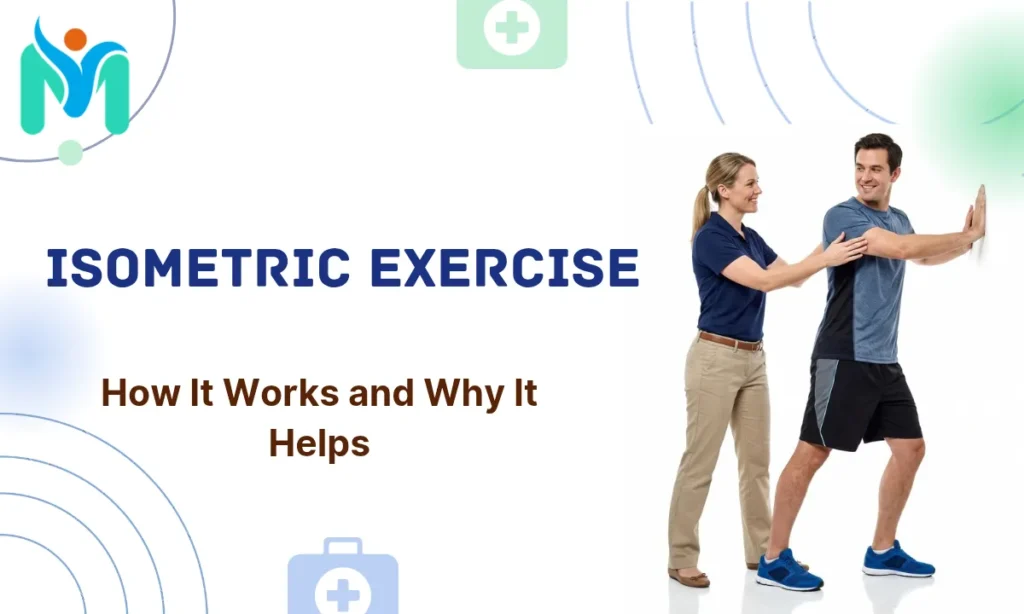
If your physiotherapist has recommended isometric exercises and you’re not entirely clear on what they are or why they’d help, you’re in the right place. The word sounds technical. The concept is not.
Isometric exercise is muscle contraction without movement. You push against something that doesn’t give way, or you hold a position against gravity, and the joint stays still while the muscle works hard. That absence of movement is precisely what makes these exercises so useful at certain stages of injury recovery.
Whether you’re managing a painful tendon, rebuilding strength after surgery, or working around a joint that hurts when it moves, understanding how and why isometric exercises work will help you get far more out of them.
What Is Isometric Exercise?
Isometric exercise is a form of muscle contraction in which the muscle generates force without changing length and without moving the joint. In physiotherapy, isometric exercises are used to maintain or build strength, manage pain during the acute phase of tendon injury, and begin loading compromised tissue when dynamic movement would be unsafe or counterproductive. The muscle works; the joint does not move.
The name comes from the Greek words isos (equal) and metron (measure), reflecting the fact that muscle length stays constant throughout the contraction. Press your palm flat against a wall and push as hard as you can: your shoulder muscles fire, force is generated, but the joint stays exactly where it is. That is an isometric contraction.
The alternative is isotonic exercise, where the muscle shortens (the concentric phase) or lengthens under load (the eccentric phase) as the joint moves through its range. A standard squat is isotonic. A held squat position is isometric. Both types build strength, but through different mechanisms and at different stages of rehabilitation. Both have a place in a well-structured recovery programme.
Why Physiotherapists Use Isometric Exercise
The most common reason a physiotherapist prescribes isometric exercises is also the most straightforward: the patient needs to load a muscle or tendon, but movement either causes pain or is currently contraindicated.
This arises most often in tendinopathy, a condition in which the tendon becomes overloaded or structurally compromised and is painful with normal activity. Researchers Cook and Purdam proposed an influential model of tendinopathy, published in the British Journal of Sports Medicine in 2009, describing it as a continuum: from reactive tendon tissue through to degenerative change. Reactive tendons respond poorly to aggressive through-range loading, but they do respond to sustained isometric loading because it generates tension without the compressive and shear forces that worsen reactive tissue. Loading a tendon carefully is better than resting it entirely. Isometric exercise is how that careful loading begins.
Isometric exercise is also central to post-surgical rehabilitation where joint movement is restricted during the early healing phase. After anterior cruciate ligament reconstruction, for example, the quadriceps typically begin their recovery through isometric contractions before the knee is progressively loaded through movement. The muscle starts to regain its neural activation and force-generating capacity while the internal repair process is protected.
Does Isometric Exercise Actually Reduce Pain?
Yes, and the speed of that effect often surprises people. Research published in the British Journal of Sports Medicine by Rio and colleagues in 2015 found that 5 sets of 45-second isometric contractions at 70% of maximal effort produced immediate, significant pain relief in athletes with patellar tendinopathy, with the analgesic effect lasting at least 45 minutes after the session ended.
The same study found that these contractions also reduced cortical inhibition (the process by which the brain suppresses voluntary motor output to a painful muscle, making it feel weak and difficult to activate fully). When cortical inhibition is reduced, the muscle responds more completely to voluntary effort. The tendon receives more consistent loading during every subsequent movement. Both the muscle and the tendon benefit from that restored activation.
Isometric exercise is one of the few interventions that produces meaningful pain relief while simultaneously beginning the loading process that tendons need to adapt, making it both a pain management tool and a rehabilitation stimulus at the same time.
A follow-up randomised clinical trial by the same research group, published in the Clinical Journal of Sport Medicine in 2017, compared isometric and isotonic exercise protocols in in-season athletes with patellar tendinopathy. The isometric group reported greater immediate pain relief than the isotonic group and maintained competitive training volume more consistently across the season. The precise neurophysiological mechanism behind isometric analgesia is still being investigated: early research suggests involvement of descending pain inhibition pathways, though larger controlled trials are needed to fully characterise this effect. The clinical result itself is well supported across multiple randomised trials.
The Benefits of Isometric Training Beyond Pain Relief
Pain relief is the reason many patients start isometric exercise. It isn’t the only thing these contractions achieve.
A 2019 systematic review by Oranchuk and colleagues, published in the Scandinavian Journal of Medicine and Science in Sports, analysed 73 studies on isometric training adaptations. The review found consistent evidence that isometric training produces meaningful strength gains, particularly at and near the joint angles where the training occurs. Neural adaptation drives the majority of early progress: the nervous system becomes more efficient at recruiting motor units and co-ordinating muscular effort, producing measurable strength improvements before any structural change in the muscle tissue itself. These neural changes can occur within 2 to 4 weeks of consistent training.
Structural changes in the tendon follow with sustained loading over time. A systematic review and meta-analysis by Bohm and colleagues, published in Sports Medicine Open in 2015, found that mechanical loading drives tendon adaptation: increasing stiffness, improving structural organisation, and building the tendon’s capacity to store and release energy. These structural adaptations typically require at least 10 to 12 weeks of consistent loading to become measurable. Isometric exercise begins that process; it doesn’t complete it on its own.
| Feature | Isometric exercise | Isotonic exercise |
|---|---|---|
| Joint movement during contraction | None: joint angle stays fixed | Joint moves through its range |
| Muscle length change | Unchanged throughout the hold | Shortens (concentric) or lengthens (eccentric) |
| Best phase in rehabilitation | Acute and reactive phase; early post-surgical; pain-limited stages | Sub-acute and progressive strengthening phases |
| Immediate analgesic effect in tendinopathy | Significant, supported by multiple RCTs | Less consistent immediate effect |
| Compressive stress on tendon | Lower | Higher, especially at end range |
Which Conditions Respond Well to Isometric Exercise?
Isometric exercise is not a single-condition tool. It is appropriate across a wide range of musculoskeletal presentations, particularly where loading the tissue is necessary but dynamic movement currently aggravates symptoms. The conditions where evidence most clearly supports its use include:
- Patellar tendinopathy: isometric quadriceps loading is supported by multiple randomised trials and produces both immediate pain relief and progressive tendon load tolerance without the compressive forces that aggravate reactive patellar tissue.
- Achilles tendinopathy: isometric calf loading reduces pain and begins the graduated tendon conditioning process, particularly during the reactive phase when through-range exercise remains too provocative.
- Rotator cuff tendinopathy: isometric shoulder contractions activate the supraspinatus and infraspinatus without the overhead arc that produces compressive loading on the subacromial space, where reactive rotator cuff tissue sits.
- Osteoarthritis: NICE Guideline NG226 (2022) and the OARSI guidelines for non-surgical management of knee osteoarthritis (McAlindon et al., 2014) both recommend exercise including muscle strengthening as a first-line treatment. Isometric exercise allows patients to strengthen the musculature around an arthritic joint without the impact and compression of dynamic loading during painful or flare-up phases.
- Early post-surgical rehabilitation: isometric contractions protect healing structures while countering the rapid muscle atrophy and cortical inhibition that follow surgery and enforced immobility.
Isometric Exercises: A Step-by-Step Guide
The 5 exercises below are commonly used in physiotherapy for different conditions and body regions. Each is an educational example. The appropriate exercise, load intensity, and dosage for your specific condition and stage of recovery should be confirmed with your physiotherapist before you begin.
Before starting any exercise here, understand the difference between working pain and warning pain. A mild ache or dull pressure sensation during a hold is working pain: it confirms the muscle is under load and should ease within a few minutes of finishing. Sharp, sudden, or worsening pain during a hold is warning pain: stop immediately and speak to your physiotherapist before continuing.
1. Isometric Quad Set (Lying)
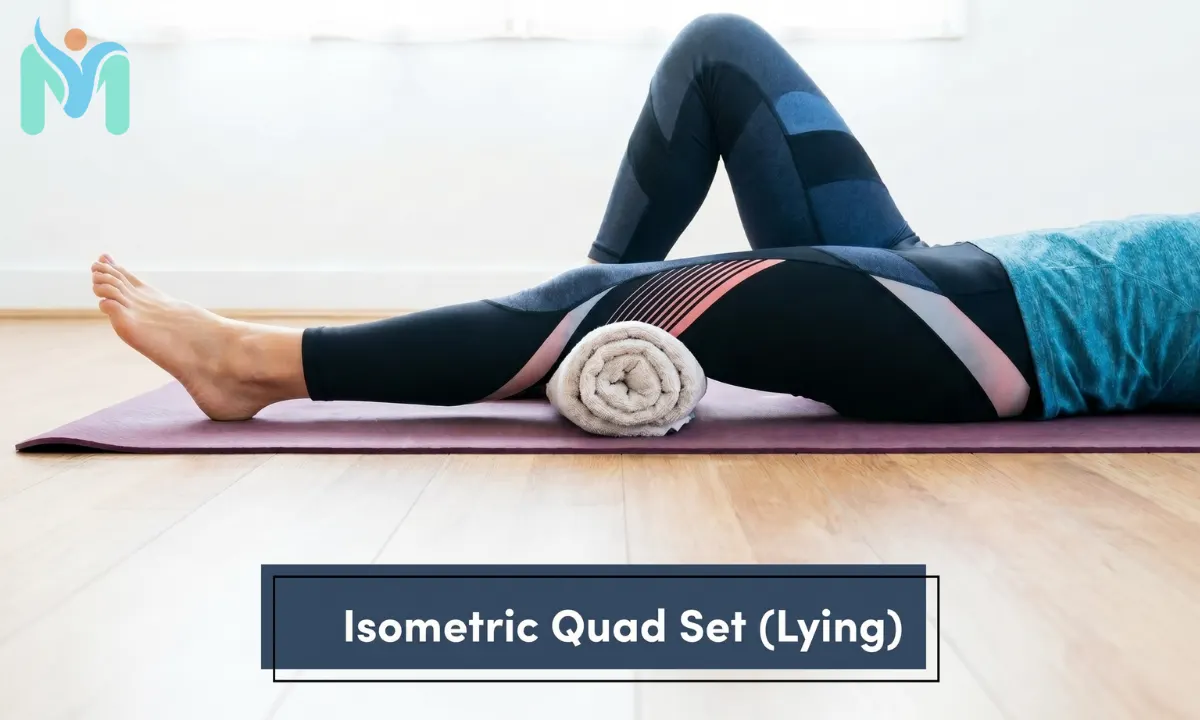
Purpose: Activates the quadriceps without flexing the knee or compressing the patellar tendon. By pressing the back of the knee into the floor, this exercise generates tension in the tendon with minimal compressive force: the safest entry point for reactive patellar tendinopathy and early post-surgical knee rehabilitation, including after anterior cruciate ligament reconstruction.
Start Position: Lie flat on your back on a firm surface with your leg straight. Place a small rolled towel under your knee if that feels more comfortable.
Movement: Tighten the muscles on the front of your thigh as firmly as you comfortably can, pressing the back of your knee down into the surface beneath it. Nothing should move. The thigh firms noticeably, the back of the knee presses downward gently. Hold for 45 seconds. Release slowly at the end of the hold.
Dosage: 5 sets of 45-second holds on the affected leg, with 2 minutes of rest between sets. Aim for approximately 70% of your maximum effort: firm and sustained, not maximal.
Safety Note: Stop if you feel sharp pain at the front of your knee during the hold. A dull ache or mild burning sensation in the thigh itself is expected.
2. Wall Sit (Isometric Squat Hold)
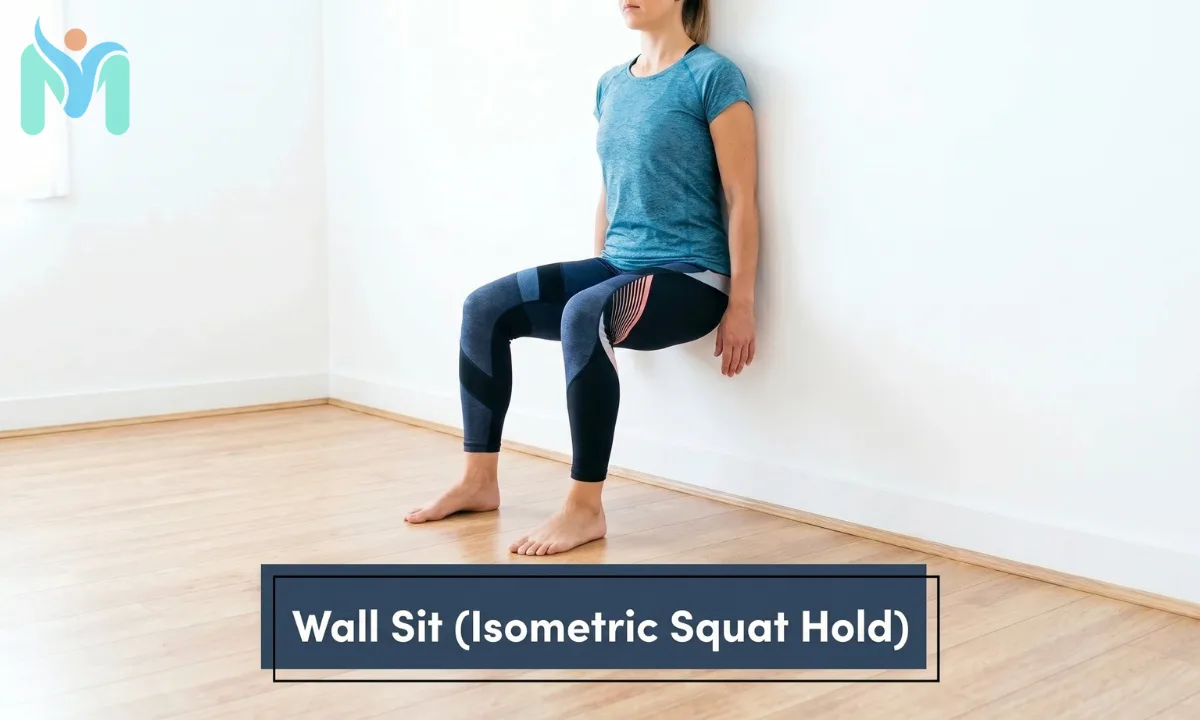
Purpose: Loads the quadriceps and patellar tendon under sustained weight-bearing tension. This exercise is appropriate once pain with basic isometric loading has reduced, and is commonly used in the later phase of patellar tendinopathy rehabilitation and for strengthening the quadriceps in osteoarthritis when full dynamic squatting is currently too painful to begin.
Start Position: Stand with your back flat against a wall. Place your feet hip-width apart, approximately 50 to 60 centimetres from the wall.
Movement: Slide your back slowly down the wall until your knees reach 60 to 80 degrees of bend (roughly a partial squat, not a full right angle). Hold this position. Keep your back in contact with the wall and your feet flat on the floor throughout. The sustained effort in your thighs is felt within seconds of settling into position.
Dosage: 5 sets of 45-second holds, with 2 minutes rest between each set. Begin at 60 degrees of knee bend if deeper angles increase your pain.
Safety Note: If your knee pain increases beyond a mild ache during the hold, reduce the bend angle. Do not go past 90 degrees of knee flexion in an early rehabilitation phase.
3. Isometric Shoulder Press Against Wall
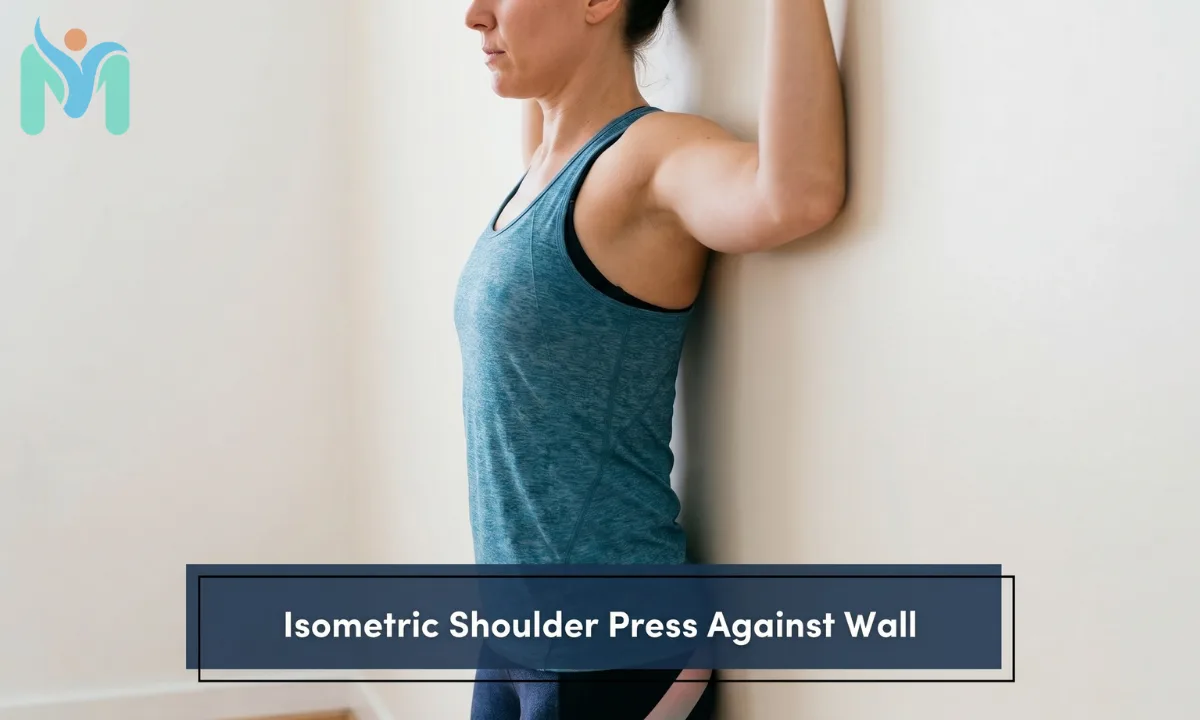
Purpose: Activates the rotator cuff muscles (primarily the supraspinatus and infraspinatus) without producing movement at the glenohumeral joint. This makes it suitable for reactive rotator cuff tendinopathy and shoulder rehabilitation phases where overhead or through-range movement is currently contraindicated. Weakness of the rotator cuff is a consistent finding in both tendinopathy and subacromial pain syndrome.
Start Position: Stand sideways to a wall with your affected shoulder closest to the wall. Bend your elbow to 90 degrees, upper arm at your side. Rest the back of your forearm lightly against the wall surface.
Movement: Push your forearm outward into the wall, as if trying to move your arm away from your body, while the wall provides an immovable resistance. Nothing moves. You should feel effort in the muscles around the back of the shoulder and along the shoulder blade. Hold for 30 seconds.
Dosage: 5 sets of 30-second holds, with 90 seconds rest between sets. Begin at a low effort level (around 40% of maximum) and increase intensity gradually over several sessions.
Safety Note: Stop immediately if you feel a sharp, catching, or clicking sensation in the shoulder. A mild ache around the back of the shoulder or upper arm during the hold is expected and normal.
4. Isometric Calf Hold (Achilles Loading)
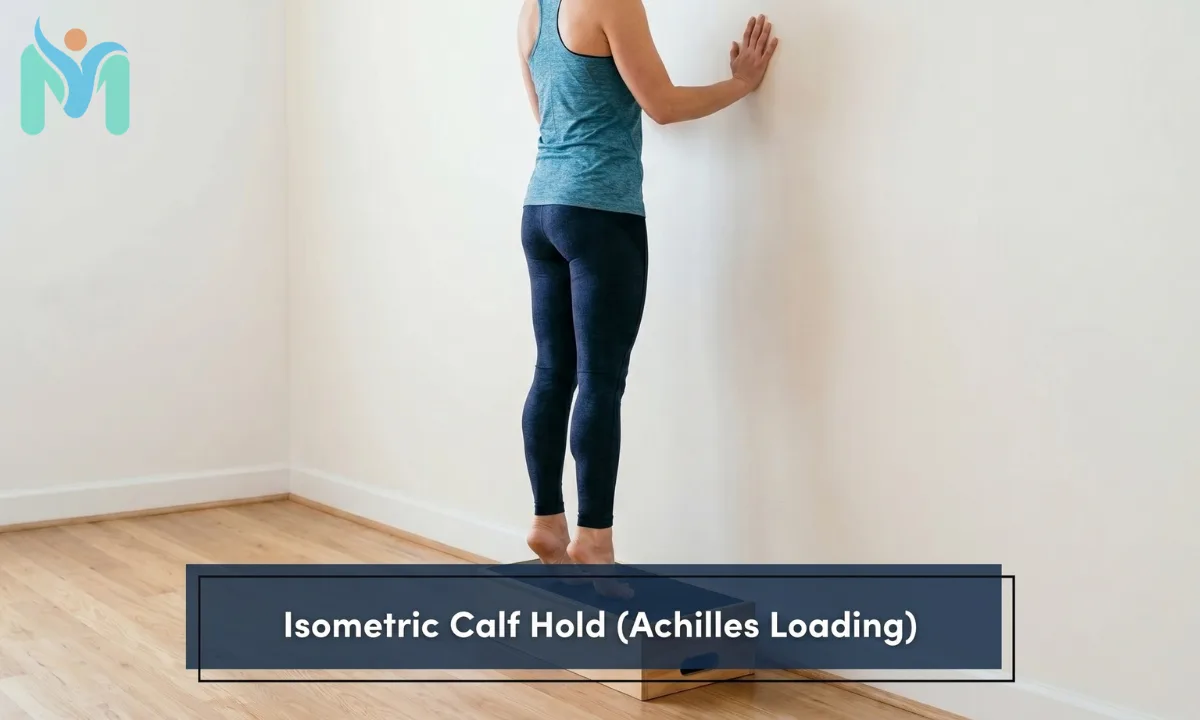
Purpose: Places the Achilles tendon and calf musculature (gastrocnemius and soleus) under sustained load in a position that avoids the peak compressive force generated at the bottom of a dynamic calf raise. This exercise is used as a starting point for reactive Achilles tendinopathy, producing analgesic benefit and beginning the tendon conditioning process when through-range calf exercise remains too provocative.
Start Position: Stand on the edge of a firm step with your heels hanging off the back edge, or stand flat on the floor if step access is not available. Hold a stable wall or railing lightly for balance only, not for weight support.
Movement: Rise slowly onto your tiptoes and hold the raised position at the top of the movement. Keep your knee straight throughout to target the gastrocnemius, the larger of the two calf muscles. You will feel sustained effort through the calf and around the Achilles tendon.
Dosage: 5 sets of 45-second holds, with 2 minutes rest between sets. Begin with both feet once you are confident in the position, then progress to single-leg loading on the affected side when the double-leg version is manageable without significant symptom increase.
Safety Note: A dull ache in the calf muscle during the hold is expected. Sharp pain at the heel or directly in the tendon is a warning signal: stop and consult your physiotherapist before continuing.
5. Isometric Hip Abduction (Side-Lying)
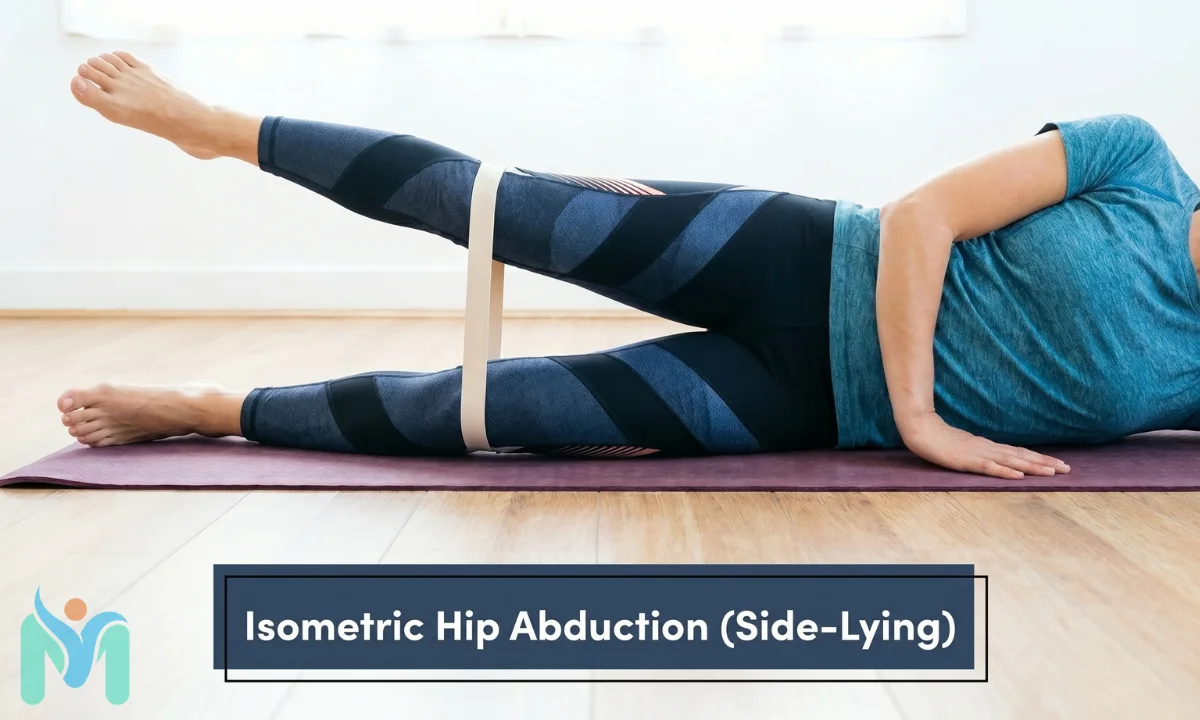
Purpose: Activates the gluteus medius, the primary muscle responsible for pelvic and hip stability during standing and movement, without dynamic joint loading. Weakness of the gluteus medius is a common contributing factor in patellofemoral pain syndrome, hip abductor tendinopathy, and many presentations of lower back and knee pain. This exercise is appropriate for early hip rehabilitation and for cases where weight-bearing hip abductor exercises remain too painful.
Start Position: Lie on your side on a firm surface. Stack your hips directly above each other. Keep your top leg straight and in line with your body.
Movement: Loop a resistance band just above both knees. Press your top knee outward into the band and hold the position, resisting its pull without allowing your leg to move. Alternatively, press the outer edge of your top foot against a wall and hold. The leg stays still; the muscles contract isometrically against the resistance. Hold for 30 seconds on each side.
Dosage: 3 sets of 30-second holds on each side, with 90 seconds rest between sets.
Safety Note: Keep your hips stacked throughout. If you feel the effort primarily in your lower back rather than your outer hip, adjust your position and reduce resistance before trying again.
How to Progress from Isometric to Full Rehabilitation
Isometric exercise is a starting point in rehabilitation, not a permanent routine. The goal is always to progress toward exercises that load the muscle and tendon through a full range of movement, and ultimately to the functional or sporting demands you want to return to. Moving through that progression too quickly is one of the most common causes of setback in tendinopathy and post-surgical recovery.
The general clinical progression sequence follows these stages:
- Isometric loading: static holds at a fixed angle, used in the reactive or acutely painful phase. A commonly used clinical guide is to keep pain during loading at 3 out of 10 or below on a simple 0-to-10 pain scale, with no increase in baseline symptoms the following day.
- Isotonic exercise at moderate load: through-range strengthening using slow, controlled movement once isometric loading is manageable. A 2009 randomised trial by Kongsgaard and colleagues, published in the Scandinavian Journal of Medicine and Science in Sports, found that heavy slow resistance training produced durable long-term improvements in patellar tendinopathy over a 12-month follow-up.
- Heavy slow resistance (HSR) training: higher-load, slow-tempo strengthening through a full range of movement. Research by Beyer and colleagues, published in the American Journal of Sports Medicine in 2015, found that HSR produced strong outcomes for Achilles tendinopathy, with superior patient satisfaction at 52 weeks compared to eccentric-only training.
- Functional and sport-specific loading: running, jumping, rapid directional changes, or the specific demands of your occupation or sport. This phase requires the tissue to handle fast, high-force loads without pain and without symptom flare in the 24 to 48 hours that follow activity.
The signal to progress from one stage to the next is not the absence of all discomfort. It is consistent, manageable performance at the current stage without symptoms worsening during or after sessions. Your physiotherapist will determine the timing of each progression based on your tissue response and functional capacity.
Getting the Most from Isometric Exercise
Isometric exercise in physiotherapy works because it matches what injured tissue actually needs at a particular stage of recovery: sustained load without the forces that cause aggravation. The evidence for its analgesic effect in tendinopathy is established across multiple randomised trials. The case for its role in preserving muscle activation, maintaining neural drive, and beginning tendon conditioning during periods of restricted loading is equally well supported.
What the research also makes clear is that dosage specificity matters. A brief, low-effort contraction is a different physiological stimulus from 5 sets of 45-second holds at 70% of maximum effort. The outcome depends on applying the right load at the right stage, not simply on performing the exercise in any form.
Isometric exercise is a phase of rehabilitation. The goal of that phase is to create conditions in which the next phase becomes possible: isotonic loading, then heavy resistance, then full functional activity. Most people managing tendinopathy, post-surgical muscle inhibition, or joint-related weakness will spend 2 to 6 weeks in the isometric phase before progressing, though that timeline varies considerably with condition severity and individual response. Used at the right stage and with appropriate dosage, isometric exercise in physiotherapy rehabilitation is one of the most effective tools available for rebuilding the tissue capacity that pain, surgery, or enforced rest has diminished.
Frequently Asked Questions (FAQs)
Isometric exercise produces muscle contraction without any change in muscle length or joint angle: the muscle works, but nothing moves. Isotonic exercise produces contraction with joint movement, where the muscle shortens during the concentric phase and lengthens during the eccentric phase. In physiotherapy, isometric exercise is typically prescribed first because it loads the muscle and tendon without the compressive and shear forces that aggravate acutely painful or reactive tissue.
Research by Rio and colleagues, published in the British Journal of Sports Medicine in 2015, used 5 sets of 45-second holds at approximately 70% of maximum effort and found significant, lasting pain relief in patellar tendinopathy. Shorter holds of 20 to 30 seconds are used in earlier or more sensitive presentations. The right duration for your specific condition and stage of recovery should always be confirmed with your physiotherapist.
Isometric exercises are generally well-suited to tendon pain because they load the tendon without the compressive and shear forces that aggravate reactive tendon tissue. Multiple randomised trials support their use in patellar and Achilles tendinopathy specifically. The key is matching the load intensity and hold duration to your current tissue tolerance. A dull ache during the hold is acceptable; sharp or worsening pain is a signal to stop and seek advice from your physiotherapist.
Yes. NICE Guideline NG226 (2022) recommends exercise including muscle strengthening as a first-line treatment for osteoarthritis in adults. Isometric quadriceps exercises are useful in early or flare-up phases because they strengthen the muscles around the joint without the impact and compression of dynamic exercise. A 2012 systematic review by Wang and colleagues in the Annals of Internal Medicine confirmed that physiotherapy exercise including strengthening consistently reduces pain and improves function in knee osteoarthritis.
After surgery, muscles lose activation rapidly through a process called cortical inhibition, in which the brain reduces voluntary motor output to protect the healing area. Isometric contractions counter this by stimulating the nerve pathways that drive the muscle, keeping voluntary activation patterns intact while the joint heals. This prevents the rapid muscle wasting and strength loss that would otherwise occur during the early post-surgical rest period, making later rehabilitation stages significantly more achievable.
Two randomised trials by Rio and colleagues (British Journal of Sports Medicine, 2015; Clinical Journal of Sport Medicine, 2017) found that isometric exercise produced immediate, significant pain relief in athletes with patellar tendinopathy, outperforming isotonic exercise for immediate analgesia in the in-season study. The proposed mechanism involves reduced cortical inhibition and possible activation of descending pain modulation pathways. The clinical effect is well supported; the full neurophysiological mechanism is still under investigation.
The general clinical guide is that you are ready to progress when you can complete your isometric sessions consistently at a moderate-to-firm effort level (around 70% of maximum), with pain staying at or below 3 out of 10 during exercise and no increase in baseline symptoms the following day. Your physiotherapist will assess your tissue response, strength, and functional capacity before confirming the right time to introduce isotonic or higher-load exercises in your programme.
Consult your doctor or a qualified physiotherapist before starting any new exercise programme, especially if you have an existing injury or medical condition.
References
- Cook JL, Purdam CR. “Is tendon pathology a continuum? A pathology model to explain the clinical presentation of load-induced tendinopathy.” Br J Sports Med. 2009;43(6):409–416. DOI: 10.1136/bjsm.2008.051193. PMID: 19332583. URL: https://pubmed.ncbi.nlm.nih.gov/19332583/. Evidence Level: 6.
- Rio E, Kidgell D, Purdam C, Samiric T, Moseley GL, Docking SI, Morrissey D, Cook J. “Isometric exercise induces analgesia and reduces inhibition in patellar tendinopathy.” Br J Sports Med. 2015;49(19):1277–1283. DOI: 10.1136/bjsports-2014-094386. PMID: 25979840. URL: https://pubmed.ncbi.nlm.nih.gov/25979840/. Evidence Level: 4.
- Rio E, van Ark M, Docking S, Moseley GL, Kidgell D, Gaida JE, van den Akker-Scheek I, Zwerver J, Cook J. “Isometric contractions are more analgesic than isotonic contractions for patellar tendon pain: an in-season randomized clinical trial.” Clin J Sport Med. 2017;27(3):253–259. DOI: 10.1097/JSM.0000000000000364. PMID: 27513733. URL: https://pubmed.ncbi.nlm.nih.gov/27513733/. Evidence Level: 4.
- Oranchuk DJ, Storey AG, Nelson AR, Cronin JB. “Isometric training and long-term adaptations: Effects of muscle length, intensity, and intent: A systematic review.” Scand J Med Sci Sports. 2019;29(4):484–503. DOI: 10.1111/sms.13375. PMID: 30580468. URL: https://pubmed.ncbi.nlm.nih.gov/30580468/. Evidence Level: 2.
- Bohm S, Mersmann F, Arampatzis A. “Human tendon adaptation in response to mechanical loading: a systematic review and meta-analysis of exercise intervention studies on healthy adults.” Sports Med Open. 2015;1(1):7. DOI: 10.1186/s40798-015-0018-3. Evidence Level: 2.
- National Institute for Health and Care Excellence. “Osteoarthritis in over 16s: diagnosis and management.” NICE Guideline NG226. National Institute for Health and Care Excellence. URL: https://www.nice.org.uk/guidance/ng226 (2022). Evidence Level: 1.
- McAlindon TE, Bannuru RR, Sullivan MC, Arden NK, Berenbaum F, Bierma-Zeinstra SM, et al. “OARSI guidelines for the non-surgical management of knee osteoarthritis.” Osteoarthritis Cartilage. 2014;22(3):363–388. DOI: 10.1016/j.joca.2014.01.003. PMID: 24462672. URL: https://pubmed.ncbi.nlm.nih.gov/24462672/. Evidence Level: 1.
- Kongsgaard M, Kovanen V, Aagaard P, Doessing S, Hansen P, Laursen AH, et al. “Corticosteroid injections, eccentric decline squat training and heavy slow resistance training in patellar tendinopathy.” Scand J Med Sci Sports. 2009;19(6):790–802. DOI: 10.1111/j.1600-0838.2009.00949.x. PMID: 19793213. URL: https://pubmed.ncbi.nlm.nih.gov/19793213/. Evidence Level: 4.
- Beyer R, Kongsgaard M, Hougs Kjær B, Øhlenschlaeger T, Kjær M, Magnusson SP. “Heavy Slow Resistance Versus Eccentric Training as Treatment for Achilles Tendinopathy: A Randomized Controlled Trial.” Am J Sports Med. 2015;43(7):1704–1711. DOI: 10.1177/0363546515584760. PMID: 25986261. URL: https://pubmed.ncbi.nlm.nih.gov/25986261/. Evidence Level: 4.
- Wang SY, Olson-Kellogg B, Shamliyan TA, Choi JY, Ramakrishnan R, Kane RL. “Physical therapy interventions for knee pain secondary to osteoarthritis: a systematic review.” Ann Intern Med. 2012;157(9):632–644. DOI: 10.7326/0003-4819-157-9-201211060-00007. PMID: 23128863. URL: https://pubmed.ncbi.nlm.nih.gov/23128863/. Evidence Level: 2.

Great article, It clearly explains isometric exercises, their benefits, and practical applications in physiotherapy. Informative, easy to understand, and highly valuable for patients and professionals alike.
Thank you, Synergy! I really appreciate the feedback. Making physiotherapy concepts easy to understand for everyone is always the goal, so I’m glad the article hit the mark for you.