

If you’ve ever sat in front of a TENS machine trying to work out what to set the frequency dial to, you’re not alone. Most guides suggest turning the intensity up until you feel a tingling and leaving it at that. But TENS parameters, when understood correctly, are doing something far more specific than that. Each one controls a distinct physiological process, and choosing the wrong settings means activating the wrong pain-relief mechanism entirely.
That distinction matters whether you’re a physiotherapy student learning electrotherapy for the first time or a patient who has been handed a TENS unit and told to “give it a go.” The parameters are the therapy. Get them right, and you’re targeting a specific neurophysiological pathway. Get them wrong, and you may be wondering why the device doesn’t seem to be working.
What do TENS parameters actually control?
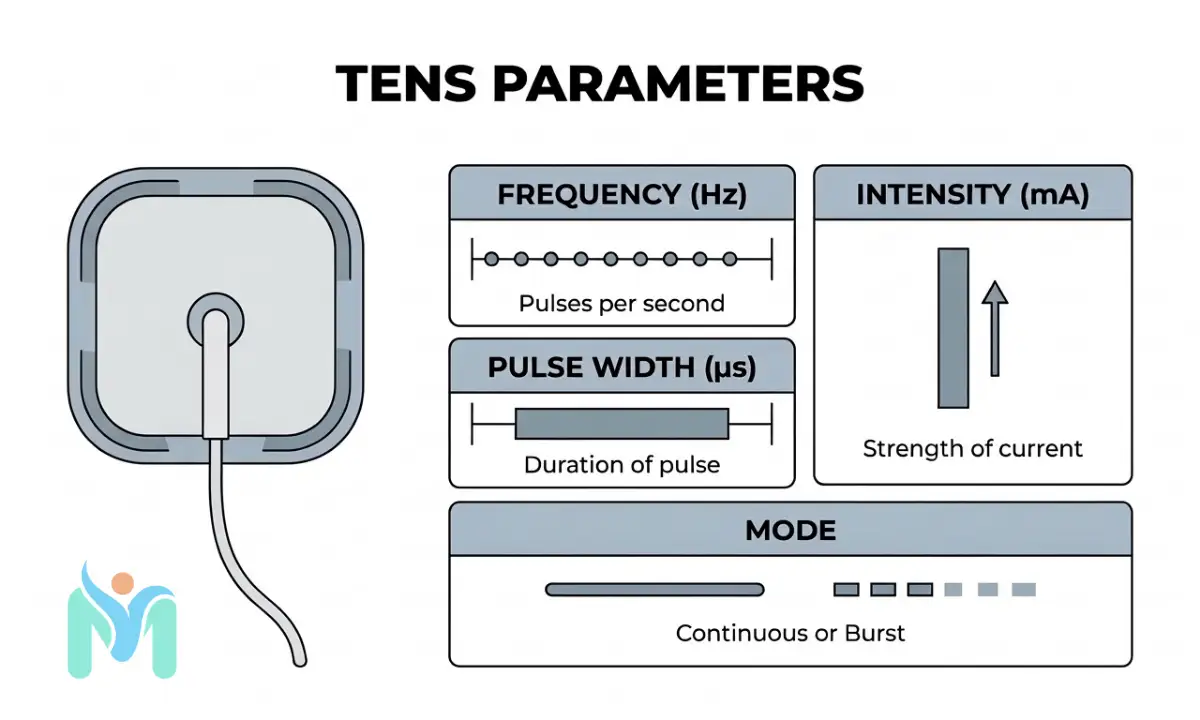
Transcutaneous Electrical Nerve Stimulation (TENS) delivers low-level electrical pulses through electrode pads placed on the skin. 3 core parameters define the character of that stimulus. Frequency sets the number of electrical pulses delivered per second, measured in hertz (Hz). Pulse width controls how long each individual pulse lasts, measured in microseconds (µs). Intensity determines the strength of the electrical current delivered, measured in milliamps (mA). Together, these 3 values determine which nerve fibres are activated, through which physiological pathway, and how the body responds to the therapy.
A 4th consideration, mode, governs whether the device delivers pulses continuously, in short burst packets, or with automatically varying parameters. Mode shapes how the therapy is tolerated over longer sessions and can be used to address a well-known challenge called accommodation, where the nervous system adapts to a repetitive stimulus and the perceived sensation fades. Understanding these parameters removes the guesswork from TENS and gives you a clinical reason for every adjustment you make.
How TENS relieves pain: gate control and endorphin release
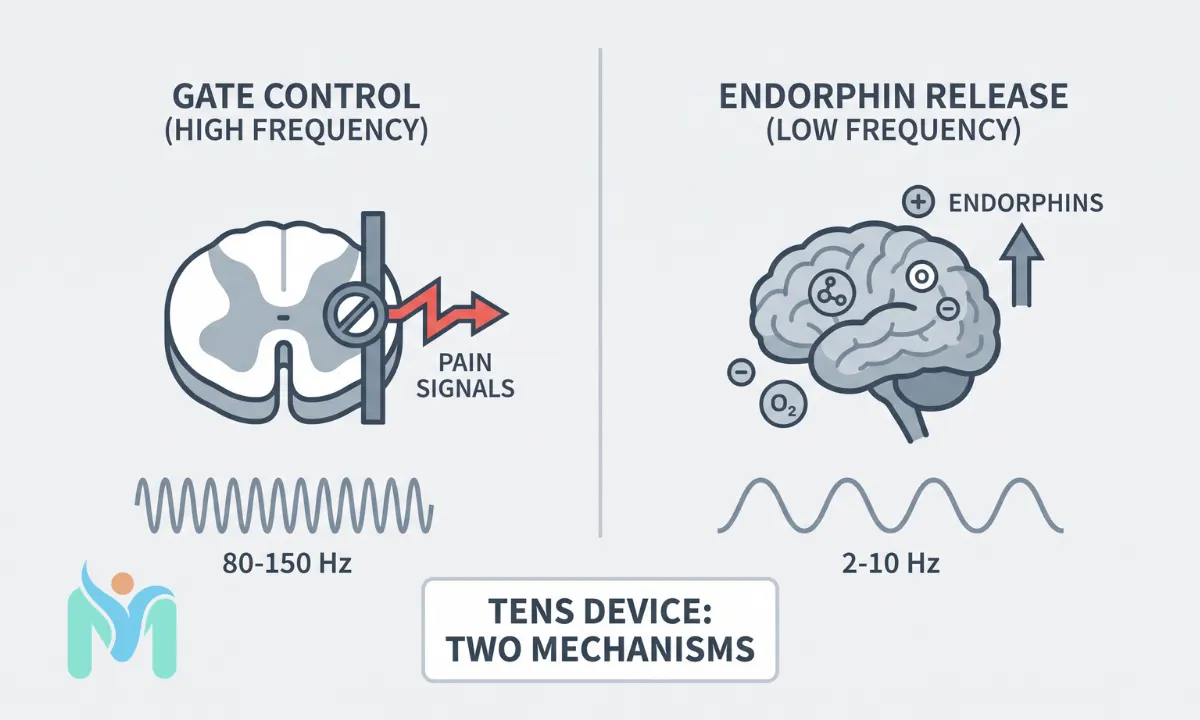
TENS doesn’t work through a single mechanism. Research by Sluka and Walsh, published in The Journal of Pain in 2003, identified 2 distinct neurophysiological pathways activated by TENS, each dependent on a different parameter profile. This distinction is the foundation of everything that follows.
The first is gate control analgesia, described in the landmark 1965 paper by Melzack and Wall in Science. High-frequency TENS (typically 80 to 150 Hz) preferentially activates large-diameter A-beta nerve fibres, which carry signals for touch and vibration. When these fibres fire, they suppress the transmission of pain signals from smaller C fibres and A-delta fibres at the level of the dorsal horn of the spinal cord (the posterior grey matter where incoming signals are processed and filtered before travelling to the brain). The gate, in effect, closes. Pain relief is felt quickly, often within a few minutes of switching the device on, but it depends on the stimulus being maintained. Turn the device off and the gate reopens.
The second pathway operates through endogenous opioid release. Low-frequency TENS (typically 2 to 10 Hz) applied at higher intensity activates A-delta fibres and produces rhythmic muscle contractions. This deeper stimulation triggers the release of the body’s own pain-relieving chemicals, including enkephalins and endorphins, from brainstem structures including the periaqueductal grey (PAG) (a region in the midbrain with a central role in descending pain modulation). The analgesia builds more slowly, typically over 20 to 30 minutes, but research by Sluka and Walsh suggests it can persist for some time after the session ends, making this pathway more suited to managing persistent background pain rather than pain during activity.
The same TENS device, programmed at 100 Hz and then reprogrammed at 4 Hz, is activating 2 completely different biological systems.
This is the clinical insight that most TENS guides don’t explain. Knowing which mechanism you’re targeting determines the parameter choices that follow.
Frequency: the most clinically significant TENS parameter
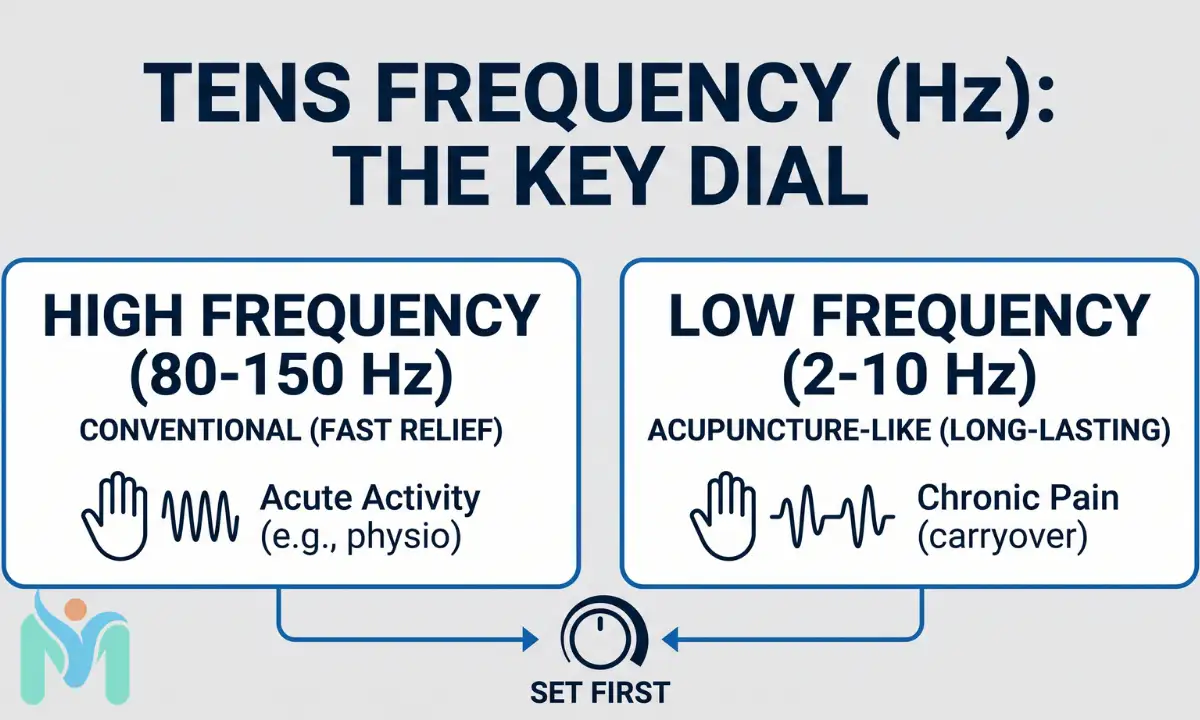
Frequency, measured in hertz (Hz), sets the number of electrical pulses per second and is the parameter most directly linked to the analgesic mechanism you’re activating. It’s the first dial to set, because everything else is calibrated around it.
High frequencies, between 80 and 150 Hz, define conventional TENS. At these rates, the stimulus feels like a consistent, comfortable tingling under the electrode pads. A-beta fibres respond preferentially at high frequencies, and the resulting gate control effect produces fast-onset pain relief. Because the analgesia depends on the ongoing electrical stimulus, conventional TENS is best suited to managing pain during a specific activity or period, such as mobilising after a musculoskeletal injury or getting through a physiotherapy session.
Low frequencies, between 2 and 10 Hz, define acupuncture-like TENS (AL-TENS). At these rates, the stimulus recruits A-delta fibres and, at adequate intensity, produces rhythmic muscle contractions that are visible through the skin. The analgesia takes longer to build, but evidence suggests it may carry over beyond the treatment session, which is why AL-TENS is often preferred for chronic or persistent pain management rather than acute activity-related relief.
TENS machines suitable for clinical or home use typically offer a frequency range from 1 to 200 Hz. For musculoskeletal pain and most acute pain applications, conventional settings between 80 and 100 Hz are the standard starting point. For persistent pain where a longer carryover effect is the priority and the person can tolerate the muscle response, lower-frequency settings between 2 and 5 Hz are more clinically appropriate.
Pulse width and intensity: controlling depth and dosage
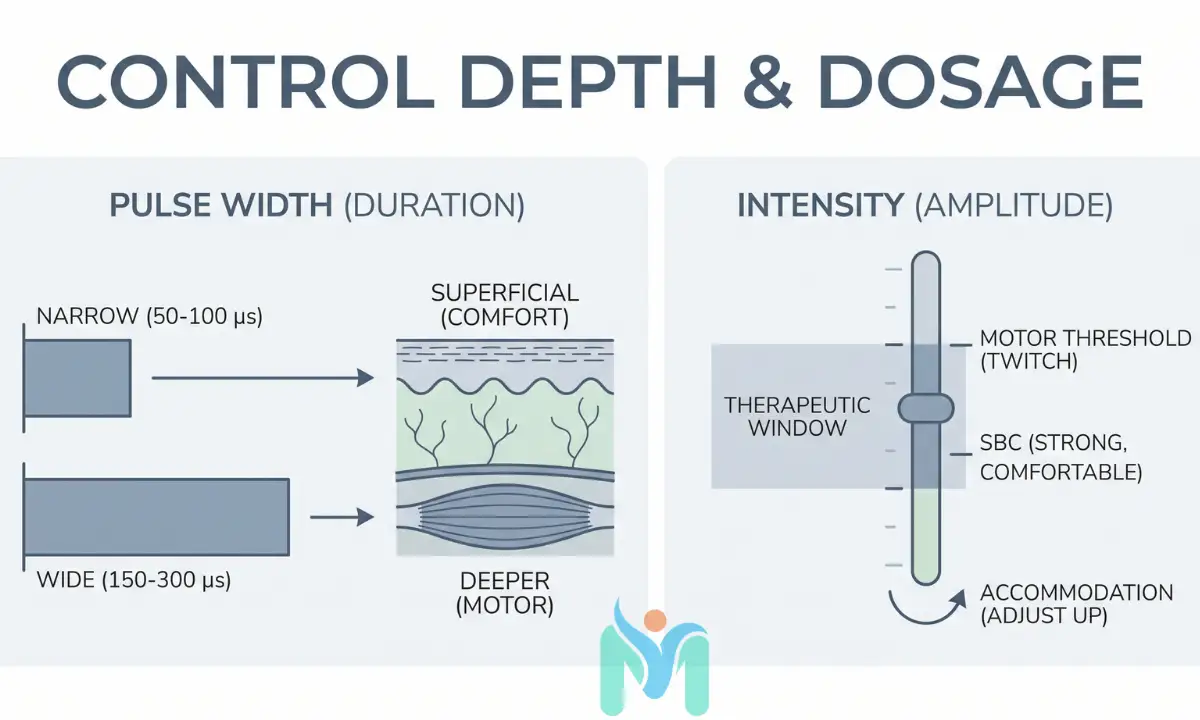
Pulse width (also called pulse duration) is the length of each individual electrical pulse, measured in microseconds (µs). Most clinical TENS devices offer pulse widths from approximately 50 µs to 250 µs or wider.
Narrower pulse widths in the range of 50 to 100 µs are more selective. They stimulate superficial, large-diameter A-beta fibres preferentially and produce a comfortable skin sensation with lower risk of discomfort. Wider pulse widths in the 150 to 300 µs range recruit a broader population of fibres, including deeper A-delta fibres, which contribute to both the motor response and the opioid analgesic pathway. For conventional TENS, pulse widths of 100 to 200 µs are typical. For AL-TENS, wider pulse widths help engage the fibres needed for motor activation and endogenous opioid release.
Pulse width and frequency interact directly. A high-frequency, narrow pulse-width combination keeps the stimulus superficial and comfortable, targeting the gate control pathway. A low-frequency, wide pulse-width combination penetrates deeper and recruits a different population of fibres, engaging an entirely different analgesic system. These 2 parameters work together, and optimising frequency without considering pulse width leaves the clinical picture incomplete.
Intensity, measured in milliamps (mA), controls the amplitude of the electrical current. The key concept is the therapeutic window: the range between too little current (sub-threshold, no clinical effect) and too much (pain or significant discomfort).
For conventional TENS, the target intensity is described clinically as strong but comfortable (SBC): clearly perceptible, strong enough to be actively felt, but not painful. The sensation should be obvious without being aversive. For AL-TENS, intensity is increased to motor threshold, the level at which visible muscle twitching occurs beneath the electrode pads. This is substantially stronger than SBC and some patients find it uncomfortable initially, though tolerance typically improves over the first few sessions.
A practical challenge with intensity is accommodation: the nervous system adapts to a repetitive electrical stimulus and the tingling sensation gradually fades during a session. This isn’t a device fault or a sign the treatment has stopped working. It’s a normal neurological response. Increasing intensity slightly to restore the sensation, or switching to a modulation mode that varies one or more parameters automatically during the session, effectively addresses this.
TENS modes compared: conventional, burst, and acupuncture-like TENS
TENS machines combine frequency, pulse width, and intensity into distinct operating modes. The 3 most clinically relevant are conventional TENS, acupuncture-like TENS, and burst mode. Understanding the difference between them, rather than treating the mode dial as an arbitrary option, lets you select the right parameter profile for the right clinical purpose.
| Mode | Frequency | Pulse width | Intensity | Primary mechanism | Onset of relief |
|---|---|---|---|---|---|
| Conventional TENS | 80–150 Hz | 50–200 µs | Strong but comfortable (non-painful) | Gate control via A-beta fibre activation | Fast (within minutes) |
| Acupuncture-like TENS (AL-TENS) | 2–10 Hz | 150–300 µs | Motor threshold (visible muscle twitch) | Endogenous opioid release via A-delta fibre and motor fibre activation | Slower (20–30 minutes) |
| Burst TENS | High-frequency internal bursts (e.g. 100 Hz) delivered at a low burst rate (2–4 bursts per second) | 150–250 µs | Motor threshold | Gate control and opioid release | Moderate |
Burst TENS delivers packets of high-frequency pulses at a low repetition rate, producing a rhythmic muscle contraction with each burst. The high internal frequency activates A-beta fibres within each burst, while the low burst rate engages the opioid analgesic pathway. Some clinicians use burst mode as a bridge for patients who want the longer carryover effect of AL-TENS but find the continuous motor threshold intensity difficult to tolerate, as burst TENS can feel more manageable at equivalent analgesic intensities.
Modulation mode, available on many modern TENS devices, automatically cycles one or more parameters through a range during the session. This is not a distinct analgesic mechanism. It’s a practical strategy to reduce accommodation and maintain the perceived sensation without requiring the user to manually adjust intensity throughout a session.
How should I choose TENS settings for my type of pain?
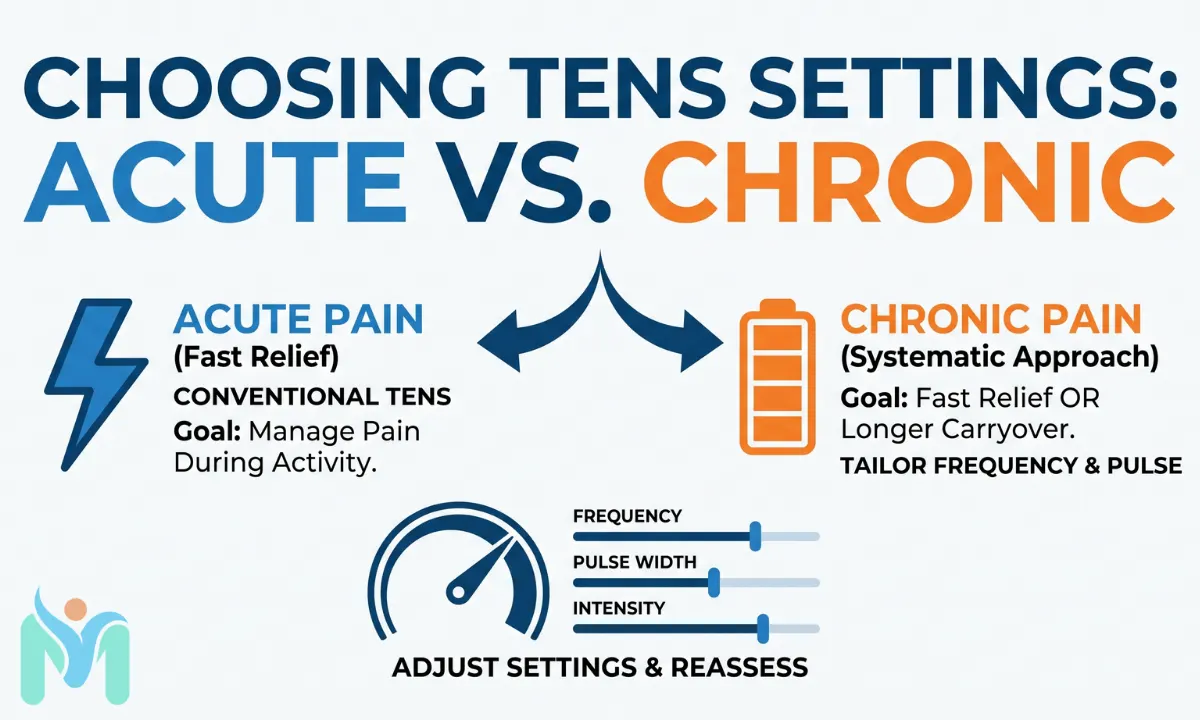
The honest answer is that choosing TENS settings well requires understanding both the physiology and the limitations of the evidence, because they don’t always point in the same direction.
For acute pain, conventional TENS is typically the first choice. The fast onset of gate control analgesia makes it well matched to managing pain during movement or activity, such as mobilising after a musculoskeletal injury or reducing procedural discomfort. Most clinicians begin with a frequency of 80 to 100 Hz, a pulse width of 100 to 200 µs, and intensity increased to a strong but comfortable level. Electrode placement matters too: for local pain, pads are positioned over or immediately around the painful area; for referred or neuropathic pain, a dermatomal pattern following the distribution of the involved nerve is more appropriate.
For chronic pain, approaching parameter selection systematically improves both consistency and the ability to evaluate whether the treatment is working. Most clinicians follow this sequence:
- Identify the primary goal: fast-onset relief during activity (gate control pathway) or longer carryover effect between activities (opioid pathway). This determines the frequency range to start with.
- Set frequency: 80 to 100 Hz for conventional TENS; 2 to 5 Hz for AL-TENS.
- Set pulse width: 100 to 200 µs for conventional TENS; 150 to 300 µs for AL-TENS.
- Increase intensity slowly to the appropriate therapeutic level: strong but comfortable for conventional TENS; motor threshold (visible twitch) for AL-TENS.
- Set session duration: 20 to 60 minutes is the typical clinical range, adjusted to the patient’s tolerance and response.
- Reassess after the first 2 to 3 sessions. Adjust one parameter at a time, not all simultaneously, so you can identify what is and isn’t contributing to the response.
The evidence base for TENS in chronic pain is real but limited. A 2008 Cochrane review by Nnoaham and Kumbang on TENS for chronic pain found that while some trials showed benefit, the overall evidence was insufficient to draw firm conclusions, largely due to inconsistent parameter reporting and methodological limitations across studies. A separate 2008 Cochrane review by Khadilkar and colleagues on TENS for chronic low back pain reached similar conclusions. A 2009 Cochrane review by Rutjes and colleagues on electrostimulation for knee osteoarthritis also found the evidence insufficient to support firm recommendations. The 2021 NICE guideline NG193 on chronic primary pain does not recommend TENS for this condition, citing insufficient evidence of benefit over placebo.
This is clinically important context, particularly for physiotherapy students setting patient expectations. It doesn’t mean TENS is ineffective for all individuals with chronic pain. It means the trial evidence hasn’t yet reached the quality threshold needed for a positive guideline recommendation, and that individual response must be assessed early rather than assumed. For conditions with a clear neuropathic component, low-frequency or burst TENS is more mechanistically appropriate given the different analgesic pathway involved, though the evidence for specific neuropathic subtypes remains limited.
When TENS should not be used: contraindications and safety
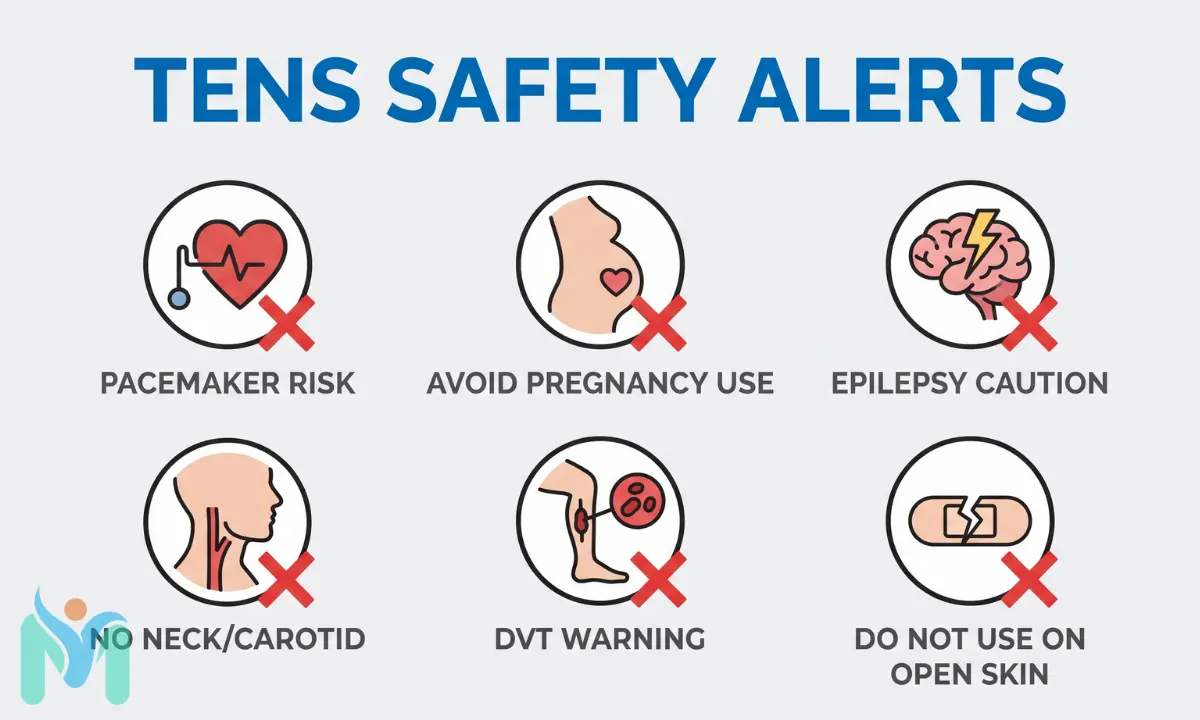
TENS is safe for most people when applied correctly, but there are well-established contraindications that must be understood before any application. These apply across all TENS modes and parameter combinations:
- Cardiac pacemaker or implanted electronic device: Electrical current from TENS can interfere with pacemaker function and other implanted devices. TENS is contraindicated in anyone with a cardiac pacemaker or implantable cardioverter-defibrillator unless under close specialist medical supervision.
- Pregnancy: TENS should not be applied over the abdomen or lower back during the first trimester. It is sometimes used in later pregnancy for labour pain management, but only under direct clinical supervision.
- Epilepsy: Electrode placement over the head or anterior neck in people with epilepsy carries a risk of triggering seizure activity and should be avoided.
- Over the carotid sinus: Electrode placement over the anterior neck near the carotid sinus can trigger cardiac reflex responses and is contraindicated in all cases.
- Active deep vein thrombosis (DVT): TENS applied over a limb with a suspected or confirmed DVT is contraindicated due to the potential risk of clot disruption.
- Malignant tissue: TENS should not be applied directly over a site of known or suspected malignancy.
- Damaged or broken skin: Electrode pads placed over open wounds, infected tissue, or severely compromised skin can worsen the condition. Always place pads on intact, healthy skin.
According to NHS guidance on TENS, if you experience any sharp, burning, or worsening pain under the electrode pads at any intensity setting, switch the device off immediately and seek advice from a physiotherapist or GP before using it again.
What the parameters tell you about TENS
TENS parameters are clinical decisions, not dial settings. Frequency determines which analgesic mechanism you’re activating. Pulse width controls the depth and selectivity of the stimulus. Intensity sets the dosage. Together, they form a coherent treatment choice grounded in neurophysiology, not trial and error.
The evidence for TENS is more nuanced than either its advocates or its critics tend to acknowledge. The Cochrane reviews highlight real methodological limitations in the trial evidence, and the 2021 NICE guideline’s caution around chronic primary pain reflects those limitations honestly. That context matters for clinical practice. Using TENS well means knowing what you’re targeting, starting with a parameter profile matched to the mechanism, and assessing response early enough to change course if needed.
For a physiotherapy student, the deeper lesson is this: the same device, with different parameters, is genuinely a different intervention. A patient who didn’t respond to TENS at one set of parameters may respond well to another. The most clinically useful question after a failed TENS trial is not “did TENS help?” but “which parameters were used, and did they match the mechanism the condition required?” That question is where good electrotherapy practice begins.
Consult your doctor or a qualified physiotherapist before starting any new exercise programme, especially if you have an existing injury or medical condition.
Frequently Asked Questions (FAQs)
The best TENS frequency depends on the type of analgesia needed. High-frequency TENS at 80 to 150 Hz activates gate control analgesia through large A-beta nerve fibres and produces fast-onset relief suited to acute or activity-related pain. Low-frequency TENS at 2 to 10 Hz stimulates endogenous opioid release and takes longer to work but may produce longer-lasting relief, making it more appropriate for persistent pain. Most clinicians start with conventional settings at 80 to 100 Hz and adjust based on response.
Pulse width, also called pulse duration, is the length of each individual electrical pulse measured in microseconds (µs). Narrower pulse widths of 50 to 100 µs stimulate superficial, large-diameter A-beta nerve fibres and feel more comfortable on the skin. Wider pulse widths of 150 to 300 µs recruit a broader range of fibres, including deeper A-delta fibres associated with the opioid analgesic pathway. For conventional TENS, pulse widths between 100 and 200 µs are typical. For acupuncture-like TENS, wider settings of 150 to 300 µs are appropriate.
For conventional TENS, you should feel a strong, consistent tingling under the electrode pads at the intensity you’ve set. If that sensation fades after 10 to 15 minutes, this is accommodation, a normal neurological response to a repetitive stimulus. Increase the intensity slightly to restore the sensation, or switch to a modulation mode if your device offers one. For acupuncture-like TENS, you should also see visible rhythmic muscle twitching under the pads at the target intensity. No sensation means the intensity is too low or the pads aren’t making proper contact.
There is no set limit on daily TENS use for most people, and many physiotherapists recommend using the device as often as the person needs it for pain management. Sessions typically last 20 to 60 minutes. According to NHS guidance on TENS, the device can be used as often as required without risk of dependency or tissue damage from the electrical current, provided it is used correctly and contraindications have been ruled out. Always discuss frequency of use with your physiotherapist or GP if you have an existing medical condition.
TENS should not be used by anyone with a cardiac pacemaker or implanted electronic device. It must not be applied over the abdomen in early pregnancy, over the anterior neck near the carotid sinus, over a limb with suspected deep vein thrombosis, over malignant tissue, or on broken or infected skin. People with epilepsy should avoid electrode placement on the head or neck. These contraindications reflect risks of electrical interference or adverse tissue response and apply across all TENS modes and parameter settings. Always confirm contraindications with a healthcare professional before starting TENS.
Conventional TENS uses high frequencies of 80 to 150 Hz at a strong but comfortable intensity, activating large A-beta nerve fibres through the gate control mechanism and producing fast-onset analgesia that depends on the device being switched on. Acupuncture-like TENS (AL-TENS) uses low frequencies of 2 to 10 Hz at motor threshold intensity, activating A-delta fibres and producing endogenous opioid release. AL-TENS takes longer to work but may produce analgesia that persists after the session ends. Research by Sluka and Walsh in The Journal of Pain (2003) describes both pathways in detail.
The 2021 NICE guideline NG193 on chronic primary pain found insufficient evidence to recommend TENS as a treatment, noting that many clinical trials of TENS have methodological limitations including inconsistent parameter reporting. This makes it difficult to draw firm conclusions about effectiveness compared to placebo. This does not mean TENS is ineffective for all individuals with chronic pain. It means the evidence has not met the quality threshold NICE requires for a positive recommendation. A qualified physiotherapist can assess whether a time-limited TENS trial is appropriate for a specific person’s situation and condition.
References
- Melzack R, Wall PD. “Pain mechanisms: a new theory.” Science. 1965;150(3699):971–979. DOI: 10.1126/science.150.3699.971. PMID: 5320816. URL: https://pubmed.ncbi.nlm.nih.gov/5320816/. Evidence Level: 6.
- Sluka KA, Walsh D. “Transcutaneous electrical nerve stimulation: basic science mechanisms and clinical effectiveness.” The Journal of Pain. 2003;4(3):109–121. PMID: 14622708. URL: https://pubmed.ncbi.nlm.nih.gov/14622708/. Evidence Level: 5.
- Nnoaham KE, Kumbang J. “Transcutaneous electrical nerve stimulation (TENS) for chronic pain.” Cochrane Database of Systematic Reviews. 2008;(3):CD003222. DOI: 10.1002/14651858.CD003222.pub2. PMID: 18843657. URL: https://pubmed.ncbi.nlm.nih.gov/18843657/. Evidence Level: 2.
- Khadilkar A, Odebiyi DO, Brosseau L, Wells GA. “Transcutaneous electrical nerve stimulation (TENS) versus placebo for chronic low-back pain.” Cochrane Database of Systematic Reviews. 2008;(4):CD003008. DOI: 10.1002/14651858.CD003008.pub3. PMID: 18843638. URL: https://pubmed.ncbi.nlm.nih.gov/18843638/. Evidence Level: 2.
- Rutjes AW, Nüesch E, Sterchi R, et al. “Transcutaneous electrostimulation for osteoarthritis of the knee.” Cochrane Database of Systematic Reviews. 2009;(4):CD002823. DOI: 10.1002/14651858.CD002823.pub2. PMID: 19821296. URL: https://pubmed.ncbi.nlm.nih.gov/19821296/. Evidence Level: 2.
- National Institute for Health and Care Excellence. “Chronic pain (primary and secondary) in over 16s: assessment of all chronic pain and management of chronic primary pain.” NICE Guideline NG193. 2021. URL: https://www.nice.org.uk/guidance/ng193. Evidence Level: 1.
- NHS. “TENS (transcutaneous electrical nerve stimulation).” NHS Conditions. URL: https://www.nhs.uk/conditions/transcutaneous-electrical-nerve-stimulation-tens/ (2022). Evidence Level: 7.