


If you’ve been handed a physiotherapy exercise sheet and wondered why it specifies 3 sets of 12 rather than 2 sets of 20, or why the same programme looks noticeably different 6 weeks later, those parameters aren’t chosen at random. Every element (how often you train, how hard you work, how long you rest, and when the programme advances) follows a clinical framework. Understanding that framework changes how you approach exercise, whether you’re designing it for patients or following it yourself.
What Is Exercise Prescription in Physiotherapy?
Exercise prescription in physiotherapy is the structured process of designing a movement-based programme using specific, measurable variables to drive a targeted biological response. Unlike a general recommendation to stay active, it assigns a precise dose of exercise, calibrated to the patient’s condition, tissue healing stage, fitness level, and treatment goals.
Exercise prescription in physiotherapy uses the FITT-VP framework to set six key variables: Frequency (how often), Intensity (how hard), Time (session duration), Type (exercise mode), Volume (total training load), and Progression (how the programme advances over time). Physiotherapists calibrate each variable to the patient’s condition, tissue healing stage, and clinical goals, creating a programme designed to drive adaptation without causing harm.
According to the American Physical Therapy Association’s Guide to Physical Therapist Practice 3.0, therapeutic exercise is one of the primary interventions a physiotherapist deploys across the rehabilitation continuum. Effective delivery depends entirely on accurate prescription of dosage parameters. A programme dosed too lightly produces no meaningful adaptation. A programme dosed too aggressively for the tissue’s current state causes harm. Both are clinical errors, and both result from imprecise prescription rather than poor exercise selection.
In practice, most patients assume that the exercises themselves are the variable that matters most. What I see most often in clinic is that the dosage (the specific combination of frequency, intensity, volume, and progression) determines whether the same exercise produces meaningful change or no change at all.
The FITT-VP Framework: How Physiotherapists Structure Every Programme

The FITT-VP model was formalised by the American College of Sports Medicine (ACSM) and forms the structural backbone of exercise prescription across clinical and rehabilitation settings. Each letter represents one variable that a physiotherapist adjusts to match the programme to the patient’s needs, goals, and current biological capacity.
| Variable | Definition | Clinical Example |
|---|---|---|
| Frequency | How often the exercise is performed | Resistance training 3 days per week |
| Intensity | How demanding the exercise is | 70% of 1RM, or RPE 13 on the Borg scale |
| Time | Duration of each session or bout | 30-minute session, 45-second hold times |
| Type | The category or mode of exercise | Resistance, aerobic, or proprioceptive training |
| Volume | Total training load (sets x reps x load) | 3 sets x 12 repetitions x 15 kg |
| Progression | Systematic increase in training demand | Adding 5% load when target reps are exceeded for 2 consecutive sessions |
The six variables interact constantly. Increasing volume (by adding sets or repetitions) while also raising intensity creates a programme that accumulates demand faster than the tissue can absorb. Increasing frequency without adequate recovery has the same effect. A physiotherapist calibrating a programme isn’t adjusting one dial. They’re adjusting all 6 simultaneously, reading how changes in one variable affect the tolerable range of the others.
A 2011 ACSM Position Stand by Garber and colleagues, published in Medicine & Science in Sports & Exercise, confirmed that appropriate prescription across all six FITT-VP variables produces measurable improvements in cardiorespiratory fitness, musculoskeletal strength, and neuromuscular function. Generalised activity advice, without structured dosing, does not reliably achieve the same outcomes.
The FITT-VP framework is the evidence-based model physiotherapists use to structure exercise prescriptions across all rehabilitation settings. It defines 6 prescription variables: Frequency, Intensity, Time, Type, Volume, and Progression. According to the American College of Sports Medicine’s 11th edition guidelines, systematically adjusting these 6 variables is what distinguishes a clinically designed rehabilitation programme from general activity guidance.
Frequency: How Often Is Often Enough?
The American College of Sports Medicine’s guidelines recommend training each muscle group 2-4 days per week, with at least 48 hours of recovery between sessions targeting the same area. But in rehabilitation, frequency is more nuanced than a simple days-per-week figure, and the common belief that more sessions always mean faster recovery is one that clinical experience consistently challenges.
The 48-hour gap between resistance training sessions isn’t rest for its own sake. After resistance exercise, muscle protein synthesis rises sharply and remains elevated for roughly 24-48 hours before returning to baseline. Training again during that window reinforces the adaptive signal. Training too early, before sufficient recovery, accumulates mechanical stress without the corresponding tissue remodelling response. That distinction is why recovery is a prescribed element of the programme, not an absence of one.
For aerobic exercise, the World Health Organization’s 2020 physical activity guidelines recommend adults accumulate at least 150-300 minutes of moderate-intensity or 75-150 minutes of vigorous-intensity activity per week. Both ACSM and WHO acknowledge this is best distributed across multiple sessions rather than condensed into fewer, longer bouts.
In rehabilitation specifically, frequency is shaped by tissue type and healing phase. Tendons respond to load on a different timescale than muscle. Daily loading of a healing tendon can be appropriate in early tendinopathy rehabilitation, where the goal is to manage load tolerance through consistent mechanical stimulation. Muscle tissue typically needs the 48-hour recovery window. A precise prescription specifies frequency separately for different tissue targets rather than applying one number across the board.
In practice, many patients increase their training frequency when progress stalls, when the actual limiting factor is insufficient recovery between sessions. Reducing frequency and improving session quality often produces more progress than adding sessions.
Exercise frequency in physiotherapy rehabilitation depends on the tissue type, healing phase, and type of exercise prescribed. The American College of Sports Medicine recommends training each muscle group 2-4 days per week with at least 48 hours of recovery between sessions. For aerobic training, the World Health Organization’s 2020 guidelines recommend 150-300 minutes of moderate activity weekly, distributed across multiple sessions rather than concentrated into fewer bouts.
What Does Exercise Intensity Mean, and How Is It Measured?
Intensity is the most clinically complex variable in exercise prescription. Too little produces no physiological adaptation. Too much, particularly in the early stages of tissue healing, risks re-injury or a prolonged inflammatory response. Getting intensity right requires selecting the measurement tool that fits both the exercise type and the patient’s current clinical state.
| Measure | Scale | Typical Rehab Target | Best Used For |
|---|---|---|---|
| % 1 Repetition Maximum (%1RM) | 0-100% | 60-70% novice; 70-80% intermediate | Resistance training |
| Borg RPE Scale | 6-20 | 12-14 (moderate-to-hard) | All exercise types |
| Borg CR10 Scale | 0-10 | 4-6 (somewhat hard to hard) | All exercise types |
| % Maximum Heart Rate (%HRmax) | 0-100% | 50-70% (moderate aerobic) | Aerobic exercise |
| Numeric Pain Rating Scale (NPRS) | 0-10 | 0-3/10 during exercise | Acute and subacute rehabilitation |
For resistance training, intensity is most precisely expressed as a percentage of 1 Repetition Maximum (1RM), the heaviest load an individual can lift once through the full range of motion with correct technique. According to the ACSM Position Stand by Garber and colleagues (2011), novice exercisers typically work at 60-70% 1RM, intermediate exercisers at 70-80%, and those training for maximal strength above 80% 1RM.
When 1RM testing isn’t safe or practical, which is common in early rehabilitation, the Borg Rating of Perceived Exertion (RPE) scale provides a validated alternative. Developed by Gunnar Borg and published in Medicine & Science in Sports & Exercise in 1982, the original scale runs from 6 to 20 and correlates with heart rate when multiplied by 10. A modified CR10 version (0-10) is often preferred in clinical settings for its intuitive range. Targeting an RPE of 12-14 on the 6-20 scale, or 4-6 on the CR10, represents a moderate-to-hard effort sufficient to drive adaptation while remaining manageable for most patients across healing stages.
In musculoskeletal rehabilitation, pain monitoring serves as a third intensity guide. Most clinical frameworks accept pain of 0-3 out of 10 on the Numeric Pain Rating Scale as a safe working threshold during exercise. Pain above 3/10, or pain that does not return to pre-exercise baseline within 24 hours, indicates the load exceeded the tissue’s current tolerance.
The distinction between working pain and warning pain matters here. Working pain is a mild, predictable ache that fades within minutes of stopping. Warning pain is sharp, sudden, or worsening during the exercise itself. One reflects appropriate tissue challenge. The other is a signal to stop and reassess the dose.
Progressive Overload and the SAID Principle
Physiotherapists change your exercises when your body has already adapted to the current load, and that adaptation is a sign of success, not stagnation. Understanding why this happens requires two principles that underpin every rehabilitation programme: the SAID principle and progressive overload.
SAID stands for Specific Adaptation to Imposed Demands. The body adapts specifically to the type of stress placed on it, which means a runner returning from a knee injury needs progressive loading that approximates the mechanical demands of running. General lower-limb strengthening in isolation builds general lower-limb strength, not the multi-joint, high-speed neuromuscular coordination that running requires. Exercise selection and progression must replicate the target demands, or the adaptation stops short of the functional goal.
SAID also means that a fixed training stimulus eventually produces a fixed, and then diminishing, response. As tissue adapts to a given load, that load stops generating a meaningful biological signal.
Every time your physiotherapist advances your programme, it means the current dose worked: your body adapted, and the previous load is no longer sufficient to drive further change.
According to a 2004 review by Kraemer and Ratamess in Medicine & Science in Sports & Exercise, progression in resistance training should occur when an individual can exceed their target repetitions for 2 consecutive sessions. A load increase of 2-10% is standard, large enough to provide a new stimulus but small enough to avoid injury.
Khan and Scott, writing in the British Journal of Sports Medicine in 2009, described the biological basis of this process as mechanotherapy: mechanical forces applied to tissue activate cellular signalling pathways that promote collagen synthesis, muscle protein synthesis, and bone remodelling. Appropriate progressive loading doesn’t just maintain healing tissue. It actively accelerates the remodelling process.
A 2017 systematic review by Schoenfeld and colleagues found that meaningful hypertrophy and strength gains occur across a broad range of loads and repetition ranges, provided total training volume is sufficient. The clinical implication is direct: patients who cannot tolerate high loads in early rehabilitation (due to pain, swelling, or tissue fragility) can still build meaningful strength through higher-repetition, lower-load work. Progression, in these cases, involves gradually shifting the load-to-repetition balance as tissue resilience develops.
Physiotherapists change exercises as part of progressive overload: the principle that training demand must increase over time to continue driving physiological adaptation. When the body has adapted to a specific load, that load no longer produces meaningful change. According to a 2004 review by Kraemer and Ratamess in Medicine & Science in Sports & Exercise, load should increase by 2-10% when target repetitions are exceeded for 2 consecutive sessions.
Why Tissue Healing Phase Changes the Exercise Rules
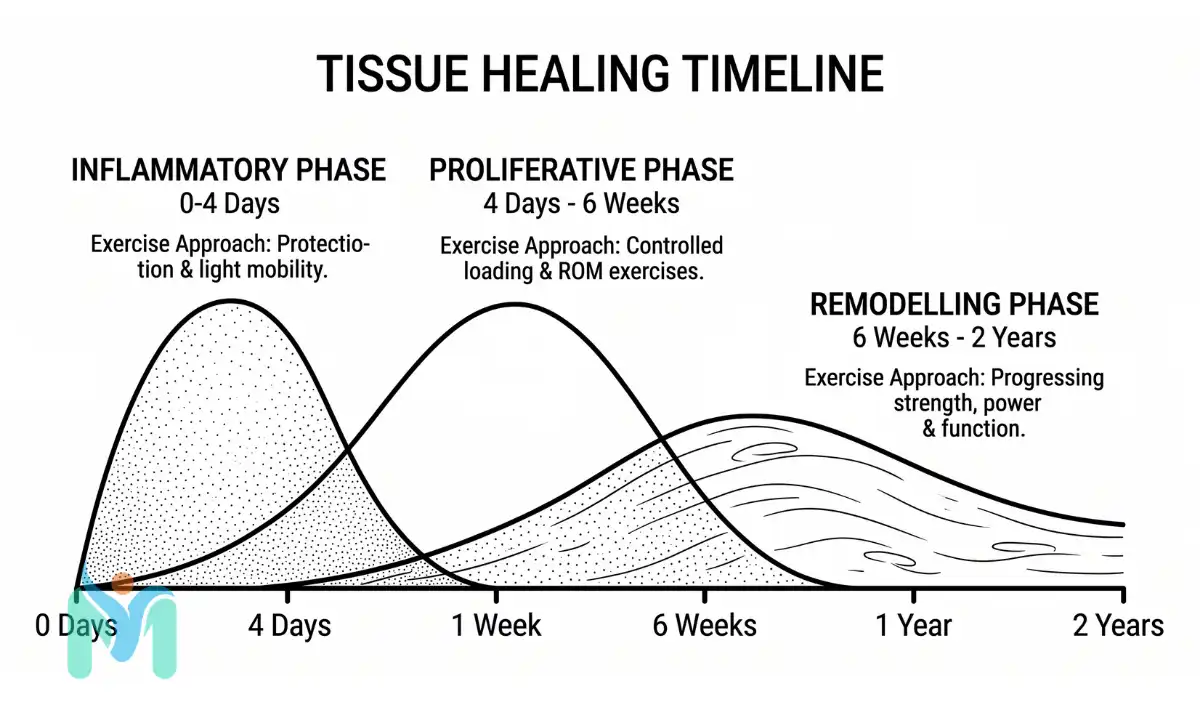
A clinically sound exercise prescription that ignores the stage of tissue healing will cause harm regardless of how well it applies the FITT-VP principles. The biological environment of a tissue 3 days post-injury is fundamentally different from the same tissue at 8 weeks, and the prescription variables must reflect that difference at every stage.
Tissue healing broadly follows 3 overlapping sequential phases, each with a distinct exercise approach:
- Inflammatory phase (approximately 0-4 days post-injury): The priority is protection and pain management. Where exercise is appropriate at all, it is gentle and pain-free, focused on maintaining circulation and preventing disuse rather than driving adaptation. High-intensity loading during this phase worsens the inflammatory response and delays the transition to the repair phase.
- Proliferative (repair) phase (approximately 4 days to 6 weeks): New collagen is deposited and the tissue begins to regain structural integrity. Progressive loading starts here, at intensity and volume calibrated to tissue tolerance. Khan and Scott (2009) identified this phase as the window in which mechanical loading most actively directs collagen alignment along functional stress lines, making appropriate loading essential rather than optional.
- Remodelling phase (approximately 6 weeks to 2 years): Collagen matures and organises along lines of mechanical demand. Progressive overload, higher intensities, and functional training that replicates the patient’s activity demands become appropriate at this stage. Cook and Purdam, writing in the British Journal of Sports Medicine (2009), demonstrated that insufficient loading during the remodelling phase leaves tissue mechanically inferior and vulnerable to re-injury.
The practical implication challenges a common instinct: early exercise, dosed correctly, is often beneficial rather than risky. Excessive caution that delays loading into the proliferative and remodelling phases is as much a clinical error as loading too aggressively in the inflammatory phase. Both interrupt the adaptation process, just at different points in the healing timeline.
How Do Physiotherapists Know When to Progress a Programme?
Progression decisions follow clinical signals, not calendars. Time since injury provides a rough biological guide, but clinical readiness determines when the prescription advances. Progressing too early risks setback. Waiting too long leaves available adaptive capacity untapped.
Physiotherapists typically look for a consistent pattern of signals across multiple sessions before advancing any element of the programme:
- Target repetitions and sets completed with controlled technique and no compensatory movement patterns for at least 2 consecutive sessions
- Pain during exercise remaining at or below 3/10 on the NPRS throughout each session
- Pain returning to pre-exercise baseline within 24 hours of completing the session
- No meaningful increase in swelling or delayed onset muscle soreness beyond what is expected and resolves normally
- Improved movement confidence reflected in reduced hesitation and better quality of movement through the task
A 2003 meta-analysis by Rhea and colleagues, published in Medicine & Science in Sports & Exercise, found that optimal training frequency differs between trained and untrained individuals. Untrained individuals make strength gains at 3 days per week. More conditioned individuals require higher frequencies to continue progressing. The same adaptive logic applies in rehabilitation: as physical capacity develops through the programme, the prescription that produced early gains becomes insufficient, and the dose must evolve to match.
When the progression signals are absent, maintaining the current dose is the correct clinical response. When a patient repeatedly falls short of target repetitions or reports elevated pain following sessions, the programme may need to be temporarily regressed. Progression in rehabilitation is not a straight line, and a physiotherapist who monitors these signals is calibrating the dose in real time, not following a fixed schedule.
Physiotherapists advance an exercise programme when a patient demonstrates consistent clinical readiness: completing target repetitions with good technique for 2 consecutive sessions, pain staying at or below 3/10 during exercise, and symptoms returning to baseline within 24 hours. These signals confirm the tissue has adapted to the current load and is ready for greater demand. Progressing before these signals are present increases the risk of setback rather than accelerating recovery.
Frequently Asked Questions (FAQs)
FITT-VP is the evidence-based model physiotherapists use to structure exercise prescriptions. It defines 6 key variables: Frequency (sessions per week), Intensity (exercise demand), Time (session duration), Type (exercise mode), Volume (total training load), and Progression (how the programme advances). According to ACSM guidelines, systematically adjusting these 6 variables is what allows exercise to drive targeted physiological adaptation while remaining clinically appropriate for the patient’s current condition and healing stage.
This depends on the type of exercise, the tissue involved, and your stage of recovery. ACSM guidelines recommend training each muscle group 2-4 days per week with at least 48 hours of recovery between sessions targeting the same area. Some conditions, particularly early-stage tendinopathy, may involve daily loading protocols. Others require longer recovery windows. Your physiotherapist will specify frequency based on your individual clinical presentation rather than a single standardised rule.
Several validated tools are used depending on the exercise type and clinical stage. For resistance training, intensity is most precisely expressed as a percentage of 1 Repetition Maximum (1RM). When 1RM testing isn’t safe or practical, the Borg Rating of Perceived Exertion scale, validated by Borg in 1982 and widely used in clinical settings, rates effort on a scale of 6 to 20. In acute rehabilitation, pain scores of 0-3/10 on the Numeric Pain Rating Scale serve as an additional real-time intensity guide.
Progressive overload is the principle that training demand must increase over time for physiological adaptation to continue. When the body has adapted to a specific load, that load no longer produces meaningful change. This principle applies directly in rehabilitation: as tissue heals and becomes more resilient, the exercise programme must advance. Kraemer and Ratamess (2004) recommend a 2-10% load increase when target repetitions are exceeded for 2 consecutive sessions, offering a practical clinical progression benchmark.
SAID stands for Specific Adaptation to Imposed Demands: the body adapts specifically to the type of stress placed upon it. In physiotherapy, this means exercise selection and progression must replicate the mechanical demands of the patient’s functional goals. A patient returning to running needs progressive loading that approximates the forces of running. General lower-limb strengthening alone develops general strength, not the task-specific neuromuscular patterns required for safe return to sport or activity.
For resistance exercises targeting the same muscle group, daily training without adequate recovery can impair adaptation. Muscle protein synthesis requires approximately 24-48 hours following resistance exercise, which is why ACSM guidelines recommend at least 48 hours between sessions targeting the same group. However, flexibility exercises, gentle mobility work, and certain tendon-loading protocols are often prescribed for daily use. Your physiotherapy programme will specify which exercises need rest days and which can be performed more frequently.
What Good Exercise Prescription Actually Looks Like
The word “prescription” implies precision, and that precision is the point. Exercise prescription in physiotherapy is not a default set of movements grouped by condition. It’s a calibrated dose, adjusted in real time as the patient’s biology responds. Frequency, intensity, time, type, volume, and progression are the 6 variables that determine whether that dose is therapeutic or counterproductive.
The frameworks described here, and explored in greater depth across MystPhysio.com’s condition-specific rehabilitation guides, don’t produce rigid rules. They produce a structured way of thinking about exercise dosage that can be applied across conditions, populations, and clinical settings. That’s the value of understanding the principles rather than memorising specific parameters: knowing what each variable does, why it matters, and how to adjust it when the patient in front of you doesn’t match the textbook.
One principle that rarely gets named directly in clinical education is that adherence is the great equaliser in rehabilitation outcomes. Physiotherapy literature consistently identifies adherence as the strongest predictor of rehabilitation success. A theoretically ideal prescription abandoned after 2 weeks produces less benefit than a well-dosed programme completed consistently over 8. This means a prescription must be not only clinically correct but feasible and sustainable for the specific person receiving it. Designing to biological optimum without accounting for the person’s life, confidence, and pain experience isn’t good prescribing. It’s just good theory.
Consult your doctor or a qualified physiotherapist before starting any new exercise programme, especially if you have an existing injury or medical condition.
References
- American College of Sports Medicine. ACSM’s Guidelines for Exercise Testing and Prescription. 11th ed. Wolters Kluwer; 2022. URL: https://www.acsm.org/education-resources/books/guidelines-exercise-testing-prescription.
- American Physical Therapy Association. Guide to Physical Therapist Practice 3.0. APTA; 2014. URL: https://guide.apta.org.
- Garber CE, Blissmer B, Deschenes MR, et al. “Quantity and quality of exercise for developing and maintaining cardiorespiratory, musculoskeletal, and neuromotor fitness in apparently healthy adults: guidance for prescribing exercise.” Medicine & Science in Sports & Exercise. 2011;43(7):1334-1359. DOI: 10.1249/MSS.0b013e318213fefb. PMID: 21694556. URL: https://pubmed.ncbi.nlm.nih.gov/21694556.
- World Health Organization. WHO Guidelines on Physical Activity and Sedentary Behaviour. WHO; 2020. URL: https://www.who.int/publications/i/item/9789240015128.
- Borg GA. “Psychophysical bases of perceived exertion.” Medicine & Science in Sports & Exercise. 1982;14(5):377-381. PMID: 7154893. URL: https://pubmed.ncbi.nlm.nih.gov/7154893.
- Khan KM, Scott A. “Mechanotherapy: how physical therapists’ prescription of exercise promotes tissue repair.” British Journal of Sports Medicine. 2009;43(4):247-251. DOI: 10.1136/bjsm.2008.054239. PMID: 19244270. URL: https://pubmed.ncbi.nlm.nih.gov/19244270.
- Kraemer WJ, Ratamess NA. “Fundamentals of resistance training: progression and exercise prescription.” Medicine & Science in Sports & Exercise. 2004;36(4):674-688. DOI: 10.1249/01.MSS.0000121945.36635.61. PMID: 15064596. URL: https://pubmed.ncbi.nlm.nih.gov/15064596.
- Schoenfeld BJ, Grgic J, Ogborn D, Krieger JW. “Strength and hypertrophy adaptations between low- vs. high-load resistance training: a systematic review and meta-analysis.” Journal of Strength and Conditioning Research. 2017;31(12):3508-3523. DOI: 10.1519/JSC.0000000000002200. PMID: 28834797. URL: https://pubmed.ncbi.nlm.nih.gov/28834797.
- Cook JL, Purdam CR. “Is tendon pathology a continuum? A pathology model to explain the clinical presentation of load-induced tendinopathy.” British Journal of Sports Medicine. 2009;43(6):409-416. DOI: 10.1136/bjsm.2008.086983. PMID: 18812414. URL: https://pubmed.ncbi.nlm.nih.gov/18812414.
- Rhea MR, Alvar BA, Burkett LN, Ball SD. “A meta-analysis to determine the dose response for strength development.” Medicine & Science in Sports & Exercise. 2003;35(3):456-464. DOI: 10.1249/01.MSS.0000053727.63505.D4. PMID: 12618577. URL: https://pubmed.ncbi.nlm.nih.gov/12618577.