


Patients often walk into clinic with the same question: “How do I build strength without hurting myself again?” It is one of the most common concerns I hear, especially after a knee injury, a prolonged hospital stay, or a long period of inactivity. The answer, almost always, begins with a structured resistance training programme, and the Macqueen Method is one of the most clinically relevant frameworks for doing exactly that.
The Macqueen Method is a form of Progressive Resistance Exercise (PRE) developed by I.J. Macqueen in 1954. PRE, broadly speaking, is a system of strength training where the load placed on a muscle is gradually increased over time as the muscle adapts and grows stronger. The Macqueen Method sits within a family of similar protocols, including the better-known DeLorme and Watkins method, but it has its own distinct structure and clinical utility.
In this article, you will learn how the Macqueen Method works, who it is designed for, how it compares with other PRE approaches, and what the current evidence says about its effectiveness. Whether you are a patient returning to exercise after injury, or a clinician looking for a reliable framework, this guide covers the essentials.
What Is the Macqueen Method?
The Macqueen Method is a structured resistance training protocol that uses three to four sets of ten repetitions, all performed at the same load. That load is the individual’s ten-repetition maximum, or 10-RM. The 10-RM is the heaviest weight a person can lift correctly for exactly ten repetitions before their muscles fail.
This is where the Macqueen Method differs from its better-known cousin, the DeLorme and Watkins method. DeLorme uses a pyramid structure: the first set is performed at 50% of the 10-RM, the second at 75%, and the third at the full 100%. It acts as a warm-up within the session. Macqueen, by contrast, works at full load from the very beginning of training (with appropriate general warm-up), or across all working sets.
Macqueen also proposed a less frequent progression schedule than DeLorme. Rather than increasing the load weekly, the Macqueen protocol tends to be used with progression occurring once the individual can comfortably complete all sets and repetitions with good technique. This makes it particularly suited for people who need a more measured, steady pace of progression.
The Science Behind Progressive Resistance
Muscle tissue responds to stress. When you repeatedly challenge a muscle beyond what it is used to, small tears occur in the muscle fibres (the individual thread-like cells inside a muscle). The body repairs these fibres, and in doing so, it rebuilds them slightly thicker and stronger than before. This process is called muscle hypertrophy (which simply means muscle growth).
Progressive resistance training works by applying a principle called the overload principle. You must apply a stimulus that is greater than what the muscle currently handles, then allow recovery, then increase the stimulus again. Over time, this cycle builds meaningful strength.
For people recovering from injury or managing a long-term condition, this process is carefully controlled. Load is not increased until the person demonstrates safe, pain-free movement through a full range of motion. That is the clinical safeguard at the heart of any PRE programme.
How the Macqueen Protocol Works
Before starting, the clinician or physiotherapist establishes the patient’s 10-RM for the relevant exercise. This might be a leg press, a knee extension, a bicep curl, or a shoulder press, depending on the area being treated. Establishing the 10-RM accurately is important. Going too heavy causes injury. Going too light produces little benefit.
The Three-Set Structure
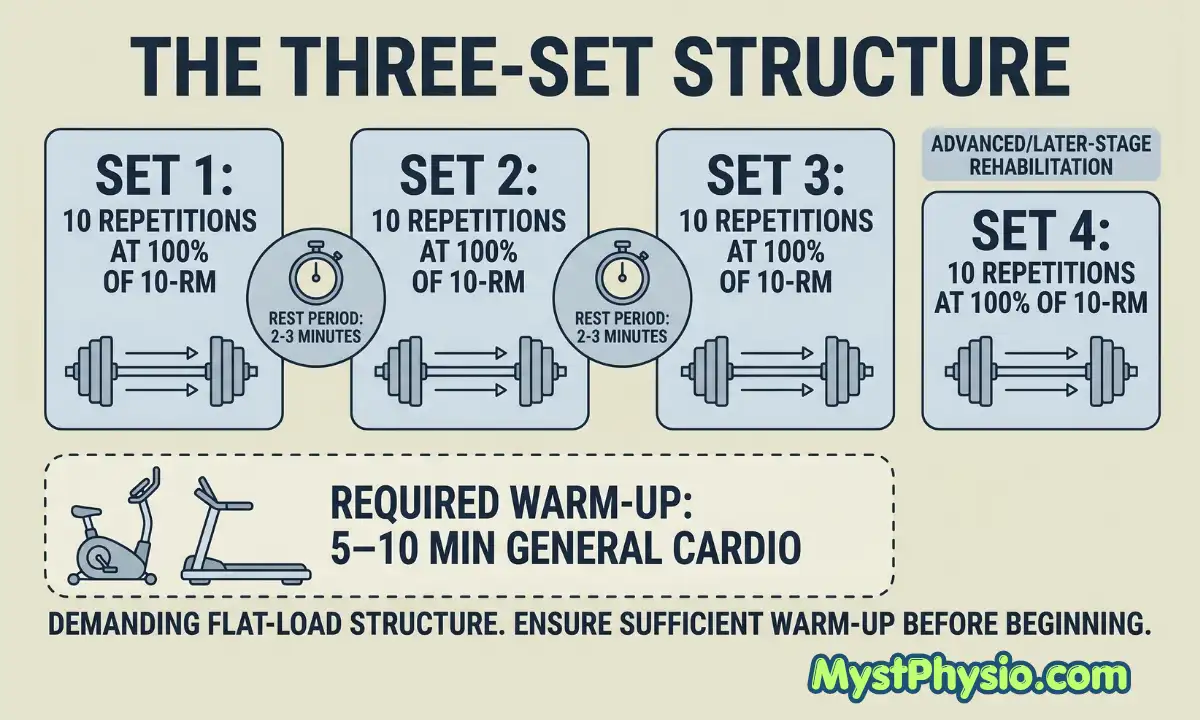
Macqueen’s original protocol for earlier-stage training uses three sets of ten repetitions:
- Set 1: 10 repetitions at 100% of 10-RM
- Set 2: 10 repetitions at 100% of 10-RM
- Set 3: 10 repetitions at 100% of 10-RM
For more advanced participants or later-stage rehabilitation, Macqueen described a four-set version, still at the full 10-RM load. Each set is separated by a rest period of approximately two to three minutes to allow partial muscle recovery.
This flat-load structure is more demanding than DeLorme’s graduated warm-up approach. It requires that the patient is already sufficiently warmed up before beginning. A general cardiovascular warm-up of five to ten minutes on a stationary bike or treadmill is typically recommended.
Load Calculation and Progression
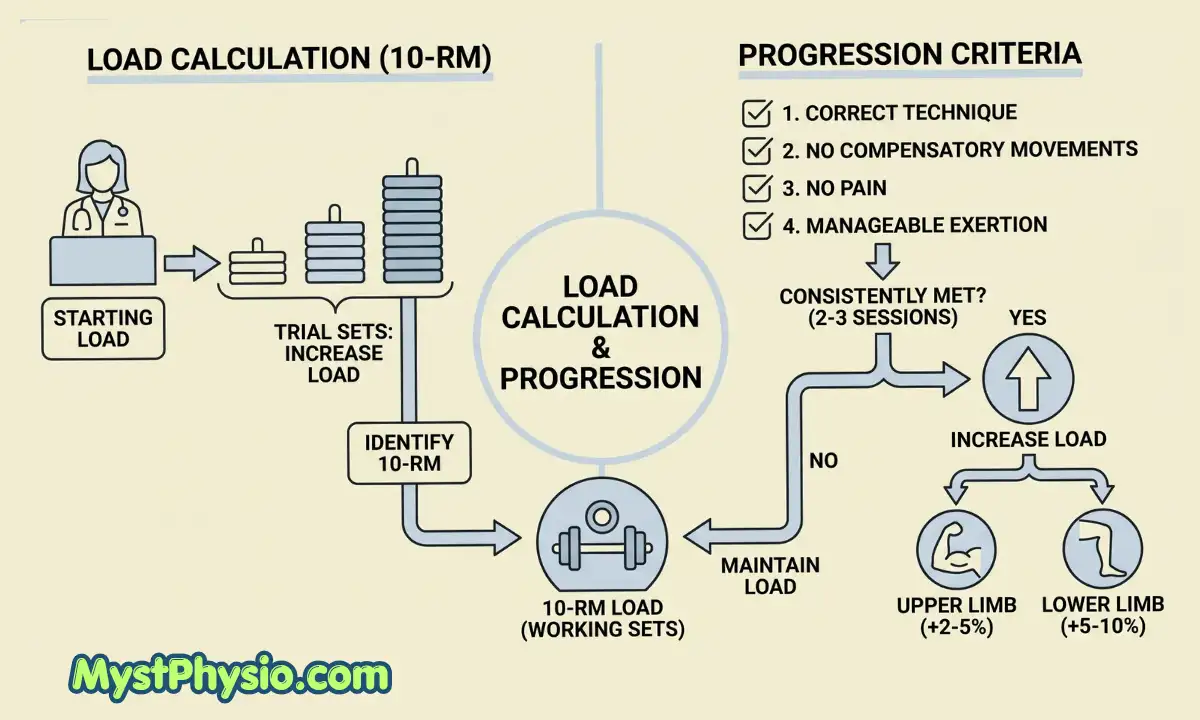
Testing for the 10-RM should be done carefully. In clinical settings, particularly post-injury, the clinician often estimates the starting load conservatively and adjusts over one to two sessions. A commonly used approach involves trial sets with progressively increasing loads until the 10-RM is identified.
Once established, that load is used for all working sets in each session. The load is not increased until the patient can complete all three (or four) sets of ten repetitions with:
- Correct, safe technique throughout
- No compensatory movements (such as leaning, shrugging, or substituting other muscle groups)
- No pain during or after exercise
- Reported exertion that feels manageable rather than maximal
When all of these criteria are met, consistently, across two to three consecutive sessions, the load is increased. A common increment is 2 to 5% for upper limb exercises, and 5 to 10% for lower limb exercises, reflecting the larger muscle mass of the legs.
Clinical Applications: Who Benefits Most?
The Macqueen Method is not a one-size-fits-all tool. In practice, it tends to work best for specific patient groups.
Rehabilitation After Injury or Surgery
People recovering from musculoskeletal injuries, such as ligament tears, fractures, or joint replacements, are often ideal candidates. After a period of immobilisation, muscles can lose significant strength (a process called disuse atrophy, meaning muscle wasting from lack of use). A structured PRE protocol helps rebuild that strength in a controlled, measurable way.
In clinical practice, patients recovering from anterior cruciate ligament (ACL) reconstruction often respond well to lower-limb PRE protocols during the mid-to-late phases of rehabilitation, once the graft has adequately healed and range of motion is restored. The Macqueen structure allows the physiotherapist to track progress objectively, using the 10-RM as a benchmark.
Older Adults and Muscle Loss
Sarcopenia is the age-related loss of muscle mass and strength. It affects a significant proportion of adults over 60 and contributes to falls, functional decline, and reduced independence. Progressive resistance training is one of the most evidence-supported interventions for sarcopenia, endorsed by organisations including the World Health Organisation (WHO) and the European Working Group on Sarcopenia in Older People (EWGSOP).
Older adults often benefit from the measured, consistent loading of the Macqueen approach. The steady progression, without the expectation of weekly load increases, tends to be more sustainable and less overwhelming for people who are returning to structured exercise after years of inactivity.
People with Chronic Conditions
People with type 2 diabetes, cardiovascular disease (conditions affecting the heart and blood vessels), or chronic obstructive pulmonary disease (COPD, a long-term lung condition that causes breathing difficulties) can safely undertake PRE programmes with appropriate medical clearance and monitoring. Resistance training in these populations has been shown to improve glycaemic control (blood sugar management), cardiovascular fitness, and functional capacity.
The Macqueen protocol’s structured, documented approach makes it easier to monitor and adjust when working alongside a patient’s wider medical team.
Macqueen vs. Other PRE Methods
Several PRE methods exist. Understanding how they compare helps clinicians select the most appropriate approach.
| Method | Sets x Reps | Load Structure | Best Suited For |
|---|---|---|---|
| DeLorme and Watkins (1948) | 3 x 10 | 50%, 75%, 100% of 10-RM | Early rehabilitation, beginners |
| Oxford Technique (Zinovieff, 1951) | 3 x 10 | 100%, 75%, 50% of 10-RM | Fatigue-based progressive loading |
| Macqueen Method (1954) | 3-4 x 10 | 100% of 10-RM (all sets) | Intermediate rehabilitation, muscle hypertrophy |
| DAPRE (Knight, 1979) | 4 x variable | Adjusted by performance | Advanced, individualised progression |
The DeLorme method remains the most widely taught in undergraduate physiotherapy curricula. The Oxford technique reverses the load pyramid, beginning heavy and reducing load as fatigue builds. The DAPRE (Daily Adjustable Progressive Resistance Exercise) method, developed by Knight in 1979, is highly individualised but requires more in-session calculation.
The Macqueen Method falls between DeLorme and DAPRE in terms of complexity. It is straightforward enough to teach and monitor, yet demanding enough to produce meaningful hypertrophy in the right patient.
Safety Considerations and Contraindications
PRE, including the Macqueen Method, is generally safe when properly supervised. However, there are situations where caution is required or where it may not be appropriate at all.
Contraindications (reasons not to proceed) include:
- Uncontrolled hypertension (high blood pressure above 160/100 mmHg at rest)
- Recent myocardial infarction (heart attack) without medical clearance
- Active inflammatory joint disease during a flare (such as rheumatoid arthritis in an active flare)
- Acute muscle or tendon tears that have not been assessed by a clinician
- Severe osteoporosis (significant loss of bone density) without specialist guidance
For people with controlled cardiovascular conditions, diabetes, or respiratory disease, PRE can often proceed with appropriate monitoring. Perceived exertion scales (such as the Borg RPE scale, where patients rate how hard exercise feels on a scale of 6 to 20) are useful in these populations.
Technique must always be prioritised over load. I have seen patients increase weight too quickly, and the result is almost always compensatory movement patterns that increase injury risk. Slow, deliberate repetitions with controlled breathing are the standard. Breath-holding during heavy lifting (known as the Valsalva manoeuvre) should generally be avoided, particularly in people with cardiovascular or blood pressure concerns.
What the Research Says
The evidence base for PRE broadly, and for Macqueen-style protocols specifically, is well established.
A 2022 systematic review published in the British Journal of Sports Medicine found that resistance training significantly reduced all-cause mortality risk, independent of aerobic exercise. Participants performing two or more sessions per week saw the greatest benefit.
For musculoskeletal rehabilitation, the American College of Sports Medicine (ACSM) recommends resistance training as a core component of recovery programmes, citing improvements in muscle strength, functional performance, and quality of life. Their guidelines support loading at 60 to 80% of 1-RM (one-repetition maximum) for hypertrophy, which is broadly consistent with the 10-RM loads used in Macqueen-style protocols.
Research on sarcopenia management, including a 2019 review in the Journal of Cachexia, Sarcopenia and Muscle, confirmed that progressive resistance exercise produced significant improvements in muscle mass and strength in older adults, with effect sizes that outperformed most other interventions including nutritional supplementation alone.
It should be noted that specific head-to-head comparisons of the Macqueen Method against other PRE protocols remain limited in the recent literature. The broader evidence for high-load, consistent-set training supports the Macqueen framework, but clinicians should use professional judgement and patient response to guide protocol selection.
Frequently Asked Questions (FAQs)
The Macqueen Method is a progressive resistance exercise protocol developed by I.J. Macqueen in 1954. It involves performing three to four sets of ten repetitions at the individual’s ten-repetition maximum (10-RM) load, with progression occurring once all sets are completed safely and comfortably.
The DeLorme method uses a pyramid loading structure (50%, 75%, then 100% of 10-RM across three sets). The Macqueen Method uses the same full load for all three or four sets, making it more demanding overall but still manageable with an appropriate warm-up.
Yes, with appropriate assessment and supervision. Older adults can benefit from Macqueen-style PRE as part of a programme targeting sarcopenia (age-related muscle loss). The load should be individually assessed and progression should be gradual. Medical clearance is advisable for those with significant co-morbidities.
Most PRE protocols, including Macqueen’s, are performed two to three times per week for a given muscle group, with at least 48 hours rest between sessions to allow muscle recovery. Your physiotherapist will tailor session frequency to your specific goals and recovery capacity.
Some exercises within this protocol can be adapted for home use using resistance bands or bodyweight progressions. However, accurately establishing and monitoring the 10-RM typically requires gym equipment and clinical oversight, particularly in a rehabilitation context. Speak with a qualified physiotherapist before beginning.
Conclusion
The Macqueen Method of Progressive Resistance Exercise offers a structured, evidence-informed approach to building muscle strength in both rehabilitation and general fitness contexts. Its consistent loading model, grounded in the individual’s 10-RM, provides a clear and measurable framework that clinicians and patients can follow together. It is not the right tool for every situation, but when used appropriately, it is an effective and well-supported option.
Consult your doctor or a qualified physiotherapist for a personalised assessment before beginning any progressive resistance exercise programme.
References
- Macqueen IJ. Current practice and theory of resistive exercise. British Medical Journal. 1954;2(4897):1193-1198.
- DeLorme TL, Watkins AL. Technics of progressive resistance exercise. Archives of Physical Medicine. 1948;29(5):263-273.
- Zinovieff AN. Heavy-resistance exercises: the Oxford technique. British Journal of Physical Medicine. 1951;14(6):129-132.
- Knight KL. Quadriceps strengthening with the DAPRE technique: case studies with neurological implications. Medicine and Science in Sports and Exercise. 1985;17(6):646-650.
- Stamatakis E, Lee IM, Bennie J, et al. Does strength-promoting exercise confer unique health benefits? A pooled analysis of eleven population cohorts with all-cause, cardiovascular, and cancer mortality endpoints. American Journal of Epidemiology. 2018;187(5):1102-1112.
- Momma H, Kawakami R, Honda T, Sawada SS. Muscle-strengthening activities are associated with lower risk and mortality in major non-communicable diseases: a systematic review and meta-analysis of cohort studies. British Journal of Sports Medicine. 2022;56(13):755-763.
- American College of Sports Medicine. ACSM’s Guidelines for Exercise Testing and Prescription. 11th ed. Philadelphia: Wolters Kluwer; 2021.
- Cruz-Jentoft AJ, Bahat G, Bauer J, et al. Sarcopenia: revised European consensus on definition and diagnosis. Age and Ageing. 2019;48(1):16-31.
- Liao CD, Chen HC, Huang SW, Liou TH. The role of muscle mass gain following protein supplementation plus exercise therapy in older adults with sarcopenia and frailty risks: a systematic review and meta-analysis. Nutrients. 2019;11(8):1713.
- Colberg SR, Sigal RJ, Yardley JE, et al. Physical activity/exercise and diabetes: a position statement of the American Diabetes Association. Diabetes Care. 2016;39(11):2065-2079.