
What Is Exercise Therapy?
Exercise therapy is a core part of physiotherapy that uses planned, purposeful physical movements to improve strength, flexibility, mobility, and overall body functions.
Unlike random workouts, exercise therapy is:
- Structured
- Goal-oriented
- Based on body mechanics
- Designed for rehabilitation, not bodybuilding
It is used to help people:
- Reduce pain
- Improve joint movement
- Build strength
- Restore balance
- Return to daily activities
At MystPhysio, we focus on educational exercise therapy, helping our readers understand what to do, why to do it, and how to do it safely.
Why Exercise Therapy Is So Important
When a muscle becomes weak, a joint becomes stiff, or movement becomes painful, the body slowly adapts to that problem. If nothing is done, the problem often gets worse.
Exercise therapy works because it:
- Stimulates muscles and joints
- Improves blood circulation
- Supports tissue healing
- Restores normal movement patterns
Over time, this leads to:
- Better mobility
- Reduced stiffness
- Improved strength
- More confidence in movement
That is why exercise therapy is used in almost every area of rehabilitation.
What You Will Find in MystPhysio’s Exercise Therapy Section
Our Exercise Therapy section is designed to be practical, educational, and easy to follow.
Step-by-step Exercise Guides
Each exercise is explained clearly, including:
- Starting position
- Movement direction
- How many repetitions to perform
- Safety tips
Condition-based Exercise Programs
We provide exercise routines for:
- Knee pain
- Shoulder stiffness
- Back pain
- Postural problems
- Balance and mobility issues
Home Exercise Plans
Simple programs that can be done:
- At home
- Without machines
- With minimal equipment
Who Can Use Exercise Therapy?
Exercise therapy is helpful for many people, including:
- People with joint pain or stiffness
- Individuals recovering from injury
- Those with reduced mobility
- Older adults wanting better balance
- Anyone who wants to move more comfortably
It is not only for patients — even healthy individuals can use exercise therapy to maintain good movement patterns.
How We Create Our Exercise Therapy Content
At MystPhysio, every exercise article is designed with three goals:
- Clarity – Easy language and simple instructions
- Safety – Avoiding risky or confusing movements
- Usefulness – Exercises that people can actually apply
We do not publish:
- Copy-paste content
- Dangerous claims
- One-line exercise lists
Our aim is to make exercise therapy understandable, not intimidating.
Example Topics You’ll Find Here
Some of the types of guides available in this section include:
- Knee strengthening exercises
- Shoulder mobility routines
- Stretching exercises for stiffness
- Balance training exercises
- Posture correction movements
Each guide is written to help users understand the purpose behind every movement, not just perform it.
Important Note
All exercise therapy content on MystPhysio is provided for educational purposes only. It is not a replacement for professional medical diagnosis or treatment. If you have a medical condition, consult a qualified healthcare professional before starting any exercise program.
Explore Exercise Therapy
You can start exploring our Exercise Therapy resources to learn:
- How to move better
- How to improve flexibility
- How to strengthen weak muscles
- How to support recovery through movement
This section is built to support long-term movement health through knowledge and consistency.
Related Articles
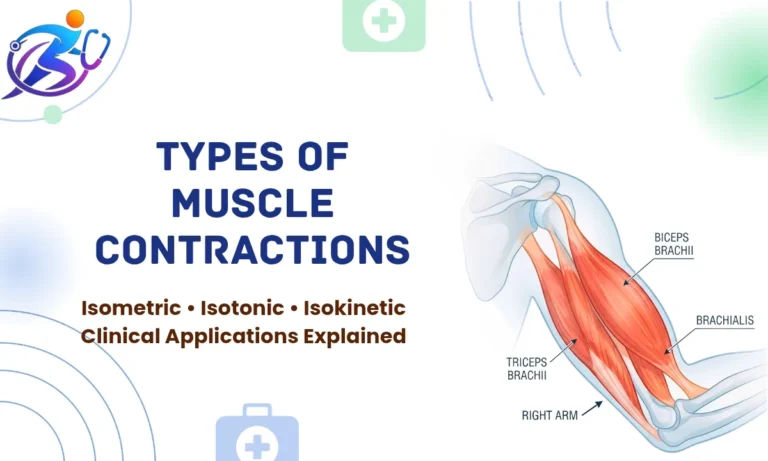
Types of Muscle Contractions Explained: Isometric, Isotonic & Isokinetic in Clinical Practice
Muscle contraction is not just a physiological event – it is the foundation of every rehabilitation program, strength protocol, and…
Read Article →
Normal Joint Range of Motion (ROM) and Variations Within Normal Limits in Physiotherapy
As a physiotherapist, I can confidently say that normal joint range of motion (ROM) is one of the most misunderstood…
Read Article →