

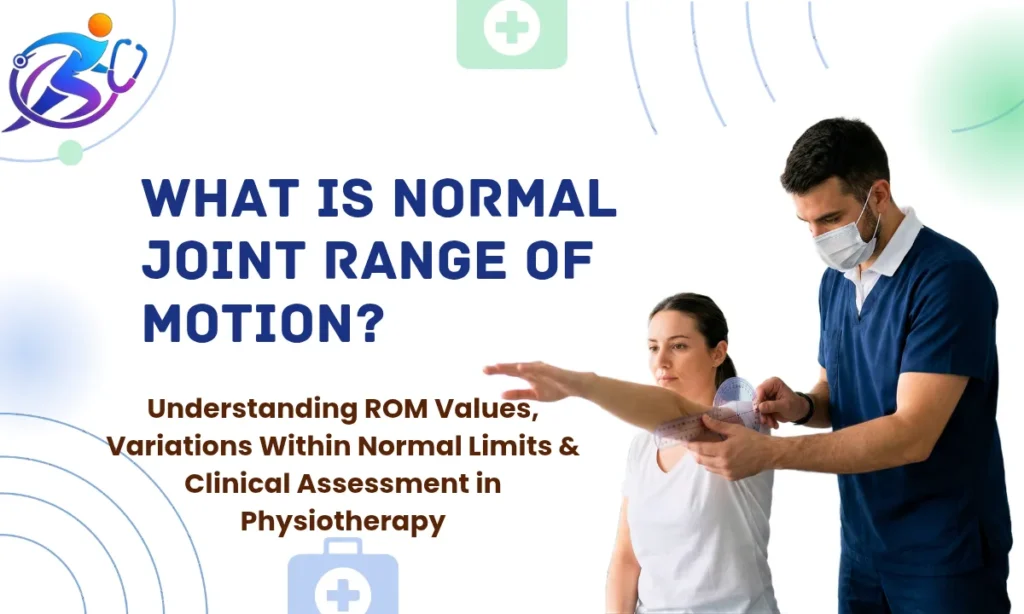
As a physiotherapist, I can confidently say that normal joint range of motion (ROM) is one of the most misunderstood concepts among students and interns. Many memorize textbook values, write them in exams, and assume that those numbers represent absolute normality. But in real clinical practice, things are rarely that rigid.
Assessing normal joint range of motion is fundamental to physiotherapy evaluation. It influences diagnosis, prognosis, goal setting, and rehabilitation planning. However, understanding variation within normal limits is equally important. Without that clinical reasoning, numbers alone can mislead you.
In this article, I will guide you through ROM assessment from a practical, evidence-based, and educator-focused perspective – exactly the way I learn during clinical postings.
What Is Normal Joint Range of Motion?
Normal joint range of motion (ROM) refers to the expected angular movement available at a joint under standard anatomical conditions. We measure it using goniometry and interpret it within the context of age, gender, joint structure, and functional demand.
But here is where students often get confused.
Textbook values represent average reference ranges, not strict cutoffs. Real-life patients rarely match textbook numbers perfectly.
Active vs Passive ROM
- Active ROM (AROM): Movement produced by the patient’s own muscle contraction.
- Passive ROM (PROM): Movement produced by the therapist without muscle activation from the patient.
PROM is usually slightly greater than AROM due to reduced muscular resistance.
Anatomical ROM vs Functional ROM
Anatomical ROM describes the maximum movement available at a joint.
Functional ROM describes the movement required to perform daily activities.
For example:
- Full shoulder flexion may be 180°
- But functional overhead reach may require less than that
This distinction is crucial in rehabilitation planning.
Factors Influencing Normal ROM
Several factors affect joint mobility:
- Joint structure and bony architecture
- Capsular pattern and ligament tension
- Muscle flexibility
- Age
- Gender
- Activity level
Understanding these helps differentiate between normal variation and pathology.
Standard Reference Values: Upper and Lower Limb
These values are based on widely accepted goniometric standards used in orthopedic assessment textbooks and musculoskeletal rehabilitation protocols.
Remember: bilateral comparison is often more clinically meaningful than textbook numbers.
Upper Limb ROM
Shoulder
- Flexion: ~160–180°
- Extension: ~50–60°
- Abduction: ~160–180°
- External rotation: ~80–90°
- Internal rotation: ~60–80°
Variation of ±5–10° may still be within normal limits if symmetrical and pain-free.
Elbow
- Flexion: ~140–150°
- Extension: 0° (some individuals may have 5–10° hyperextension)
Forearm
- Pronation: ~80–90°
- Supination: ~80–90°
Wrist
- Flexion: ~70–90°
- Extension: ~60–80°
Lower Limb ROM
Hip
- Flexion: ~110–120°
- Extension: ~10–20°
- Abduction: ~40–50°
- Internal rotation: ~30–40°
- External rotation: ~40–60°
Knee
- Flexion: ~130–140°
- Extension: 0° (slight hyperextension may be normal)
Ankle
- Dorsiflexion: ~15–20°
- Plantarflexion: ~40–50°
Again, symmetrical, pain-free range with normal end feel usually indicates normality.
Variations Within Normal Limits
This is where true clinical understanding begins.
1. Age-Related Variation
- Children often show greater flexibility.
- Older adults may show mild reduction due to capsular stiffness.
- A 65-year-old with 110° hip flexion may still be functionally normal.
2. Gender Differences
Females often demonstrate greater flexibility due to ligamentous laxity and hormonal influence.
3. Dominant vs Non-Dominant Side
The dominant side may show:
- Slightly increased mobility in athletes
- Or slightly reduced mobility due to repetitive load
Always compare both sides.
4. Hypermobile Individuals
Some patients naturally exceed textbook ROM values.
If:
- End feel is normal
- No pain
- No instability symptoms
It is variation – not pathology.
5. Athletes vs Sedentary Individuals
- Gymnasts may exceed normal values.
- Sedentary individuals may have reduced flexibility but still function normally.
6. Occupational Adaptations
A painter may have increased shoulder mobility. A desk worker may show mild thoracic stiffness affecting shoulder range.
7. Postural Influence
Forward head posture and thoracic kyphosis may alter apparent shoulder ROM.
Differentiating Normal Variation from Pathology
Ask yourself:
- Is there pain?
- Is end feel abnormal?
- Is capsular pattern present?
- Is function restricted?
- Is there recent trauma?
If reduction is painless, symmetrical, and functional – it may be normal variation.
If painful, progressive, or asymmetrical – investigate further.
Clinical Assessment Process
Step 1: Proper Patient Positioning
Incorrect positioning is the most common student mistake.
Stabilize proximal segments to avoid compensatory movements.
Step 2: Landmark Identification
Accurate bony landmarks improve reliability.
Step 3: Goniometer Alignment
- Fulcrum over joint axis
- Stationary arm aligned with proximal segment
- Moving arm aligned with distal segment
Step 4: Assess End Feel
End feel interpretation is as important as the numeric value.
Step 5: Documentation
Document as:
“Shoulder flexion: 170°, pain-free, firm end feel.”
Avoid writing only numbers.
Common Student Mistakes
- Ignoring compensations
- Measuring too quickly
- Not stabilizing
- Failing to compare bilaterally
- Forgetting to assess PROM
Understanding End Feel
Normal end feels:
- Firm: capsular or muscular stretch (e.g., shoulder external rotation)
- Soft: soft tissue approximation (e.g., knee flexion)
- Hard: bony contact (e.g., elbow extension)
Abnormal end feels:
- Empty (pain-limited)
- Spasm
- Springy block
Capsular Pattern Concept
Each joint has a predictable pattern of restriction in capsular involvement.
Example: Shoulder capsular pattern — ER > Abduction > IR restriction.
If pattern matches and pain is present, suspect joint pathology.
Red Flags: When ROM Is Not Just Normal Variation
Be cautious when you observe:
- Sudden loss of ROM
- Progressive painful restriction
- Post-traumatic stiffness
- Neurological weakness limiting AROM
- Systemic inflammatory signs
Do not dismiss these as normal variation.
Clinical Decision-Making in Different Settings
Orthopedic Rehabilitation
ROM guides exercise progression and joint mobilization planning.
Neurological Rehabilitation
Distinguish between:
- True joint restriction
- Spasticity-related limitation
- Motor control deficits
Post-Surgical Cases
Understand surgical precautions and tissue healing timelines.
Chronic Pain Patients
Sometimes ROM appears limited due to fear avoidance rather than structural restriction.
Numbers alone never tell the full story.
Clinical reasoning always matters.
Clinical Tip for Physiotherapy Students
Here are common viva questions:
- What is normal shoulder flexion ROM?
- What is capsular pattern?
- Difference between active and passive ROM?
- What is firm end feel?
In practical exams:
- Always compare bilaterally.
- Always mention end feel.
- Always mention pain.
When explaining to patients, say:
“Your movement is slightly reduced compared to the other side, but it is within acceptable limits and not structurally concerning.”
Examiners often trap students by presenting slight variations and asking if it is abnormal. Remember – context defines normality.
Engagement and Community Discussion
If you are a physiotherapy student or intern and unsure about a borderline ROM case, share your scenario.
- Was it symmetrical?
- Was it painful?
- What was the end feel?
Clinical discussion builds better reasoning than memorizing tables.
Internal Learning Path (MystPhysio Readers)
To deepen understanding, I recommend exploring:
- Physio education articles on joint assessment
- Orthopedic rehabilitation guides
- Exercise therapy principles for mobility restoration
- Pain management approaches for stiff joints
ROM assessment becomes powerful when integrated with full musculoskeletal evaluation.
How This Content Was Developed
This article is based on:
- Standard goniometric measurement principles
- Evidence-based musculoskeletal assessment protocols
- Orthopedic clinical guidelines
- Established capsular pattern concepts
- Professional physiotherapy practice experience
The goal is to provide clinically accurate, education-focused, and practical guidance for physiotherapy students and rehabilitation professionals.
If you master the concept of normal joint range and its variations, you move from memorizing numbers to thinking like a clinician. And that shift changes everything in practice.