
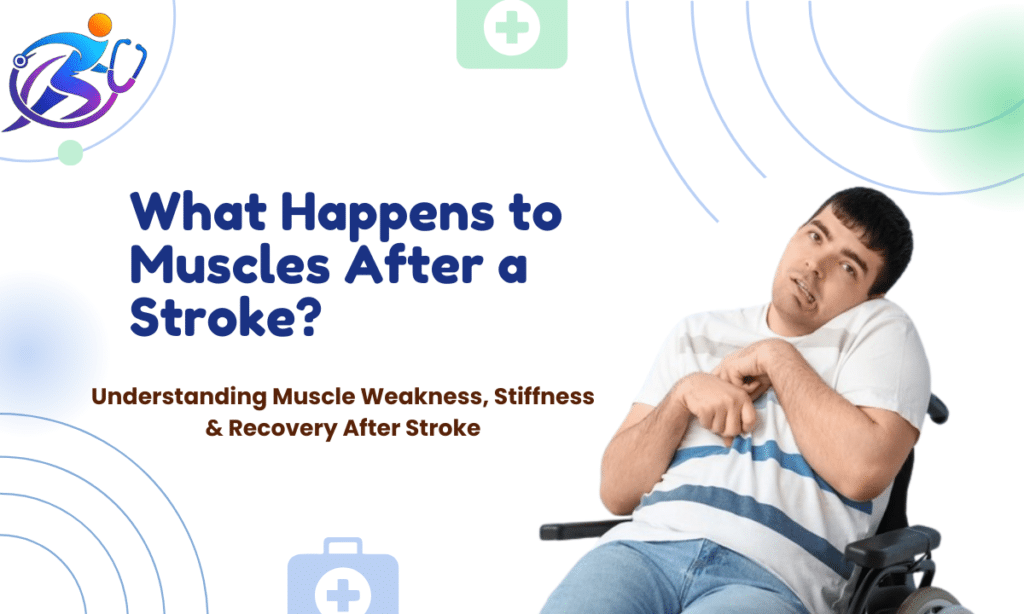
If someone you love has suffered a stroke, you may notice something frightening very quickly:
One arm feels weak.
One leg does not move normally.
The hand becomes stiff.
The muscles feel tight or floppy.
Many families think:
“The muscles are damaged.”
But in most stroke cases, the muscles themselves are not injured.
The real problem lies in the brain’s control over those muscles.
Let us understand what truly happens inside the body after a stroke.
First Important Truth: The Muscles Are Not Broken
A stroke is a brain injury, not a muscle injury.
Your muscles are like a powerful engine.
Your brain is the driver.
After a stroke:
- The engine is still there
- But the driver has lost control over some parts
So the muscles:
- Do not receive clear signals
- Do not contract normally
- May become weak, stiff, or uncoordinated
This is why stroke causes paralysis, stiffness, or abnormal movement.
What the Brain Normally Does
In a healthy person:
- The brain sends electrical signals through nerves
- These signals tell muscles when to tighten and relax
- Movements are smooth and controlled
After a stroke:
- Blood supply to part of the brain stops
- Brain cells get damaged
- Signals cannot travel properly to muscles
So muscles start behaving differently.
What Actually Happens to Muscles After Stroke
After a stroke, muscles go through four main stages:
1. Early Stage – Floppy or Weak Muscles (Flaccidity)
In the first days or weeks:
- The affected arm or leg feels soft and heavy
- The person cannot move it properly
- There is no resistance when you lift it
This happens because:
- The brain is not sending signals
- Muscles are “offline”
This is why patients say:
“My arm feels dead.”
2. Abnormal Muscle Tightness Begins (Spasticity)
After some weeks:
- Muscles start becoming tight
- Arm may bend inward
- Fist may clench
- Leg may feel stiff while walking
This is called spasticity.
It happens because:
- The brain has lost control over muscle relaxation
- Muscles stay partly contracted all the time
This causes:
- Pain
- Difficulty in movement
- Joint stiffness
3. Muscle Shortening & Joint Stiffness
When muscles remain tight for long time:
- They shorten
- Joints become stiff
- Range of motion reduces
This is called contracture
Without therapy:
- The hand may stay closed
- The elbow may stay bent
- The foot may point downward
This makes daily activities very difficult.
4. Muscle Weakness and Wasting
If muscles are not used:
- They become thinner
- Strength reduces
- Fat replaces muscle tissue
This is called muscle atrophy
It happens because:
- Weak muscles are not exercised
- Brain is not activating them normally
Why One Side of the Body Is Affected
The brain controls the opposite side of the body.
So:
- Stroke in right brain → left side weakness
- Stroke in left brain → right side weakness
This is why only one arm and one leg usually get affected.
Do Muscles Recover After Stroke?
Yes — but only with proper physiotherapy and brain training.
The brain has a powerful ability called neuroplasticity.
It means:
The brain can learn new pathways and relearn movement.
But this happens only if:
- The muscles are moved
- Exercises are done
- The brain is stimulated
Why Physiotherapy Is Essential After Stroke
Physiotherapy helps by:
- Stretching tight muscles
- Activating weak muscles
- Preventing joint stiffness
- Training the brain to control muscles again
Without therapy:
- Muscles become stiff permanently
- Recovery becomes limited
With therapy:
- Movement improves
- Spasticity reduces
- Independence increases
Clinical Note (From Physiotherapy Practice)
Many stroke patients believe:
“My muscles are damaged forever.”
In reality:
- The muscles are still healthy
- They are just not receiving proper signals
When we start correct movement training early, we often see:
- Stiff hands slowly opening
- Weak legs beginning to walk
- Pain reducing
Key Concept to Remember
Stroke does not break muscles — it breaks communication between the brain and muscles.
Physiotherapy rebuilds that communication.
Summary
After a stroke:
- Muscles become weak and floppy at first
- Then they may become tight and stiff
- Over time they shorten and lose strength
- But they can recover with proper rehabilitation
The earlier physiotherapy starts, the better the recovery.
If you are caring for a stroke patient, remember:
The muscles are waiting for the brain to learn again — and physiotherapy is the teacher.