

Electrotherapy is one of the most widely used modalities in physiotherapy practice. However, many students and even clinicians often confuse the practical differences between low frequency, medium frequency, and high frequency currents.
Understanding these differences is not just theoretical – it directly influences:
- Patient comfort
- Depth of penetration
- Therapeutic effect
- Clinical outcomes
According to the World Health Organization (WHO), appropriate use of physical therapy modalities plays a significant role in non-pharmacological pain management strategies. Similarly, the National Institutes of Health highlights electrical stimulation as an evidence-supported approach for pain relief and neuromuscular rehabilitation.
In this article, we will clearly explain:
- What low, medium, and high frequency currents are
- Their physiological effects
- Clinical applications
- Advantages and limitations
- Practical comparison table
What Is Frequency in Electrotherapy?
Frequency refers to the number of electrical pulses delivered per second. It is measured in Hertz (Hz).
- 1 Hz = 1 pulse per second
- 100 Hz = 100 pulses per second
The frequency determines how the body tissues respond to stimulation.
Electrotherapy currents are broadly classified into:
- Low Frequency Currents (< 1000 Hz)
- Medium Frequency Currents (1000–100,000 Hz)
- High Frequency Currents (> 100,000 Hz)
1. Low Frequency Currents (Below 1000 Hz)
Definition
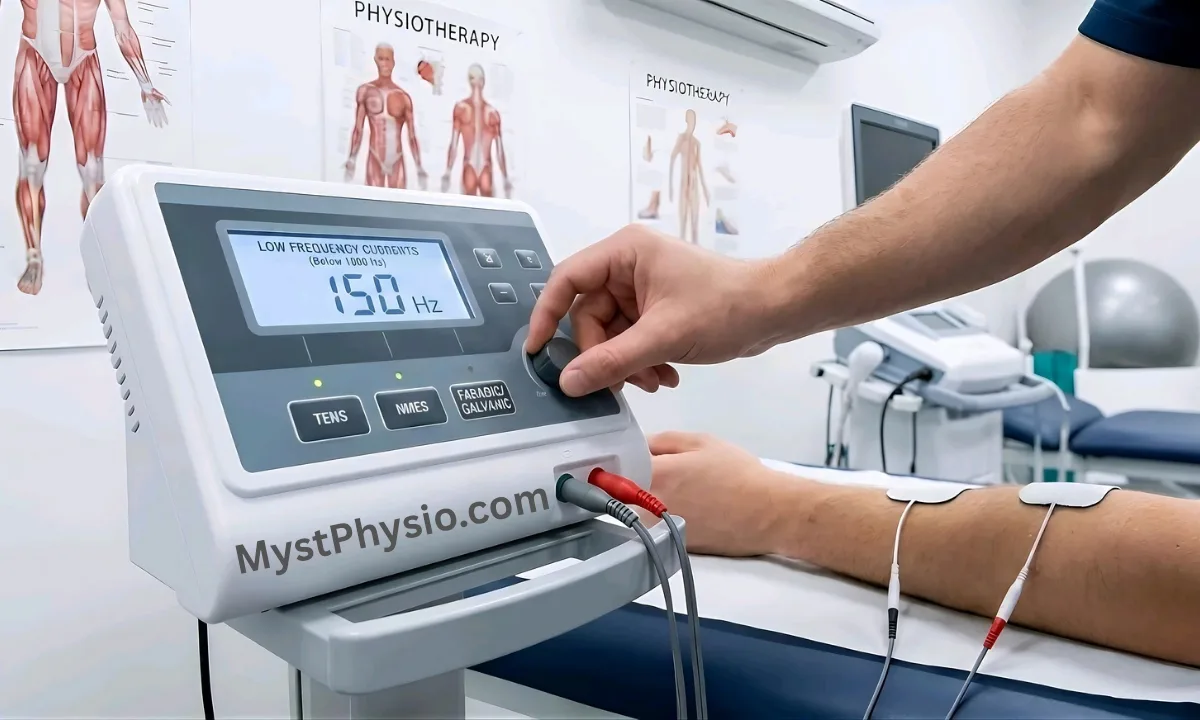
Low frequency currents are electrical currents with a frequency below 1000 Hz. These are the most commonly used currents in physiotherapy clinics.
Examples
- TENS (Transcutaneous Electrical Nerve Stimulation)
- NMES (Neuromuscular Electrical Stimulation)
- Faradic current
- Interrupted galvanic current
Physiological Effects
Low frequency stimulation primarily affects:
- Sensory nerves (pain modulation)
- Motor nerves (muscle contraction)
Mechanisms include:
- Gate control theory of pain
- Endorphin release
- Muscle re-education
- Prevention of muscle atrophy
The Centers for Disease Control and Prevention recognizes TENS as a non-opioid modality for certain pain conditions.
Clinical Uses
- Acute and chronic pain
- Muscle strengthening
- Post-operative rehabilitation
- Neurological rehabilitation
- Muscle re-education
Advantages
- Effective pain control
- Good for muscle stimulation
- Widely available
Limitations
- Higher skin resistance
- Can cause discomfort
- Limited depth of penetration
2. Medium Frequency Currents (1000–100,000 Hz)
Definition
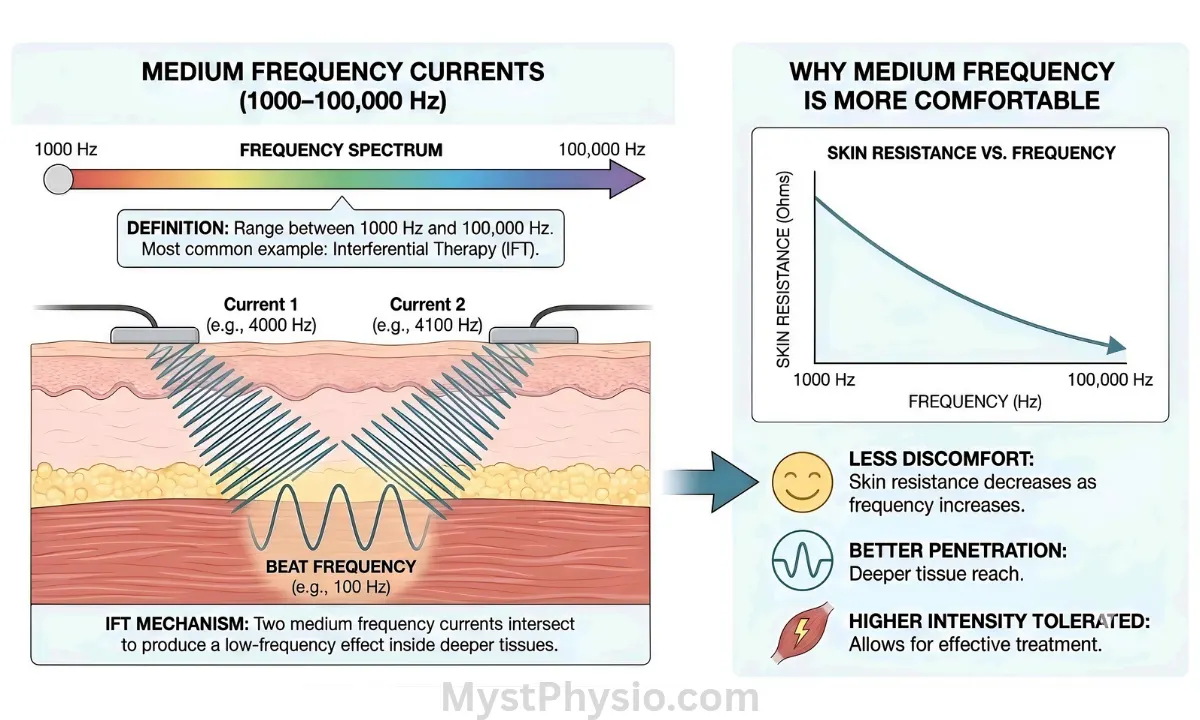
Medium frequency currents range between 1000 Hz and 100,000 Hz. The most common example is Interferential Therapy (IFT).
Why Medium Frequency Is More Comfortable
Skin resistance decreases as frequency increases.
This means:
- Less discomfort
- Better penetration
- Higher intensity tolerated
IFT uses two medium frequency currents that intersect to produce a low-frequency effect inside deeper tissues.
Physiological Effects
- Deep pain relief
- Increased blood circulation
- Reduced muscle spasm
- Edema reduction
Evidence summaries from Cochrane indicate that interferential therapy may provide short-term pain relief in musculoskeletal conditions when appropriately applied.
Clinical Uses
- Chronic low back pain
- Osteoarthritis
- Shoulder pain
- Sciatica
- Soft tissue injuries
Advantages
- Deeper penetration
- More comfortable than low frequency
- Suitable for larger areas
Limitations
- Equipment cost
- Less specific motor stimulation
3. High Frequency Currents (Above 100,000 Hz)
Definition
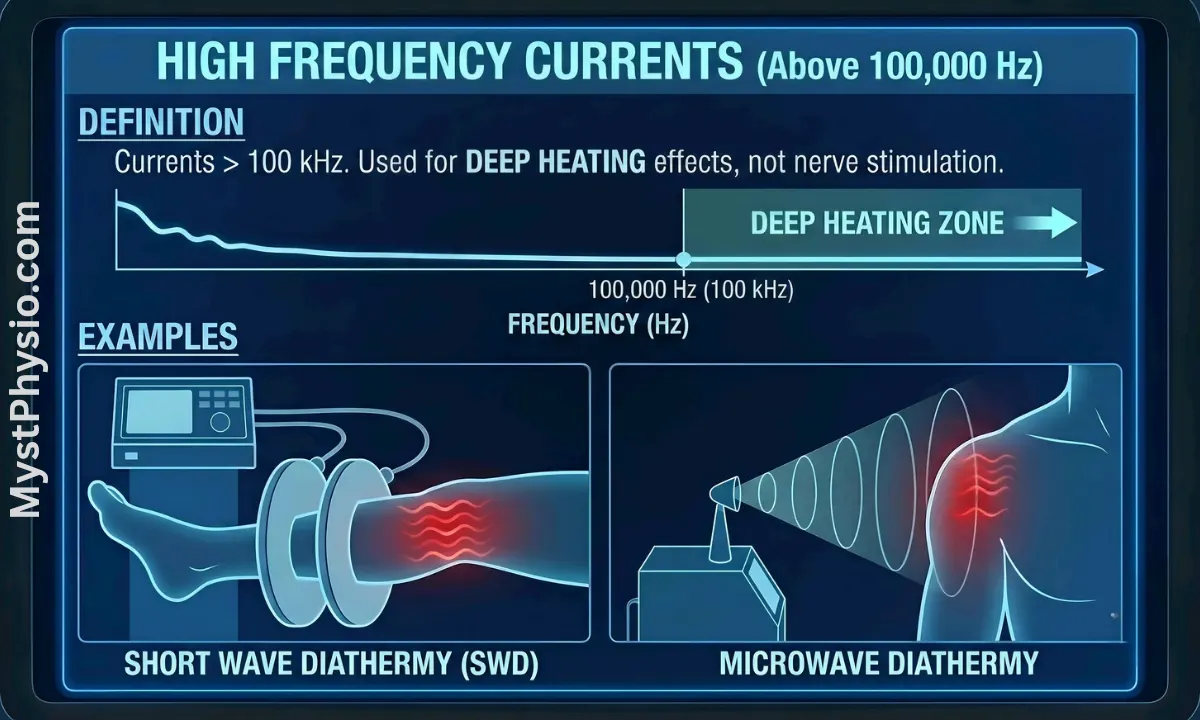
High frequency currents are above 100,000 Hz and are primarily used for deep heating effects rather than nerve stimulation.
Examples
- Short Wave Diathermy (SWD)
- Microwave Diathermy
Physiological Effects
High frequency currents produce:
- Deep tissue heating
- Increased circulation
- Reduced joint stiffness
- Muscle relaxation
These modalities are commonly used in chronic inflammatory conditions and degenerative joint disorders.
Clinical Uses
- Chronic arthritis
- Deep muscle spasm
- Joint contractures
- Frozen shoulder
Advantages
- Deep heating effect
- Improves tissue extensibility
- Useful before stretching
Limitations
- Contraindicated in metal implants
- Not suitable for pacemaker patients
- Requires safety precautions
Comparison Table
| Feature | Low Frequency | Medium Frequency | High Frequency |
|---|---|---|---|
| Frequency Range | < 1000 Hz | 1000–100,000 Hz | > 100,000 Hz |
| Main Effect | Nerve & muscle stimulation | Deep pain relief | Deep heating |
| Comfort Level | Moderate | High | Very high |
| Penetration Depth | Superficial | Moderate to deep | Deep |
| Example | TENS | IFT | SWD |
Key Clinical Difference (In Simple Terms)
- Low frequency: Stimulates nerves and muscles
- Medium frequency: More comfortable, deeper pain relief
- High frequency: Produces heat in deep tissues
Contraindications (Important for Practice)
All electrotherapy currents are contraindicated in:
- Pacemaker patients
- Malignancy
- Active infection
- Pregnancy (over abdomen/lumbar region)
- Impaired sensation
Always perform proper assessment before application.
Frequently Asked Questions (FAQs)
Medium frequency (IFT) is often preferred for deep musculoskeletal pain due to better penetration and comfort.
TENS is a low frequency current.
High frequency currents like Short Wave Diathermy produce therapeutic heating.
Because skin resistance decreases with increasing frequency.
Clinical Insight for Physiotherapists
In real practice:
- Use Low frequency for muscle strengthening and motor re-education
- Use Medium frequency for chronic pain conditions
- Use High frequency when deep heating is required before mobilization
Correct selection improves patient compliance and treatment outcomes.
Conclusion
Understanding the difference between low, medium, and high frequency currents is essential for effective electrotherapy application.
Each type serves a different therapeutic purpose:
- Low frequency: neuromuscular stimulation
- Medium frequency: deep pain modulation
- High frequency: therapeutic heating
Choosing the correct modality is not about machine availability – it is about clinical reasoning.