

There’s a particular complaint that shows up in clinics again and again. A patient rubs the inside of the elbow and says something like:
“My little finger keeps going numb… especially when I’m on the phone.”
Sometimes they think it’s a circulation issue. Sometimes they assume they just slept on the arm the wrong way.
But when that tingling repeatedly appears in the ring finger and little finger, especially with elbow bending, it often points toward cubital tunnel syndrome – a condition caused by irritation or compression of the ulnar nerve at the elbow.
The encouraging news is that many cases improve with physiotherapy and conservative care, meaning surgery is not always necessary.
Before diving into treatment strategies, it helps to understand what’s actually happening inside the elbow.
What Is Cubital Tunnel Syndrome?
Cubital tunnel syndrome occurs when the ulnar nerve becomes compressed as it passes through the cubital tunnel, a narrow channel located along the inner side of the elbow.
You may have experienced a quick electric shock when accidentally hitting your “funny bone.” That sensation occurs because the ulnar nerve is briefly irritated. In cubital tunnel syndrome, the nerve is not just bumped – it becomes chronically compressed or stretched.
The ulnar nerve controls several important functions:
- Sensation in the little finger and half of the ring finger
- Fine motor control of small intrinsic hand muscles
- Grip coordination and finger spreading
Because this nerve lies very close to the skin at the elbow, it is particularly vulnerable to mechanical pressure.
According to the American Academy of Orthopaedic Surgeons, cubital tunnel syndrome is the second most common nerve compression condition of the upper limb, following carpal tunnel syndrome.
Common Symptoms
Symptoms often develop gradually rather than appearing suddenly.
Many patients describe noticing the problem first during quiet activities like reading, typing, or holding a phone.
Common symptoms include:
- Tingling or numbness in the little finger and ring finger
- Intermittent electric-shock sensations along the inner forearm
- Weak grip strength
- Hand clumsiness when performing fine tasks
- Pain or aching along the inner elbow
- Symptoms worsening when the elbow stays bent for long periods
In more advanced cases, patients may notice intrinsic muscle weakness. Tasks such as opening jars, gripping small objects, or spreading the fingers apart can become difficult.
Signs of intrinsic muscle weakness sometimes include:
- Froment’s sign – compensatory thumb flexion when gripping paper
- Wartenberg sign – little finger drifting outward due to muscle imbalance
If these signs appear, professional evaluation becomes important.
What Causes Ulnar Nerve Compression?
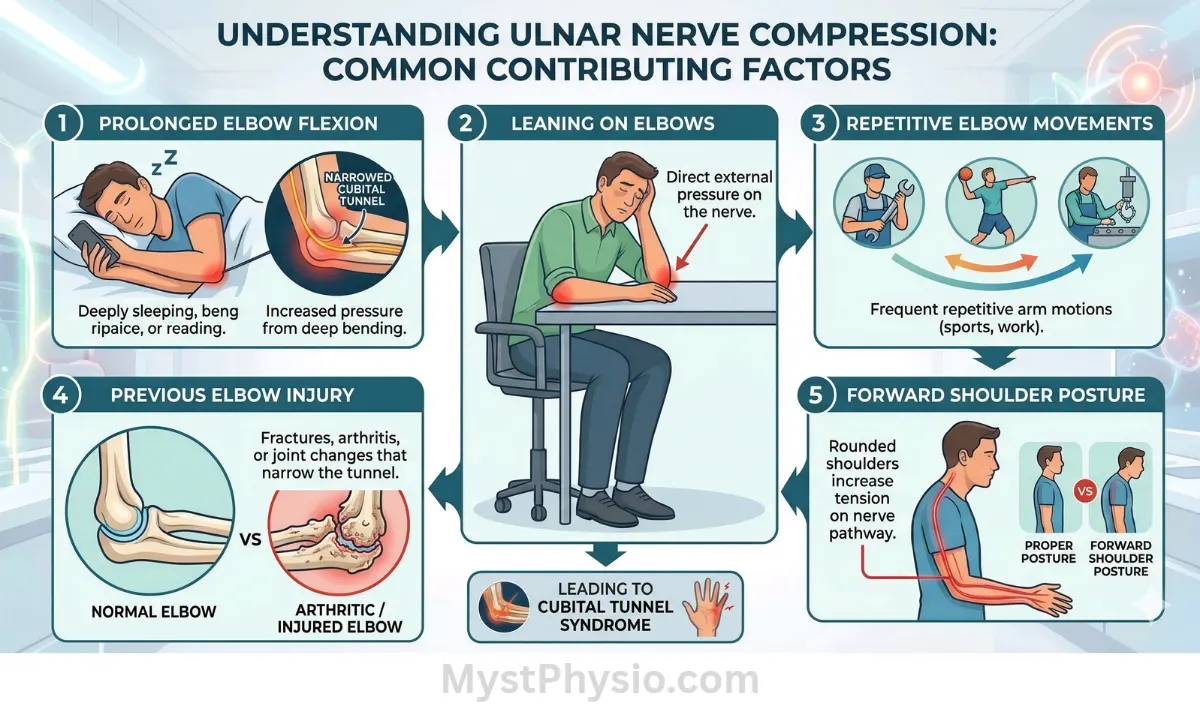
Cubital tunnel syndrome usually develops due to repeated mechanical stress on the nerve.
Common contributing factors include:
a. Prolonged elbow flexion
When the elbow bends deeply, the cubital tunnel becomes narrower. Pressure inside the tunnel can increase several times compared with the straight-arm position.
b. Leaning on the elbows
Hard surfaces such as desks or armrests can compress the nerve directly.
c. Repetitive elbow movements
Athletes, mechanics, and individuals performing repetitive arm movements are at higher risk.
d. Previous elbow injury
Fractures, arthritis, or joint changes may narrow the cubital tunnel.
e. Forward shoulder posture
This is often overlooked. When the shoulders remain rounded forward, tension increases along the ulnar nerve pathway from the brachial plexus through the medial arm, potentially contributing to nerve irritation.
According to the National Institute of Neurological Disorders and Stroke, sustained mechanical pressure is one of the main contributors to peripheral nerve compression disorders.
How Is Cubital Tunnel Syndrome Diagnosed?
Diagnosis usually begins with clinical examination.
A physiotherapist or physician may assess:
- Sensory changes in the ring and little finger
- Grip strength using a dynamometer
- Elbow flexion test
- Tapping over the ulnar nerve (Tinel’s sign)
Additional clinical indicators include:
- Froment’s sign
- Wartenberg sign
- Reduced pinch strength
In some cases, doctors may order nerve conduction studies or electromyography (EMG) to measure how well electrical signals travel through the ulnar nerve.
These tests help determine the severity of compression.
Physiotherapy Management Without Surgery
Conservative treatment focuses on reducing stress on the nerve and restoring normal movement of surrounding tissues.
Physiotherapy management generally involves three main components:
- reducing mechanical pressure on the nerve
- restoring nerve mobility
- improving strength and posture
When addressed early, these strategies can significantly reduce symptoms.
RELATED: Why Pain Remains Even After Healing? Understanding Persistent Pain Clinically
Activity Modification (Often the Most Effective Step)
Many people unknowingly aggravate the ulnar nerve throughout the day.
Physiotherapy often begins with identifying and correcting these habits.
Helpful changes may include:
- Avoid resting elbows on hard surfaces
- Adjust desk height and keyboard position
- Take regular breaks during repetitive tasks
- Avoid prolonged elbow bending
A surprisingly effective technique is wrapping a soft towel around the elbow at night.
This simple method prevents the elbow from bending excessively during sleep, which often triggers morning numbness.
Patients sometimes expect complex therapy, but small mechanical changes often produce meaningful relief.
Night Splinting
Night splints help maintain the elbow in a more neutral position during sleep.
When the elbow bends beyond about 90 degrees, pressure inside the cubital tunnel increases significantly. A splint prevents prolonged flexion, giving the irritated nerve a chance to recover.
Patients who wake with morning tingling in the fingers often benefit the most from this approach.
Ulnar Nerve Gliding Exercises
Peripheral nerves normally slide and move through surrounding tissues during arm movement. When irritated, this movement can become restricted.
Ulnar nerve gliding exercises aim to restore this mobility.
It’s important to distinguish between two approaches:
- Nerve sliders – gentle movement that promotes nerve mobility
- Nerve tensioners – stronger stretches that increase nerve tension
For cubital tunnel syndrome, physiotherapy typically begins with nerve sliders, which place less stress on the nerve.
Ulnar Nerve Slider Exercise
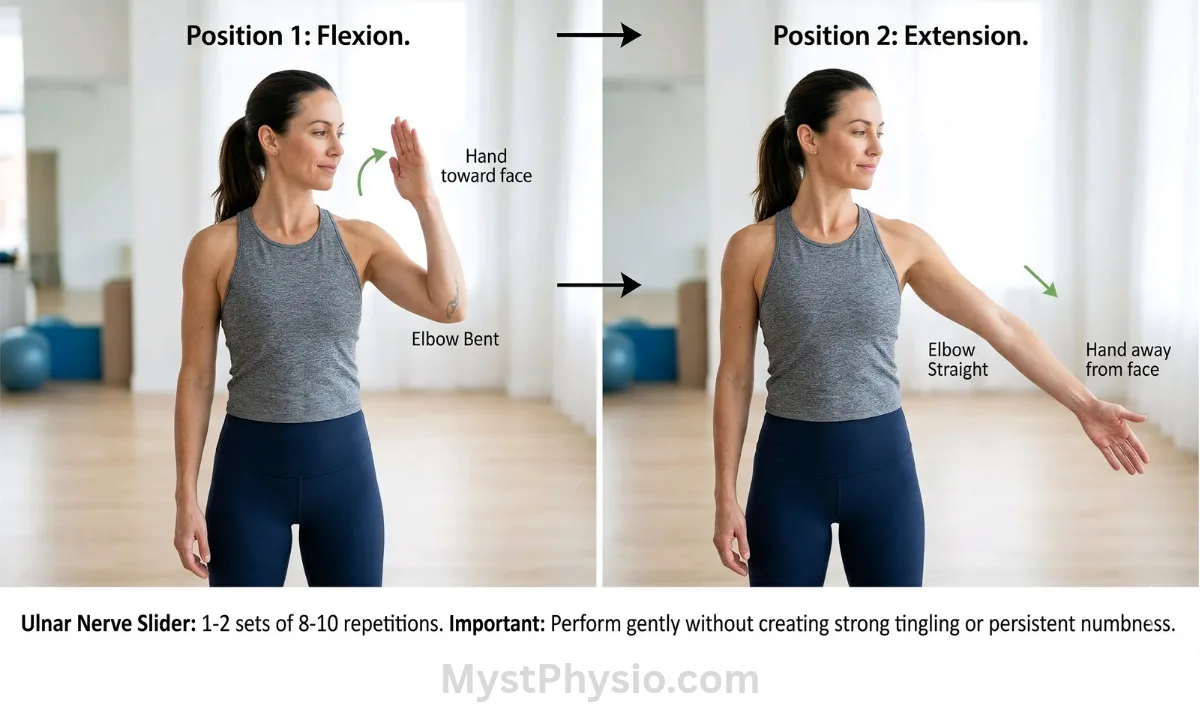
- Raise the arm slightly out to the side (shoulder abducted).
- Bend the elbow while bringing the hand toward the face.
- Extend the wrist and fingers gently as if making a “stop” sign.
- Slowly straighten the elbow while moving the hand away from the face.
- Return smoothly to the starting position.
Begin with 1–2 sets of 8-10 repetitions, performed once or twice daily.
Important safety guidance:
- The exercise should not create strong tingling
- Stop if numbness persists longer than several minutes
- Avoid aggressive stretching
Gentle mobility is the goal – not force.
Rehabilitation Progression
Stage 1 – Nerve Mobility
Focus on nerve gliding exercises and reducing irritation.
Stage 2 – Gentle Strengthening
Exercises may include:
- light grip strengthening
- finger spreading with resistance bands
- wrist stabilization exercises
These help support the elbow and forearm structures.
Stage 3 – Functional Loading
Later stages may introduce tasks that mimic daily activities or work movements to restore normal function.
Postural Correction
Posture plays a bigger role than many people expect.
Rounded shoulders and forward head posture can increase tension along the brachial plexus and medial arm, placing additional strain on the ulnar nerve.
Physiotherapy may include:
- scapular stabilization exercises
- thoracic extension mobility
- ergonomic workstation adjustments
Sometimes correcting shoulder posture alone reduces symptoms significantly.
Physiotherapy Modalities
Therapeutic modalities are sometimes used to support recovery, although they are generally adjunct treatments rather than primary therapy.
a. Therapeutic ultrasound
Some physiotherapy clinics use ultrasound therapy to support recovery around irritated tissues near the nerve. While it isn’t a primary treatment, it may help reduce local irritation when combined with exercise and activity modification.
b. TENS therapy
Transcutaneous electrical nerve stimulation can help reduce nerve-related pain signals and provide temporary symptom relief.
c. Manual therapy
Soft tissue techniques around the forearm may help reduce muscle tightness that contributes to nerve compression.
According to the American Physical Therapy Association, therapeutic exercise and patient education remain the foundation of conservative treatment for nerve compression disorders.
RELATED: TENS Therapy in Physiotherapy: Uses, Benefits & Pain Relief
Recovery Timeline
Recovery varies depending on the severity of nerve compression and how early treatment begins.
Typical timelines may look like this:
Mild cases
Symptoms may improve within 3-6 weeks with consistent activity modification and exercise.
Moderate cases
Recovery may take 6-12 weeks or longer.
Peripheral nerves recover slowly. Nerve tissue may regenerate at roughly 1 millimeter per day, which explains why progress sometimes feels gradual.
Consistency tends to matter more than intensity.
Red Flags – When to Seek Medical Evaluation
Stop exercises and consult a healthcare professional if:
- hand weakness increases
- muscle wasting appears in the hand
- persistent numbness continues
- severe elbow pain develops
These signs may indicate more significant nerve compression requiring further evaluation.
Frequently Asked Questions (FAQs)
Yes, Many mild to moderate cases improve with physiotherapy, activity modification, and nerve gliding exercises.
Ulnar nerve gliding (slider) exercises are commonly recommended to improve nerve mobility without overstressing the nerve.
Recovery varies depending on severity, but symptoms often improve within several weeks to a few months with proper treatment.
Final Thoughts
Cubital tunnel syndrome can feel frustrating, especially when something as simple as holding a phone triggers tingling in the hand.
But many cases respond well to conservative care.
Through thoughtful physiotherapy management – including activity modification, nerve mobility exercises, strengthening, and posture correction – it’s often possible to relieve symptoms and restore normal hand function without surgery.
Sometimes recovery begins with surprisingly small changes… like adjusting how you rest your elbow on a desk or how you position your arm during sleep.
And those small adjustments can make a meaningful difference for the nerve that quietly powers much of the hand’s precision and strength.
Medical Disclaimer:
This article is intended for educational purposes only and should not replace professional medical advice. If symptoms persist or worsen, consult a qualified physiotherapist or healthcare professional for proper evaluation and treatment.