
If you have ever sat in a physiotherapy clinic with sticky electrode pads on your skin, you have already experienced electrotherapy. Maybe a gentle buzz ran through your shoulder. Maybe your muscle twitched on its own and you laughed nervously. Either way, you probably wondered: what is this thing actually doing to my body?
The answer lives in frequency. Not every electrical current in therapy is the same. The frequency, meaning how fast the electrical signal cycles per second, changes everything. It changes what tissue the current reaches, how the body responds, and what condition it can actually help.
This guide breaks down the three main frequency ranges used in clinical electrotherapy.
What Is Electrotherapy, and Why Does Frequency Matter?
Electrotherapy uses controlled electrical currents to stimulate nerves, muscles, and tissue. Physiotherapists, rehabilitation specialists, and sports medicine clinicians use it to manage pain, support muscle recovery, and promote healing.
Frequency is measured in Hertz (Hz). One Hz means the electrical current completes one cycle per second. Think of it like a wave. A slow wave has low frequency. A fast, tight wave has high frequency.
Here is why that matters. Different tissues in your body respond to different speeds of electrical stimulation. Your pain-sensing nerves respond to one range. Your motor nerves, the ones that fire your muscles, respond to another. Your deeper tissues and cells respond to yet another.
Choose the wrong frequency range and you might get minimal effect. Choose the right one and you can block a pain signal, contract a weakened muscle, or reduce swelling in a stubborn injury.
Low Frequency Currents (1 Hz – 1,000 Hz)
What Low Frequency Actually Does
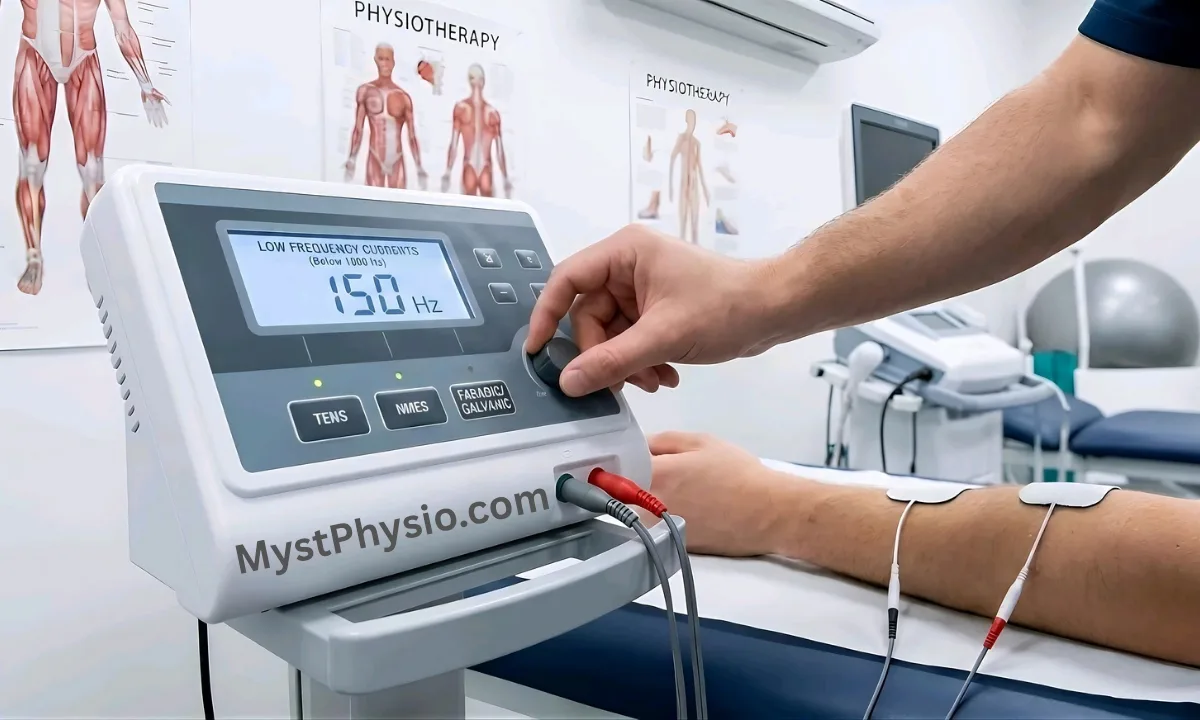
Low frequency currents are the most direct form of electrical stimulation. They deliver discrete, individually felt pulses. Your body perceives each pulse clearly. That is by design.
The most well-known low frequency application is TENS – Transcutaneous Electrical Nerve Stimulation. Transcutaneous simply means “through the skin.” TENS is widely used for pain relief. The NHS recognises it as a non-drug option for managing both acute (short-term) and chronic (long-lasting) pain.
At low frequencies, particularly around 1-10 Hz, the current stimulates your body to release endorphins. Endorphins are your body’s natural painkillers. Think of them as an internal version of morphine, produced by your own nervous system.
At slightly higher settings within this range, roughly 80-150 Hz, TENS works differently. Here, it floods your nervous system with non-painful signals, essentially crowding out the pain signals trying to reach your brain. This is called the gate control theory of pain, first described by Melzack and Wall.
Neuromuscular Electrical Stimulation (NMES)
Also within the low frequency range sits NMES – Neuromuscular Electrical Stimulation. Where TENS targets sensory nerves to reduce pain, NMES targets motor nerves. Motor nerves are the ones that tell muscles to contract.
NMES is used after surgery, injury, or periods of immobility when muscles weaken rapidly. A study published in the Journal of Rehabilitation Medicine found NMES effective at maintaining quadriceps (thigh) muscle mass in people recovering from knee replacement surgery.
Who Is Low Frequency Best For?
- People managing persistent back or neck pain
- Those recovering from sports injuries
- People with arthritis-related pain flares
- Post-surgical patients rebuilding muscle function
- Individuals with neurological conditions affecting muscle control
One important note: Low frequency currents do not penetrate deeply. They work primarily on surface-level nerves and muscles. For deeper tissue, you need a different approach.
Medium Frequency Currents (1,000 Hz – 100,000 Hz)
The Interference Principle
Medium frequency currents are where things get genuinely interesting, and a little clever.
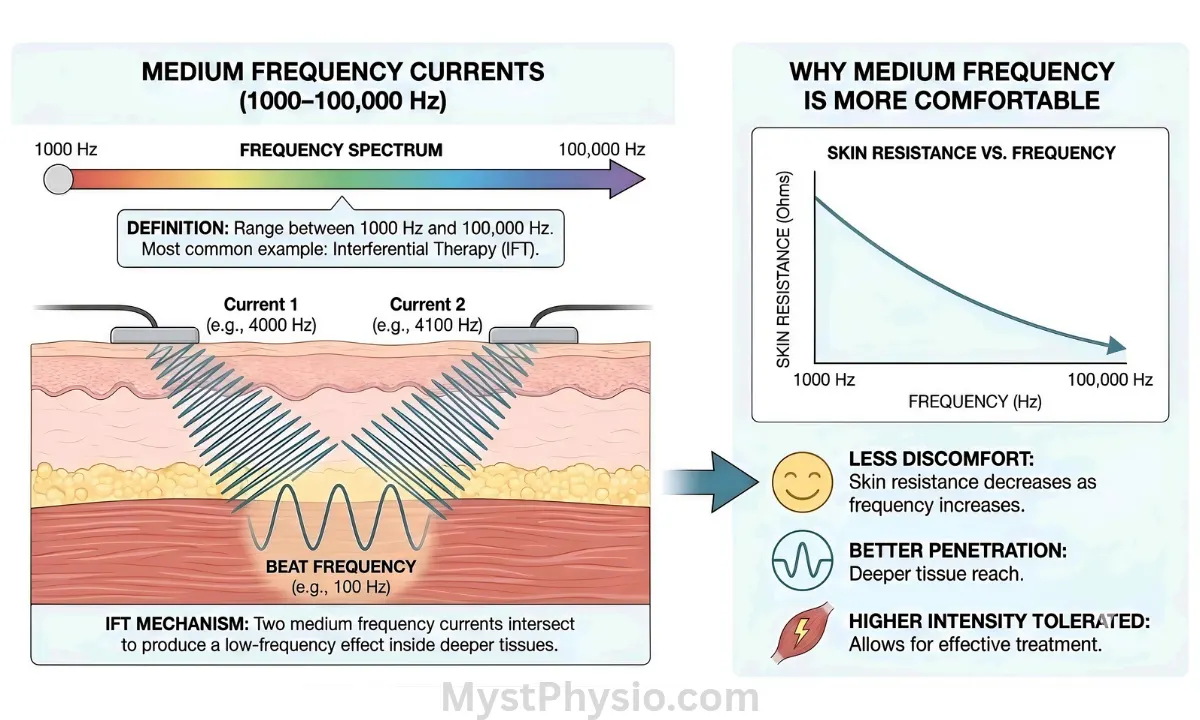
At medium frequencies, your skin’s natural electrical resistance drops significantly. That means the current can travel deeper into tissue without causing surface discomfort. But there is a trade-off: medium frequency currents on their own do not effectively stimulate nerves or muscles. The signal cycles too fast for your nervous system to “catch.”
So clinicians use a technique called Interferential Therapy (IFT). Two separate medium frequency currents, typically around 4,000 Hz, are applied simultaneously at slightly different frequencies. Where they cross inside your tissue, they create an “interference pattern.” That interference pattern produces a much lower effective frequency, usually in the 1-150 Hz range, right where it is needed, deep inside the body.
Imagine two ripples on water colliding. At the point they meet, they create a new, combined wave. IFT does the same thing electrically, but inside your knee, hip, or lower back.
What Interferential Therapy Treats
IFT has a strong track record in clinical practice. Research published in Physical Therapy Reviews supports its use in musculoskeletal pain management, particularly for conditions involving deeper joint structures.
Common clinical uses include:
- Chronic lower back pain – deep muscle spasm and joint irritation respond well to the penetrating effect
- Osteoarthritis – the deep joint structures can be reached without surface discomfort
- Post-surgical swelling – IFT can support lymphatic drainage (the system that removes fluid build-up) in recovering tissue
- Shoulder and hip impingement – where surface-level currents simply cannot reach the affected structures
Russian Stimulation – A Specific Medium Frequency Technique
Russian Stimulation, developed originally for athletic performance enhancement, uses a 2,500 Hz carrier current. It is delivered in bursts to produce powerful muscle contractions without the discomfort of equivalent low frequency stimulation.
It remains one of the more effective tools for re-educating severely weakened muscles, particularly after neurological events or prolonged immobilisation. A Cochrane review noted its potential in improving muscle strength outcomes in rehabilitation settings.
High Frequency Currents (Above 100,000 Hz)
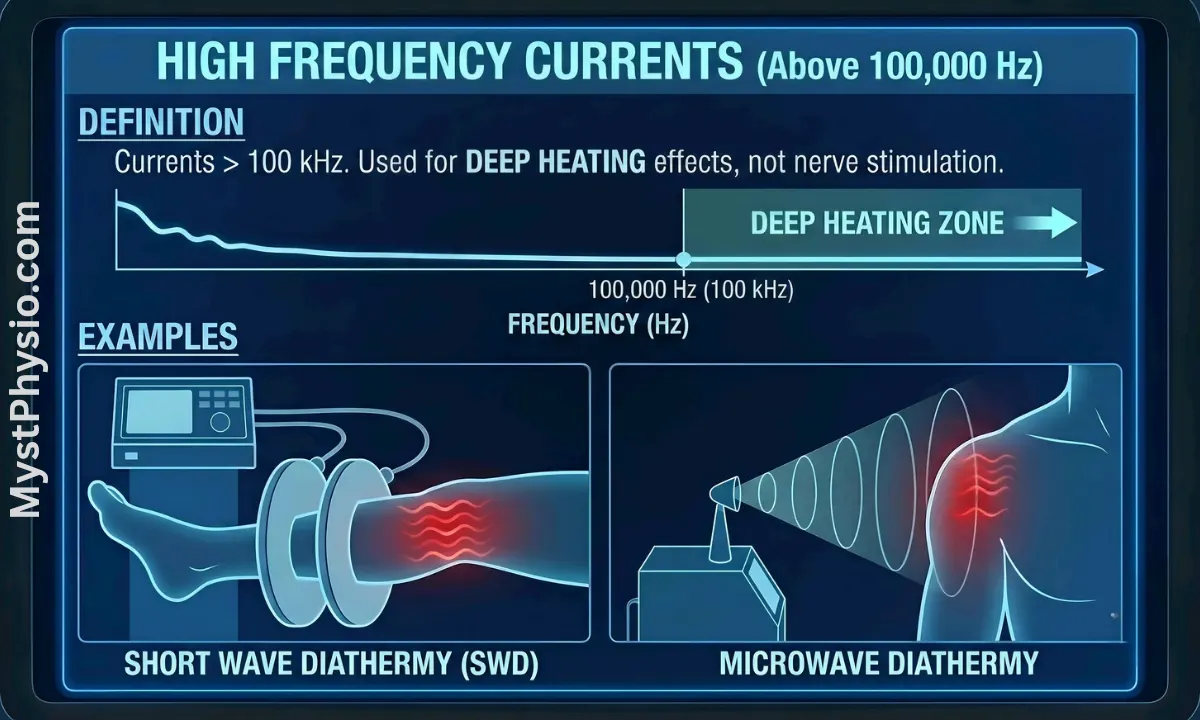
A Completely Different Mechanism
High frequency currents work in a fundamentally different way. At frequencies above 100,000 Hz (100 kHz), the current oscillates so rapidly that it no longer causes nerve or muscle stimulation at all. Your nervous system simply cannot track signals that fast. Instead, the energy converts to heat deep within tissue.
This is called diathermy, specifically, shortwave diathermy (SWD) or microwave diathermy. Diathermy means “heating through.”
The thermal (heat-based) effects are significant. Deep heating increases local blood flow, relaxes muscle spasm, accelerates tissue repair, and improves the extensibility (stretchability) of collagen, the structural protein in tendons, ligaments, and joint capsules.
Shortwave Diathermy in Practice
SWD operates typically at 27.12 MHz (megahertz). That is 27 million cycles per second. At that speed, the energy penetrates 3-5 cm into tissue, reaching muscles, tendons, and joints that surface heat or low frequency current simply cannot access.
Clinical applications include:
- Pelvic floor conditions – deep heating of pelvic musculature for people with pelvic pain or after childbirth
- Chronic soft tissue injuries – longstanding tendon or ligament conditions that have not responded to surface treatments
- Muscle spasm relief – particularly in large deep muscle groups like the paraspinals (the muscles running alongside the spine)
Non-Thermal High Frequency: Pulsed Shortwave Therapy
Not all high frequency electrotherapy heats tissue. Pulsed Shortwave Therapy (PSWT) delivers the same high frequency current in short bursts. Between bursts, tissue cools. The result is a largely non-thermal effect, one that influences cellular repair mechanisms rather than temperature.
Research published in Archives of Physical Medicine and Rehabilitation found pulsed shortwave therapy showed benefits for wound healing and post-operative tissue recovery.
Side-by-Side Comparison: What Each Frequency Range Does
| Feature | Low Frequency (1-1,000 Hz) | Medium Frequency (1-100 kHz) | High Frequency (>100 kHz) |
|---|---|---|---|
| Main effect | Pain relief, muscle contraction | Deep pain relief, muscle re-education | Deep heating or cellular repair |
| Tissue depth | Superficial | Moderate to deep | Deep |
| Nerve stimulation | Yes | Via interference pattern | No |
| Muscle contraction | Yes (NMES) | Yes (Russian Stim) | No |
| Examples | TENS, NMES | IFT, Russian Stimulation | SWD, Microwave Diathermy, PSWT |
| Best for | Acute and chronic pain, post-surgical rehab | Joint pain, deep muscle conditions | Chronic soft tissue, pelvic conditions |
How Clinicians Actually Choose Between Them
Here is something textbooks rarely tell you: experienced clinicians rarely stick rigidly to protocol. The frequency range chosen depends on several overlapping factors.
Location of the problem. A superficial knee ligament might respond well to TENS. A deep hip joint capsule probably needs IFT or diathermy.
Goal of treatment. Is the priority pain relief today, or long-term tissue remodelling? TENS handles the first. Diathermy and PSWT are more suited to the second.
Stage of healing. Acute injuries involve fresh inflammation (swelling, heat, redness). High frequency thermal currents are generally avoided during this stage, you do not heat already inflamed tissue. Low frequency TENS or non-thermal pulsed shortwave are safer choices early on.
Patient tolerance. Some people find the deep muscle contractions of Russian Stimulation uncomfortable. Others can tolerate it well and benefit enormously. Treatment is always adjusted to the individual.
Common Misconceptions Worth Clearing Up
“Higher frequency means stronger treatment.” Not true. Frequency determines mechanism, not intensity. High frequency diathermy does not “treat more aggressively” than TENS, it treats differently.
“Electrotherapy is just a short-term fix.” Evidence increasingly supports electrotherapy as part of a broader rehabilitation approach, not a standalone solution, but a meaningful adjunct that can accelerate recovery when combined with exercise and manual therapy.
“All TENS machines are the same.” Consumer TENS units sold online operate at fixed settings. Clinical devices offer programmable waveforms, precise frequency control, and parameters tailored to the patient. The clinical version and the at-home version share a name but are not equivalent in capability.
Frequently Asked Questions (FAQs)
No. People with pacemakers, implanted metal devices near the treatment area, active cancer in the treatment region, or during pregnancy should not receive most forms of electrotherapy without specialist medical clearance. Always disclose your full medical history to your clinician.
Not quite. TENS units provide low frequency pain relief, which can be genuinely helpful at home. IFT requires dual-channel medium frequency currents, that is specialist equipment. They serve different purposes.
It varies widely. Some people notice pain relief within one TENS session. Conditions requiring tissue remodelling, like chronic tendinopathy or pelvic floor dysfunction, may need a series of sessions over several weeks before significant change is felt.
It should not. Most patients describe a tingling, buzzing, or warmth depending on the modality. If you feel sharp pain or significant discomfort, tell your clinician immediately. Settings can always be adjusted.
Some modalities are used carefully near the spine. However, electrodes should never be placed directly over the spinal cord, across the chest (especially for people with heart conditions), or over the carotid arteries in the neck. A qualified physiotherapist knows these contraindications well.
A Quick Note on Evidence
Electrotherapy research has matured considerably in recent decades. Some modalities, particularly TENS for pain relief and NMES for muscle rehabilitation, have a robust evidence base from multiple clinical trials and systematic reviews. Others, like pulsed shortwave for wound healing, have promising but still-evolving evidence. This does not mean they are ineffective. It means the research is ongoing, and clinical decision-making should always consider individual patient response alongside published evidence.
The Bottom Line
Low, medium, and high frequency currents are not interchangeable. Each has a specific mechanism, a specific tissue target, and a specific clinical purpose.
Low frequency is your pain-relief and muscle-activation workhorse. Medium frequency gets deeper and handles conditions that surface-level currents cannot reach. High frequency converts to heat or cellular stimulation energy for chronic and deep tissue conditions.
Understanding these differences helps you have a more informed conversation with your physiotherapist or rehabilitation specialist. You can ask better questions. You can understand why a particular modality was chosen for you. And you can better recognise whether what you are receiving matches the condition you are actually trying to treat.
Consult your physiotherapist or doctor before starting any electrotherapy treatment. This article provides general clinical education and does not replace a personalised assessment by a qualified healthcare professional.
References
- National Health Service (NHS). TENS (transcutaneous electrical nerve stimulation). NHS.uk. Available at: https://www.nhs.uk/conditions/transcutaneous-electrical-nerve-stimulation-tens/
- Melzack R, Wall PD. Pain mechanisms: a new theory. Science. 1965;150(3699):971-978. DOI: https://doi.org/10.1126/science.150.3699.971
- Stevens-Lapsley JE, Balter JE, Wolfe P, et al. Relationship between intensity of quadriceps muscle neuromuscular electrical stimulation and strength recovery after total knee arthroplasty. Physical Therapy. 2012;92(9):1187-1196.
- Fuentes JP, Armijo-Olivo S, Magee DJ, Gross DP. Effectiveness of interferential current therapy in the management of musculoskeletal pain: a systematic review and meta-analysis. Physical Therapy. 2010;90(9):1219-1238.
- Maffiuletti NA. Physiological and methodological considerations for the use of neuromuscular electrical stimulation. European Journal of Applied Physiology. 2010;110(2):223-234.
- Rohde C, Overgaard Thomsen M, Simonsen OH, Tingleff J. The effect of pulsed electromagnetic fields on knee osteoarthritis. Archives of Physical Medicine and Rehabilitation. 2013;94(11):2130-2138.
- Vance CGT, Dailey DL, Rakel BA, Sluka KA. Using TENS for pain control: the state of the evidence. Pain Management. 2014;4(3):197-209.
Written by a Senior Medical Writer and Clinical Specialist. Reviewed for clinical accuracy against NHS guidance, WHO frameworks, and peer-reviewed literature. For educational purposes only.